
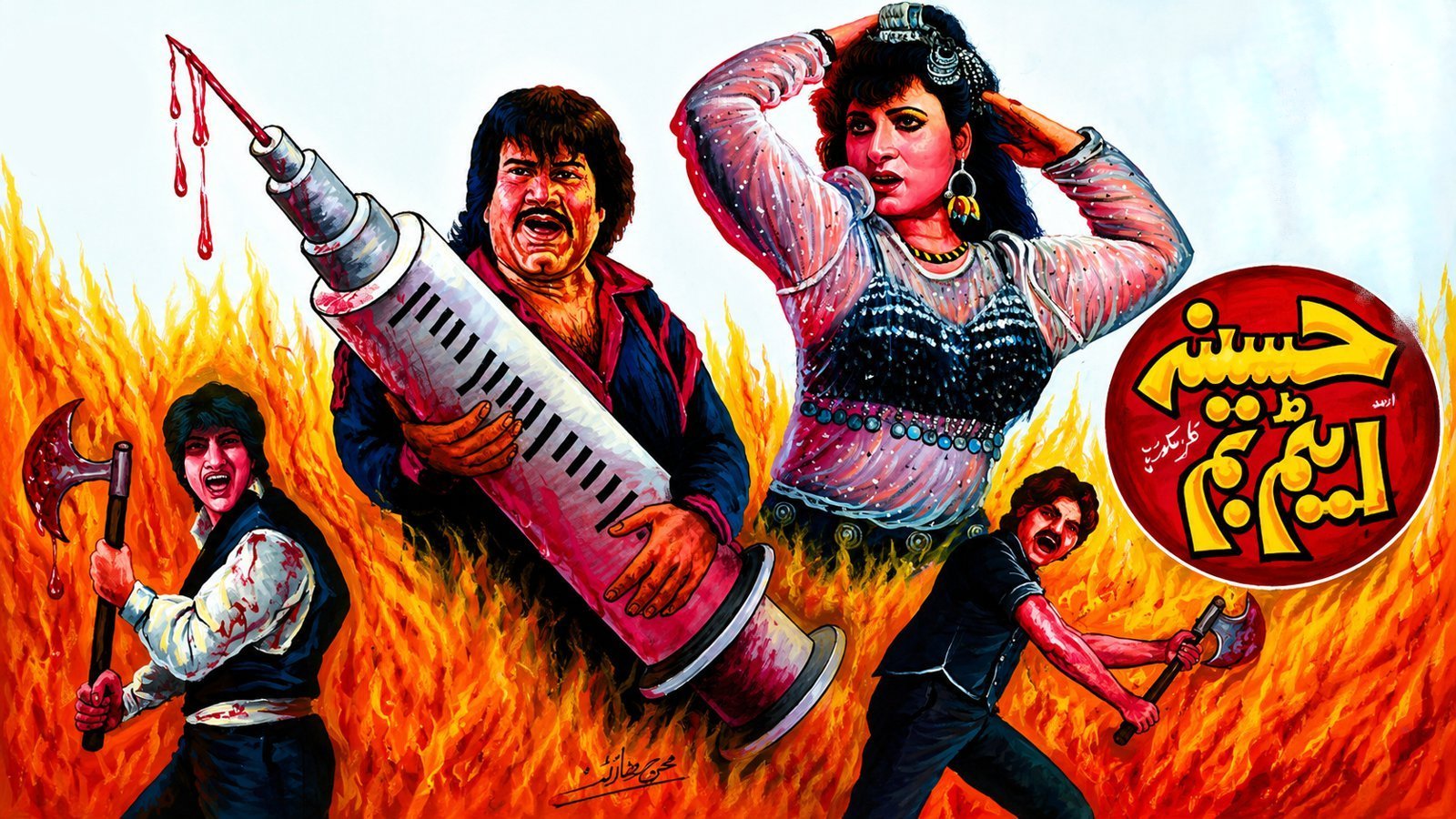
Haseena Atom Bomb (1990) AKA Haseena Atim Bum
Cast: Mussarat Shaheen, Badar Munir, Shaheen, Shehnaaz, Nazia Hafiz
Director: Saeed Ali Khan
Synopsis: Mind-exploding experience reaching new heights of Trash art brilliance. Astounding!
Review by Omar Ali Khan
Haseena Atom Bomb (aka Atom Bomb) became a nationwide craze in the early '90s shortly after its release, and it is not difficult to understand why. The film is nothing short of a major work of art, instantly elevating its director into the exalted ranks of John Waters, Russ Meyer, Herschell Gordon Lewis, Paul Naschy and the other undisputed masters of gutter-trash cinema. It is a breathtaking slice of the bizarre and the macabre, as well as a searing socio-political indictment of a society gone spectacularly haywire. Haseena Atom Bomb is one of the few truly great films to have emerged from the subcontinent in many a decade and deserves to be admired by a far wider audience.
The film became such an extraordinary phenomenon that its producers were forced to satisfy a thirsting nation by releasing dubbed versions, allowing this epic masterpiece to be appreciated by those unfortunate souls not fluent in Pashto—that most divine of tongues, the language of the gods. It was essential that the film's profound philosophical observations be understood by everyone, not merely Pashto speakers, and so the dubbed editions arrived as both a blessing to mankind and an exceptionally sound business decision. Before long, Haseena Atom Bomb was conquering the box office throughout Pakistan before setting its sights overseas, with video distributors scrambling to release it in such lucrative international markets as London, New York, Cannes... and Kabul.
The film explodes into life with a blistering dance number belted out by the evergreen Madame Noor Jehan—Malka-e-Tarannum, the Melody Queen, if not the Beauty Queen as well. The song reaches its glorious crescendo with the immortal refrain, "Main hoon, main hoon Haseena Atom Bomb!" At precisely this moment, the director cuts to a series of astonishing shots of a volcanic eruption, almost certainly borrowed from a National Geographic documentary.
This was clearly a deliberate artistic decision. It would have been painfully obvious—even crude—to illustrate the lyric by merely showing atomic bombs exploding whenever Madame Noor Jehan sang "Atom Bomb". No, our visionary director instead chose to compare the devastating power of his heroine with the raw, uncontrollable violence of nature itself. The symbolism is almost overwhelming.
The opening dance number is no less than hypnotic in its sheer dazzle and oomph. Both the choreographer and costume designer deserve enormous praise for assembling a sequence that is an absolute showstopper, and one that arrives within the opening moments of the film.
Having completed her rollicking rendition of "Main Hoon Haseena Atom Bomb", our heroine wanders happily through forests and fields on her way home. It happens to be her wedding day and, like any sensible young bride, she decides to seize the opportunity to jump into the nearest stream for a quick bath—naturally, while remaining fully clothed.
While our naïve beauty frolics innocently in the water, she unknowingly attracts the attention of a gang of thoroughly despicable hoodlums—the sort who used to bathe in the stream beside the service road at FC College in Lahore.
Just as these specimens of refined civilisation prepare to descend upon our compromised heroine—who has mysteriously changed from revealing disco attire into a modest hijab between shots—a handsome, dashing (if slightly overweight) young hero gallops to her rescue atop what can only be described as a rather undernourished white horse. A handful of aerial somersaults and several magnificently repeated flying kicks later, the villains retreat gingerly into the distance, their "animal lust" still frustratingly unsatisfied.
At this point the film pauses to deliver a series of flashbacks designed to establish the credentials of its assorted characters and explain why they are... well... the way they are.
One particularly memorable sequence, performed with almost "Dentonic" precision by the child actors involved, sees two youngsters engaged in an argument that rapidly escalates into an all-out hair-pulling contest, each seemingly determined to remove the other's scalp altogether.
This bizarre episode is immediately followed by an inspired moment of patricide when one particularly conscientious tot becomes thoroughly disgusted with his father's heroin-dealing activities. Grabbing his trusty tape-ball cricket bat, the morally outraged youngster proceeds to square-cut his errant father to death in a performance that would have made Inzamam-ul-Haq proud.
A late cut if ever there was.
Anyway, this pseudo-idyllic community of earnest, God-fearing simple folk is terrorised by the local gangsters, who rule the area with a distinctly Stalinist iron fist and possess a rather unusual interpretation of justice and virtue... but then, don't we all?
The film eventually returns to the present, where Atomic, having been rescued by Tubby aboard his emaciated Pegasus clone, skips merrily home to prepare for her wedding to local heart-throb, village law enforcer and all-round good egg, Cool Joe. Like Tubby before him, Joe also favours white when it comes to his mode of transport—albeit the four-legged variety.
Just as marital bliss is about to be consummated, disaster strikes. The same vengeful hoodlums who earlier received such a thorough drubbing return to satisfy their lingering animal lust. One has to admire their persistence if nothing else.
The gang rape sequence that follows is remarkable for being both astonishingly gratuitous and seemingly interminable, yet it was nevertheless considered perfectly acceptable family entertainment by the censors, children included. Poor Atomic's unfortunate husband is forced to watch helplessly as each member of the gang takes his turn before a brief—but thoroughly enjoyable—fight sequence leaves him dangling precariously from a rope suspended from the ceiling.
For a few fleeting moments, his only means of support is Atomic herself, but after everything she has just endured, she can hardly be expected to continue propping him up indefinitely. Before long, she quite understandably decides that she has had enough of standing.
Her unfortunate husband remains hanging there for the best part of two-thirds of the film, gradually developing into something of a festering interior decoration. Atomic, meanwhile, drops in from time to time whenever she needs a sympathetic ear, a familiar face or simply wishes to update the increasingly decomposed corpse on the progress of her campaign of vengeance.
And vengeance is precisely what her life becomes.
At this point, the film veers enthusiastically into I Spit on Your Grave territory. Atomic sheds her image as a dutiful, purdah-clad wife and reinvents herself as a hardened, relentless one-woman vigilante. The remainder of the film chronicles her determined efforts to ensure that the men responsible for destroying her life experience a series of increasingly miserable ends.
Along the way, we are treated to an endless succession of scintillating dance numbers in which Mussarat Shaheen demonstrates exactly why she reigned supreme as the undisputed pin-up queen of the North-West Frontier Province throughout the 1980s. The make-up department must have exhausted entire warehouses of cosmetics, for there is scarcely a single frame in which Atomic appears anything less than utterly radiant, with dazzling colours erupting from every conceivable angle of her magnificently sculptured physique.
The costume designer, meanwhile, has produced a wardrobe that would surely be the envy of every Parisian fashion house. The only obstacle to recreating these unforgettable creations on the catwalk would be finding models capable of doing them justice. That, alas, would prove considerably more difficult.
The film itself is a heady, surreal concoction assembled from the most bewildering ingredients imaginable, complete with a moral compass every bit as confused as the society that produced it. Among its many moments of cinematic inspiration are the unforgettable scenes in which gigantic syringes are employed to drain the blood from heroin-dealing villains. The symbolism is almost painfully sophisticated. To use oversized syringes as instruments of righteous vengeance against drug pushers is the sort of profound visual metaphor that could only have emerged from the mind of a director blessed with extraordinary vision, intelligence and artistic insight.
The cameraman, meanwhile, displays a modest fascination with certain regions of the female anatomy. I hardly need to tell you which particular areas repeatedly attract his attention. Now and again, he supplements these lingering observations with the tasteful deployment of the zoom lens to create that wonderfully subtle "in-out" effect.
Delicate.
Serene.
Beautiful.
One can only applaud the censors for recognising the unquestionable artistic merit of these numerous sizzling dance sequences, each one, naturally, performed to the incomparable voice of Madame Noor Jehan.
Many of the film's dialogues are peppered with wonderfully crude double entendres and innuendoes, techniques that the filmmakers have refined into an art form, allowing industrial-strength smut to flourish quite happily within the supposedly strict confines of Pakistan's censorship code.



0 Comments
Leave a Comment