
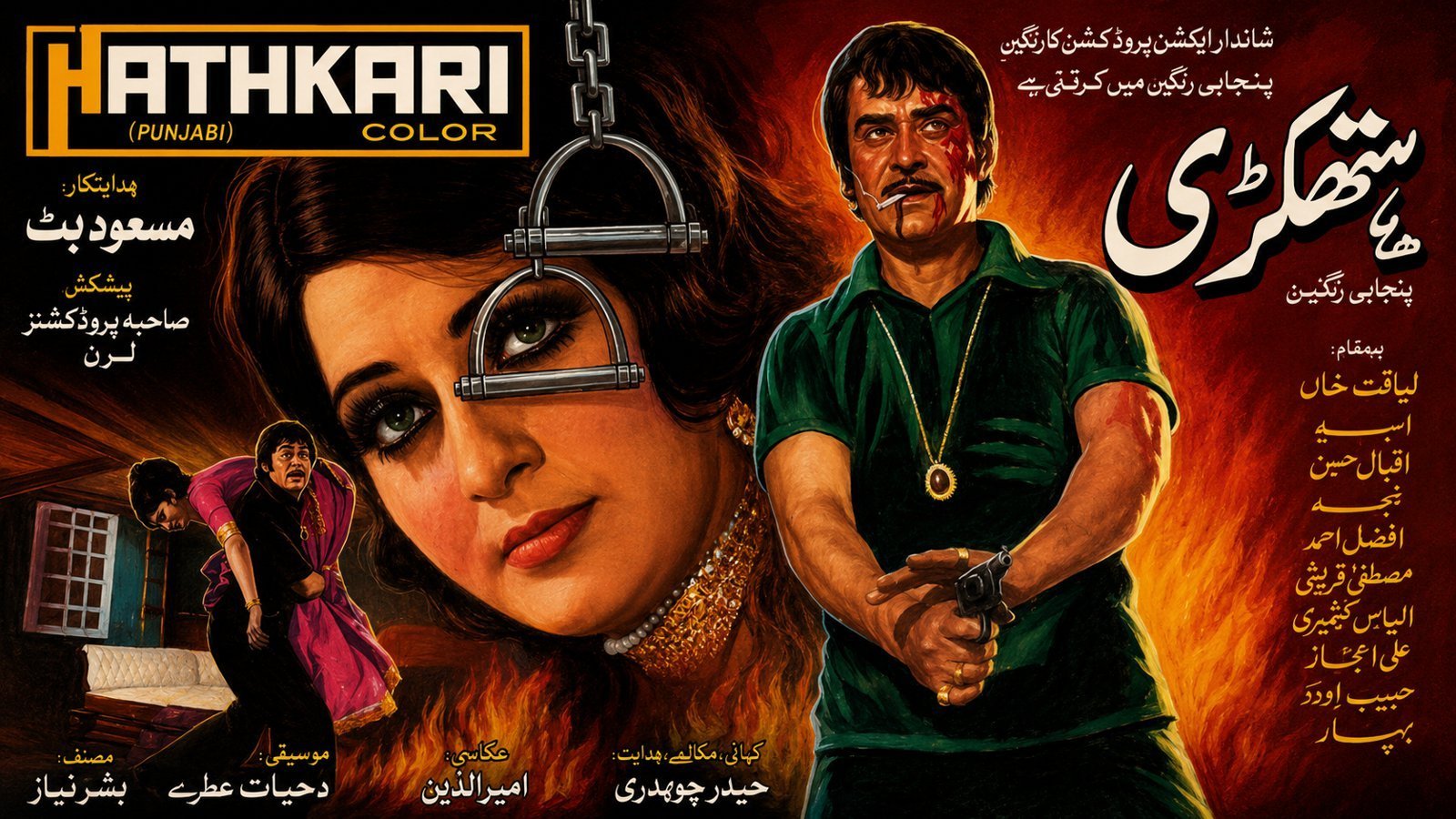
Hathkari (1975)
Cast: Asiya, Yousuf Khan, Iqbal Hassan, Najma, Afzaal Ahmad, Mustafa Qureshi, Bahar, Ali Ejaz
Director: Haider Chaudhary
Synopsis: Meandering, morality-laden Punjabi action flick “inspired” shamelessly by Bollywood’s Deewar.
Reviewed by: Omar Khan
There are so many successful Lollywood films that we do not discuss. Partially because they usually do not have much aesthetic or artistic value as “good cinema,” they are worth their weight in gold when analyzing the film as a reflection of the era in which it was produced.
The values, the issues, the themes, the styles, the political undercurrents, the references, the clothes, the sights and sounds, and in many cases, the levels of sex and violence on display are a clear reflection and a snapshot of what Pakistani society was at that time.
The films that reigned supreme at the Box Office in Pakistan were often not among those genteel, aesthetically refined and correct films that our elites liked to discuss at their dinner tables. There is often much more fascination in a rough and gritty black-and-white Punjabi film that ran in Urdu-speaking Karachi for a year than in an “Award Winning” period piece. Why would a movie that most didn’t understand the language of run to packed houses for over a year? 1974’s sleazy pot-boiler, aimed at the front bench crowd, Khatarnak, scored a massive bull’s eye all over Pakistan, mainly fueled by sleazy club dances with some highly “sexualized” choreography. What they call “vulgar” at our dinner tables was what the public was lapping up in their hordes. As every producer you will ever meet will tell you, “SEX SELLS,” and this is not a country or region-centric thing. It remains the primary and most timeless universal rule, tried and tested to death.
My interest in local cinema has always tended to gravitate towards content that the junta – Films the common folk would watch as opposed to the kind of films that we have droll discussions over herbal tea. Therefore, viewing the 1975 Punjabi colour film that is part of director/Producer Haider Chaudhary’s “Hathkari” trilogy was essential.
The hope was to find some old-fashioned desi masala, grit, and sleaze in the wake of Khatarnak, innovative camera angles, and judicious use of the zoom lens hotly anticipated on the menu.
And so on to Hathkari, the film’s tone is set in the introductory scenes, when Habib is leading his co-workers in a protest against a callous mill owner. A heroic Habib is invited inside for “talks,” beginning with an attempted bribe. When that is refused, the coercion turns to blackmail and threats of dire consequences for his wife and children. Habib cracks under pressure, resulting in the wrath of the workers and his community.
Bahar, his wife, rages at him for betrayal, and that night, downtrodden and crushed by guilt, he leaves the village for a new life, leaving his poor wife to deal with two young sons to bring up in an atmosphere where the family is hated for her husband’s deeds. She, too, is forced to flee with her two sons, coping with extreme hardship as she tries to work menial jobs to make ends meet and feed her children. Her older son, merely 14, decides to step up as the man of the house and vows to provide for the family by working day and night.
Hathkari
Years pass, and the family barely survive, with the younger son unable to get a decent job and the older one having to turn to work with some unsavory types, such as the dastardly Mustafa Qureshi. As Yusuf Khan finds himself embroiled in the underworld, his younger brother Iqbal Hassan lands a job with the police, and presto, the film’s central theme is born with the triangle created by the two brothers and their mother. Aasia shows up for a few songs as a club dancer with a golden heart who falls for Yusuf Khan, while Najma pops up occasionally as Iqbal Hassan’s romantic interest.
As the film progresses, it becomes evident that it is a Punjabi remake of the successful Bollywood film starring Amitabh Bachchan called Deewaar. It follows roughly the same template, including the life-saving locket/medallion thingy numbered “786”. When that locket falls off, you know things will not be correct. Hathkari lumbers along, and most of the dramatics, as usual, come from the fire-breathing Bahar but the rest of the show feels somewhat formulaic and not particularly innovative or exciting. Yes, there are a couple of hit Madam Noor Jehan numbers, but nothing exceptional. There is also an appearance by the fantastic Parveen Bobby, performing her patented jittery-style dance movement (No wonder Amrozia dismissed her in an interview as “no competition”). Still, even that is not enough to relieve the feeling of boredom that begins to creep in soon into the movie.
It is all somewhat predictable and quite dull. However, that said, the film managed to more than hold its own at the box office back in 1975 and was yet another hit for Aasia and Yusuf Khan and, of course, Haider Chaudhary. “Warrant,” starring the same couple, was to follow the following year with similar success.



0 Comments
Leave a Comment