
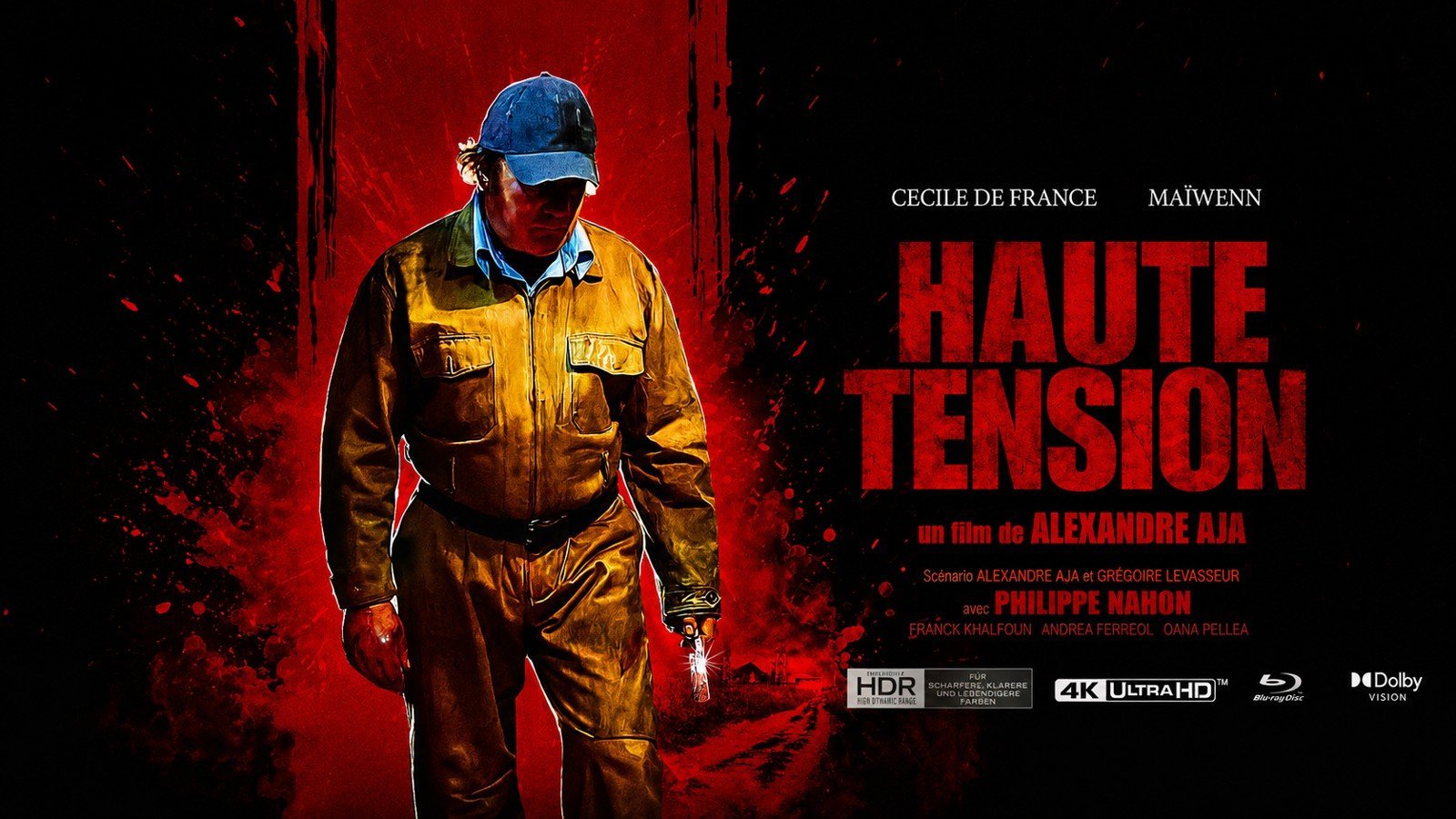
Haute Tension (Switchblade Romance/ High Tension) (2003)
Cast: Cecile de France, Maiwenn, Phillip Nahon
Director: Alexandre Aja
Synopsis: easily the most ferociously tense terror ride in years - a classic!
Reviewed by: Omar Khan
"Packed with anxiety, Haute Tension upsets and unsettles in equal measure - bloody scary" Total Film (4 stars)
"a sick and slick little movie that will get under your skin and stay there for weeks" Empire (4 stars)
"Deftly juggles gore and suspense."— Lisa Nesselson, Variety
"Has a sinister, haemoglobin look that fits the story like a glove."— Lisa Nesselson, Variety
"The film revels in blood and gore, but this is not just a run-of-the-mill splatter film."— James Berardinelli, ReelViews
"French horror pastiche up to more than mimicry."— Mark Holcomb, The Village Voice
"The philosopher Thomas Hobbes tells us life can be 'poor, nasty, brutish and short.' So is this movie."— Roger Ebert, Chicago Sun-Times
"A plot hole that is not only large enough to drive a truck through, but in fact does have a truck driven right through it."— Roger Ebert, Chicago Sun-Times
"There is a good quantity of tension in this French slasher..."— Rotten Tomatoes Critics Consensus
"High Tension's strength is that it is about as violent and blood-soaked as any film from the period that it pays homage to."— IMDb Editorial Review
Haute Tension (2003)
When Alexandre Aja stepped onto the stage to introduce Haute Tension at the Sitges Film Festival in 2003, he described his latest film rather modestly as "a story about love and obsession."
He neglected to mention one rather important detail.
It also happened to be the most ferocious exercise in white-knuckle suspense since John Carpenter's Halloween.
Nor did he mention that it was one of the most visually accomplished European slasher films ever made.
From its opening moments, Haute Tension announces itself with astonishing confidence. The film begins with fragmented images of a young woman, horrifically wounded, stumbling through a dark forest before collapsing. A voice-over quietly promises to explain "what happened," while the opening titles flash across the screen like the cold, unforgiving headlights of an approaching truck.
It is a magnificent beginning.
The images are beautiful, unsettling and full of foreboding, immediately creating the uneasy feeling that something dreadful has already happened and that we are simply waiting for events to catch up with the inevitable.
The nightmare abruptly gives way to daylight as Marie awakens from her disturbing dream while travelling with her closest friend, Alex.
The journey into the French countryside feels deceptively ordinary. The girls are heading to Alex's family farmhouse to spend a few weeks studying before their examinations. They laugh, tease one another and enjoy the drive with not the slightest hint that their lives are about to descend into unimaginable horror.
Aja understands one of Hitchcock's oldest lessons.
The audience should always know more than the characters.
That simple principle lies at the heart of Haute Tension.
As the girls approach the isolated farmhouse, Aja quietly introduces Alex's family. Her mother hangs washing in the sunshine, her father works contentedly at his computer, while young Tom, dressed proudly as a cowboy, runs through the fields chasing the family dog.
It is domestic tranquillity at its most idyllic.
The calm, however, is short-lived.
Almost unnoticed, Aja's camera drifts towards an old, rusting truck parked nearby.
There appears to be some sort of movement inside.
Nothing more.
Nothing less.
Yet every instinct tells us something is terribly wrong.
The characters remain blissfully unaware.
We are not.
The effect is exquisite.
Then...
without warning...
Aja detonates one of the finest jump scares in modern horror.
The timing is immaculate.
The shock is genuinely startling.
And, judging by the collective gasp that erupted around the Sitges audience, almost nobody saw it coming.
It is a wonderful moment because it achieves exactly what every great horror film should achieve.
It announces that nobody is safe.
From that point onwards, the audience sits forward almost involuntarily.
The tension becomes almost unbearable.
A brief interlude in the surrounding cornfields only increases the anxiety. Once again, Aja borrows directly from Hitchcock's playbook, allowing the audience to sense danger while those on screen continue blissfully through their ordinary routines.
Every passing minute tightens the screw.
Eventually, the girls arrive home.
Marie relaxes outside on a swing while Alex heads upstairs for a shower.
Horror fans will immediately recognise Aja's affectionate salute to The Texas Chainsaw Massacre. The isolated farmhouse. The overwhelming silence. The lazy rhythm of the swing. Every frame positively drips with anticipation as the audience waits for the inevitable arrival of that battered old truck.
It does not keep us waiting for long.
What follows is one of the most sustained and nerve-racking home invasion sequences horror cinema has produced in years.
Yes, there is gore.
Plenty of it.
But the gore is not what makes these scenes so effective.
It is the tension.
Every movement feels dangerous.
Every sound becomes threatening.
Every corner of the house suddenly appears capable of concealing unimaginable violence.
Aja orchestrates the sequence with astonishing assurance for a director barely into his twenties. Rather than relying on cheap shocks alone, he steadily tightens the emotional pressure until both his characters and his audience seem barely able to breathe.
By the time Marie finds herself hiding in desperate silence while unimaginable carnage unfolds around her, the audience has become an unwilling accomplice, holding its collective breath in the hope that the slightest movement will not betray her hiding place.
The violence is brutal.
The suspense is almost unbearable.
And the nightmare has only just begun.
Haute Tension (2003) – Part Two
Once the initial bloodbath has subsided, Haute Tension settles into what is arguably its greatest strength.
Suspense.
Not gore.
Not violence.
Not elaborate make-up effects.
Suspense.
That distinction is important because many critics lazily dismissed the film as nothing more than another exercise in Grand Guignol excess. They saw only the blood. What they failed to appreciate was the astonishing craftsmanship underpinning almost every sequence.
The violence is merely the punctuation.
The tension is the language.
Alexandre Aja displays an extraordinary understanding of suspense, particularly for a filmmaker barely twenty-five years old. His influences are obvious—John Carpenter, Alfred Hitchcock and Tobe Hooper loom over virtually every frame—but influence should never be mistaken for imitation.
Aja learns from the masters.
He doesn't simply copy them.
Like Hitchcock, he understands that suspense comes from allowing the audience to know more than the characters.
Like Carpenter, he appreciates the terrifying power of waiting.
Like Hooper, he recognises that atmosphere can often be far more disturbing than explicit violence.
Throughout the film, he repeatedly refuses to release the pressure.
Instead, he keeps tightening it.
One sequence in particular, as Marie desperately searches the surrounding cornfields, demonstrates just how sophisticated Aja's command of suspense already was. The camera tracks anxiously alongside her while the soundtrack seems to attack from every conceivable direction. Every rustle becomes threatening. Every gust of wind appears to conceal movement. Every stalk of corn could be hiding a killer.
The viewer becomes just as paranoid as Marie herself.
It is masterfully executed.
In fact, one of the film's true stars is neither Alexandre Aja nor Cécile de France.
It is the sound design.
Without it, Haute Tension would still be an effective slasher.
With it, the film becomes something altogether more oppressive.
The soundtrack constantly manipulates the audience's emotions, raising anxiety almost imperceptibly before unleashing sudden eruptions of terror. François Eudes' magnificent score alternates between eerie atmospheric passages and pulsing, Carpenter-esque rhythms that pound away with mechanical inevitability as danger closes in.
The effect is extraordinary.
Close your eyes and simply listen.
Half the horror is still there.
Perhaps even more.
Equally deserving of praise is Philippe Nahon.
Remarkably little dialogue is required from him throughout the film, yet his looming physical presence dominates every scene in which he appears. Without resorting to elaborate disguises or iconic masks, he creates one of the most unsettling killers modern horror has produced.
His greatest asset...
is anonymity.
Unlike Michael Myers, Jason Voorhees or Leatherface, he wears no distinctive mask.
Yet Aja understands an equally effective rule.
He rarely allows us a proper look into Nahon's eyes.
That small decision makes an enormous difference.
Eyes humanise.
Eyes invite understanding.
Eyes create empathy.
By denying us that connection, Aja transforms an ordinary-looking man into something deeply disturbing.
He becomes less a person than an unstoppable force of malevolence.
It is an inspired directorial decision.
Cécile de France is equally remarkable.
Much of the film rests squarely upon her shoulders, and she responds with an extraordinarily physical performance. Long before the script begins demanding emotional complexity, she convinces simply through fear, exhaustion and determination. Her terror feels authentic because Aja wisely allows the audience to experience events almost entirely through her perspective.
Unfortunately...
This is also where the film ultimately stumbles.
Everything builds with astonishing confidence towards its closing revelation.
The problem is that the revelation itself simply cannot bear the weight placed upon it.
The notorious twist is certainly audacious.
One cannot accuse the filmmakers of lacking ambition.
But ambition alone is not enough.
The ending asks the audience to accept a solution that fundamentally undermines much of what has preceded it. Rather than encouraging viewers to rethink the film in admiration, it risks leaving them feeling that the rules have quietly been changed without warning.
That is a dangerous thing for any thriller.
Great twist endings should make audiences smile with admiration.
This one leaves too many scratching their heads.
It is immensely frustrating because fully ninety per cent of what precedes it is so astonishingly accomplished.
For almost its entire running time, Haute Tension stands shoulder to shoulder with the finest suspense films of the modern era.
Then comes a finale that cannot quite live up to the brilliance that has gone before.
It is not enough to ruin the film.
But it is enough to prevent it from becoming the unquestioned masterpiece it so nearly becomes.
Haute Tension (2003) – Part Three
For all the controversy surrounding its ending, Haute Tension remains one of the defining horror films of the new millennium.
Few modern horror films genuinely succeed in frightening an audience.
Many rely upon noise.
Many rely upon gore.
Many mistake frantic editing for suspense.
Alexandre Aja understands that true terror is something altogether more primal.
It comes from anticipation.
From uncertainty.
From allowing the audience's imagination to work just a little harder than the camera does.
That is why Haute Tension succeeds where so many contemporary slashers fail.
It genuinely earns its title.
The tension is almost unbearable.
When the film premiered at Sitges in 2003, the response confirmed that audiences recognised they had witnessed something rather special. The film deservedly walked away with several of the festival's major honours, including Best Director for Alexandre Aja, Best Actress for Cécile de France and Best Special Effects. It also received the prestigious Méliès d'Or, awarded collectively by Europe's fantastic film festivals to the outstanding genre film of the year.
The recognition was richly deserved.
Aja announced himself not merely as another horror director but as a filmmaker with an instinctive understanding of cinematic suspense. It is astonishing to think that someone so young could display such confidence over every aspect of his craft. Every camera movement, every edit, every silence and every burst of music appears carefully calculated to tighten the screws another notch.
One leaves the cinema exhausted rather than exhilarated.
That is exactly as it should be.
Roger Ebert famously dismissed the film as "nasty, short and brutish."
Personally, I took that as something of an endorsement.
One suspects that many dedicated horror fans will feel much the same. Ebert was one of America's greatest film critics, but he never entirely warmed to horror cinema when it ventured into genuinely unpleasant territory. If a horror film succeeded in making him deeply uncomfortable, there was often a fair chance that genre enthusiasts were about to discover something worth celebrating.
There is, however, one important warning.
Avoid the American theatrical version at all costs.
In an attempt to secure an R rating rather than the commercially disastrous NC-17 certificate, the film was subjected to cuts and, perhaps even worse, an English-language dub that strips away much of the original performances. The results are nothing short of catastrophic.
The very first spoken lines immediately sound artificial, and from that moment onwards, the illusion is shattered. Voices never seem to belong to the faces on screen, emotional intensity evaporates, and what was once a taut, atmospheric thriller becomes a strangely detached viewing experience.
It is almost impossible to persevere beyond the opening reels.
The damage inflicted by the dubbing is that severe.
It is a genuine tragedy because American audiences deserved to experience Haute Tension in the form Alexandre Aja intended. Instead, many were introduced to a compromised version that diluted one of the film's greatest strengths—its authenticity.
If at all possible, seek out the original French-language release.
The difference is night and day.
Despite its frustrating final twist, Haute Tension remains one of the most exhilarating horror experiences of the modern era. It is a film that understands suspense with a confidence rarely encountered since the glory days of John Carpenter, while paying affectionate homage to classics such as Halloween and The Texas Chainsaw Massacre without ever becoming merely derivative.
Very few debut features demonstrate such remarkable command of atmosphere, pacing and sheer cinematic technique.
It is, therefore, all the more heartbreaking that the screenplay ultimately denies the film the masterpiece status it comes so tantalisingly close to achieving.
Even so, the achievement remains extraordinary.
Quite simply, Haute Tension is one of the most ferociously tense horror films made in the past quarter of a century.
Flawed?
Undoubtedly.
Forgettable?
Not for a single second.
For ninety glorious minutes, Alexandre Aja demonstrates that suspense is still the most powerful weapon in horror cinema.
The ending may stumble...
...but what comes before it is close to unforgettable.
0 Comments
Leave a Comment