
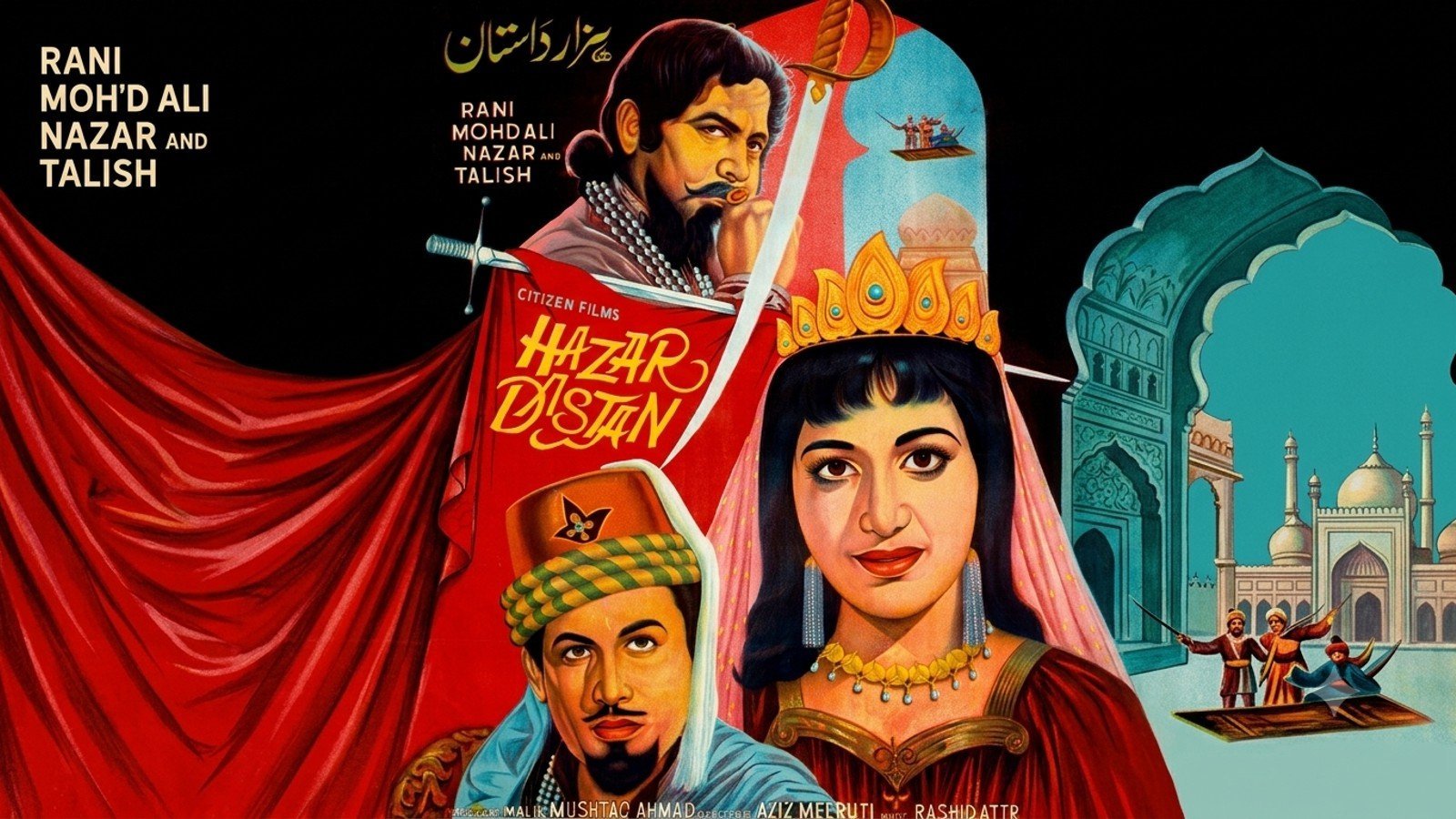
Hazaar Dastan (1965)
Cast: Muhammad Ali, Asad Bukhari, Amy Minwala, Nazar, Talish
Director: Aziz Meeruti
Synopsis: Another Ali Baba/Arabian Nights-style movie so popular in the ‘60s with wholesome entertainment for the entire family.
Reviewed by: Omar Khan
Producer Malik Mushtaq was always a fan of the Arabian Adventure genre, and spent much of his efforts cooking up movies in proper swashbuckling mode, despite being hampered by technical expertise and a lack of up-to-date special effects. Undaunted, he dabbled with this genre enough to gain a good reputation as the Man with the Flying Carpets.
Hazaar Daastan, which translates to A Thousand Tales, starts with a gnarled old fisherman bringing back a baby boy to his wife, telling her that the kid would have died had he not rescued it in the storm, swept away in the river to his death. The fisherman remarks that the child looks like he belongs to a “good stock” (fair skinned?). So, rather than blame him for stealing somebody’s child, she should be grateful that he saved the infant’s life.
Meanwhile, tears flow in the Royal Palaces, where the Prime Minister’s wife is inconsolable at a loss of her beloved child in the storm, and nobody seems to find him. She is crestfallen and bereft at her loss, and her husband does his best to alleviate her pain to no effect.
The fisherman’s son grows up as handsome, brave and rebellious Yousuf, a dab hand with the fishes and known as a lad with a fiery temper, especially when there is any injustice in his sight. Yousuf is generally a happy-go-lucky sort of guy. Still, one day when he finds a royal guard making sexual advances to one of the poor village belles, he reacts strongly and lands up at the court of his birth father, the prime minister, though nobody knows this fact.
The Prime Minister is impressed with Yousuf’s bold manner in speaking up against any injustice and sets him free.
The Princess of the Kingdom arrives with her posse, and once again, Yousuf (Mohammad Ali) speaks out for a poor man thrashed by her entourage. Impressed at his handsomeness and courageous manner, Princess Rani is somewhat enchanted. Yousuf is excited when he catches her stealing glances at him, as her carriage is carried away to the Palace. Later that night, Rani is all starry-eyed and loved up, and her special confidante makes fun of her infatuation with the young fisherman Yousuf, and she wonders if Yousuf is also feeling the same way. Soon enough, we see that both are equally enamoured of each other, even if it is unheard of for a Princess to be courting a lowly fisherman.
Elsewhere, Fairy Queen Husna is showering an unusual amount of love on a Pekinese dog. We discover her suitor, Jalal (Asad Bukhari), has been turned into a dog by the devious wizard Samri. Unfortunately for Asad and the Fairy Queen, the evil magician Samri has his eye on the Princess. The ultimate goal is the Talismi Diamond, as whoever has this Diamond, gets all his wishes to pass.
The diabolical Samri conducts all sorts of dubious black magic in his den and summons his rubber-faced genie to advise him about certain events. When he asks about the acquisition of the famed Talismi Diamond, Rubber Face tells him that only the son of the Princess will acquire the Diamond and that, too, only when he turns seven years old. So clearly, there may be a considerable wait, but Samri starts to plot and scheme and offers Jalal his human form, only if he follows the plan devised by the evil wizard.
Hazaar Dastan
The plot thickens with Yousuf now a wanted man, after being framed by the greedy political forces within the Royal Court. Then Samri restores the buffoon Kamal (who had also been turned into a dog), to his human form and sends him off to assist Jalal in carrying out the Samri Masterplan that involves access to the Princess’ 7-yearold boy, so that he can get a hold of the Enchanted Diamond.
The bumbling Kamal must now enter the body of the King, who has just died but suddenly revives as a wildly different personality. The Princess is thrilled that her father still lives, while all the others are stunned at the reawakened King. Not so much that he has suddenly returned from the dead but more at the major twist in personality he has undergone. From being a stern authoritarian, rigid, cold and ruthless, the King seems to have morphed into Shangela in Halleloo mode from RuPaul’s Drag Race, with a fierce sense of fun and humour.
All the rebellious criminals in the dungeons are released at the King’s order, including Yousuf, and slowly but surely, it emerges that this fine young man “who doesn’t look like a fisherman” is the PM’s son. Still, all that fades into insignificance when the horrible Samri kidnaps the Princess’s young son on his 7th birthday, and whisks him off to the enchanted land where only he can acquire the Magical Diamond.
The child must go through deadly obstacles and particularly aggressive snakes before reaching the Diamond, but only for Samri to eagerly wait outside to snare him. Once Samri has the Diamond, all will be lost.
It remains to be seen if Kamal can engineer matters to salvage the situation. Mohammad Ali is galvanised into action, and Asad realises how he has been used and tricked by Samri and upset his girlfriend, the Fairy Princess. Asad now promises to redeem himself, but is it all too late? The child has the Diamond in his hands and is moments away from handing it over to the dastardly Samri, waiting in his finest Skull and Scorpion robes and wearing his sexiest lip gloss.
It’s a thrilling end to a roller-coaster ride of a film filled with intrigue, romance, charm, some reasonable songs and solid acting, especially from Talish, who steals the show when his character transforms after being possessed by Nazar. He turns in a wonderfully unselfconscious performance and lights up the movie with his inane antics with a bit of help from Nazar, who is again in top form in the film.
Once again, Nazar is the pivotal character in the movie and displays his comic range in a thoroughly crowd-pleasing performance. Having watched Nazar perform in several films from the 1960s, it is relatively easy to see why he was the number one comic when it came to Urdu movies and had an influence on Lehri, the great comedian of the ‘70s.
Mohammad Ali looks youthful and relatively fit in this 1965 movie, and plays his role with spirit and enthusiasm. The film is laced with a “rebellious” undertone against a corrupt, unjust authoritarian regime favouring the elite. The script carries a tone that is not so much leftwing as it is meant to be a crowd-pleaser to the masses; for a country like Pakistan, most of the masses live below the poverty line. Rani looks pretty but doesn’t have the scope she would enjoy in her movies with her husband, Hassan Tariq, where she would dominate proceedings from beginning to end. Here she is merely another cast member and must look alluring rather than display her histrionic range, but she manages both easily whenever she is on screen.
Asad Bukhari has a confident screen presence, and the supporting cast all do their jobs more than capably, with perhaps the slimy politician a little less interesting than the others.
Hazaar Dastan The film could have lost one of the several sword fight scenes and maybe a song along the way. Still, on the whole, it manages to hold attention reasonably well. It is even rather charming in a clunky oldschool way, with its pretty dreadful but well-intentioned array of dazzling special effects. The props are excellent, and some flying creatures and the weird magical objects featured along the way, add to the film’s rather foolish but endearing charm. Hazaar Daastan delivers a spirited, creaky, but enjoyable oldschool ride and is worth a look for those interested in the popular Pakistani cinema of an Era considered by most as “The Golden Era of Pakistani Cinema”.


0 Comments
Leave a Comment