
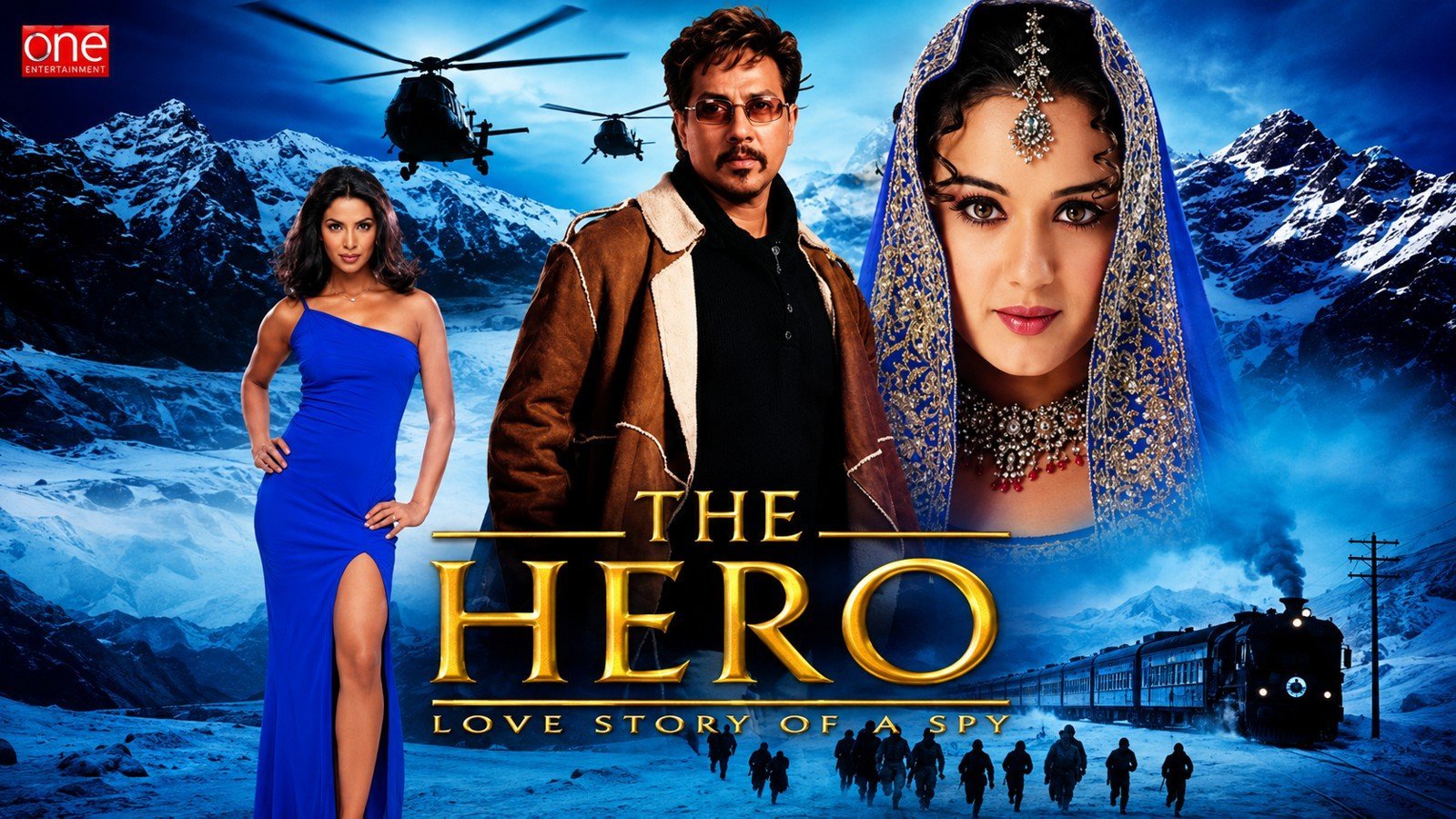
Hero (2003)
Cast: Sunny Deol, Priety Zinta, Amrish Puri, Priyanka Chopra, Kabir Bedi
Director: Anil Sharma
Synopsis: The Gadar team reunite for more (im)potent and dodgy patriotism
Reviewed by: Omar Khan
After gleefully twisting history to satisfy their lusting front-bench audiences in Gadar, the dynamic duo of Anil Sharma and Sunny Deol attempt a similar hijacking of reality, only this time the action is set in present-day Kashmir.
Here we have Sunny Deol, a veritable superhero, being decorated for his incredible gallantry and bravery by the Canadian police. After delivering a modest acceptance speech, he heads back home to India, where pressing matters await—those wretched Pakistani fanatics creating a nuisance yet again. Before undertaking his next assignment, our superhero agent lapses into a flashback recalling earlier events in Kashmir, where he had lost both his heart and, tragically, the simple village belle who had captured it.
We are shown how he had previously taken Kashmir by storm, spreading a message of love rather than hatred. The bearded lot, looking more like Great Uncle Bulgaria from The Wombles than hardened fundamentalists, are taken aback by these shrewd tactics and completely disarmed by the kindly Major’s human approach. He plays with cherubic children, smiles at rosy-cheeked damsels and watches them happily carrying their itsy-bitsy little lambs in equally itsy-bitsy baskets.
The Kashmir we are introduced to appears to be a picture of peace and tranquillity, notwithstanding the occasional misguided beardie spouting inflammatory nonsense. Beneath the surface, however, dark and diabolical events are brewing as the devilish Pakistani Ishaq Khan plots to obliterate India by manufacturing his very own nuclear bomb. The slimy Pakistani authorities secretly allow the dastardly Ishaq Khan (Amrish Puri) to slip out of prison so that he can carry out his nefarious scheme.
Ishaq and his bearded cohorts retreat to the remote reaches of Kashmir to construct their “jihadi bomb”, but matters do not proceed quite as smoothly as planned. In order to complete the wretched device they must travel to Canada and enlist the help of pharmaceutical kingpin Kabir Bedi. Fortunately, Sunny Deol is always at least two steps ahead of the snarling Pakistanis and pursues them wherever they go, determined to derail their plans.
Meanwhile, back in the flashback, we discover how he won and lost the village belle played by Preity Zinta. She had become completely smitten with him during his previous assignment and eventually agreed to act as an informer, entering Pakistani territory disguised as a servant in order to obtain vital intelligence about enemy operations. She performs her task brilliantly until one fateful day when everything goes horribly wrong.
Preity somehow ends up in Pakistan after drifting downstream and is rescued by a collection of dreadful Pakistani yuppies who speak Urdu in an extraordinarily stiff, bookish fashion and evidently possess endless amounts of money and time. Sadly, she has lost the use of her legs, but this presents no difficulty for her generous hosts, who promptly fly her all the way to Canada for specialist treatment. How remarkably kind of them.
The audience is made to squirm repeatedly as the separated lovers almost bump into one another several times—first at the airport, then aboard the same aircraft and finally at the baggage carousel upon reaching Canada. Quite how they fail to notice each other remains a mystery, especially as she appears to be the only passenger in a wheelchair and one tends to notice such things, particularly when one is supposedly the finest and most intuitive intelligence officer in the world.
She might also have noticed him despite his disguise. The look he chooses is approximately thirty-five years out of date and hardly ideal for someone hoping to remain inconspicuous. Preity nevertheless fails to recognise this forty-five-year-old man with flowing tresses who appears to be preparing for an audition with Spinal Tap.
Later, while both happen miraculously to be shopping in the same mall, she finds a scarf he has dropped and recognises it as one she had made for him. She therefore realises that she may be on the verge of rediscovering her long-lost beloved. Once again they miss each other by a matter of seconds and life moves on.
Meanwhile, superhero Sunny must ensnare Kabir Bedi’s gorgeous daughter, Priyanka Chopra, who also happens to be the doctor treating Preity’s injured legs. The plot thickens when the odious Ishaq Khan arrives with his cronies, posing as Uncle Imtiaz, and resumes his association with Kabir Bedi. Poor Priyanka remains blissfully unaware that her father is a creep who has sold out to the Pakistanis and is doing everything in his power to help them manufacture their bomb.
As usual, super Sunny remains two steps ahead, now masquerading as a brilliant Pakistani nuclear scientist named Wahid Khan. The drooling Pakistanis attempt to woo Wahid, not realising that they are merely witnessing the master of disguise at work. Ishaq Khan, however, eventually smells a rat and matters become increasingly complicated until, at long last, Preity and Sunny finally come face to face—at his wedding to Priyanka!
Is it possible that this terrible mess can somehow be resolved happily? Impossible though it may seem, the film reaches an appropriately risible conclusion entirely in keeping with everything that has gone before.
The only real saving grace in this unimaginative and mundane exercise in Pakistan-bashing is Preity Zinta’s bright performance as the simple village belle turned super-sleuth. Not only does she bring considerable spark to an absurd role, but she is also extremely easy on the eyes. Sunny Deol, on the other hand, delivers a performance that provokes a perpetual snicker, particularly during the magnificent series of disguises he employs to fool those brain-dead Pakistanis time and again.
The true giveaway in this routine and shoddy, though needlessly lavish and reputedly Rs. 55-crore, production comes when Sunny begins falling in love with Preity. The audience is clearly meant to feel uncomfortable because he is a good, pious Hindu while she appears to be one of “them”. Fortunately, it is revealed fairly early in proceedings that the girl is actually a Hindu who was orphaned as a child and raised by kindly Muslim neighbours.
Naturally, they never attempted to impose their own religion upon her. Instead, they presumably bought her idols for pooja and sent her off to the temple while the rest of the family attended the local mosque. The audience can therefore breathe a collective sigh of relief upon discovering that the woman of the superhero’s dreams remains suitable, untainted and entirely acceptable after all.
Why could the filmmakers not simply have allowed her to remain a Muslim? Clearly, the very thought would have been considered unpalatable to much of the target audience.
The film itself is an unsophisticated slice—or rather, a great hulking lump—of propagandist trash, precisely what one would expect from the people responsible for Gadar. It aims squarely at the lowest common denominator, hoping to reap a bounty by wrapping its masala-laden message of hostility in the trappings of glossy entertainment.
One can only hope Indian audiences are made of sterner stuff and refuse to be taken in by this kind of pap. Sadly, The Hero merely joins the growing list of Cold War-style propaganda films now being produced with alarming regularity on both sides of the border.

0 Comments
Leave a Comment