
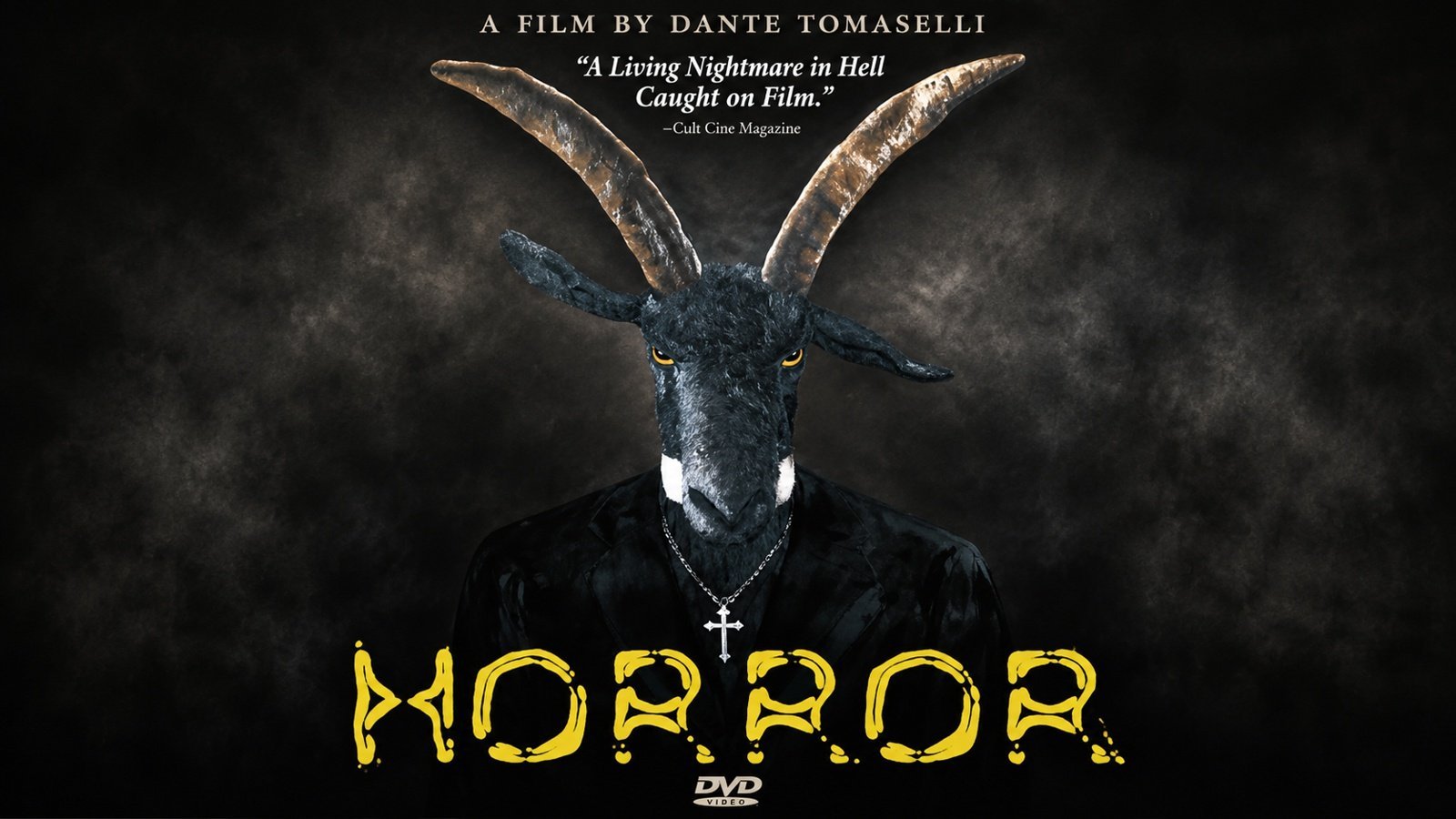
Horror (2002)
Cast: Kreskin, Leslie Mahon, Danny Lopes, Vincent Lamberti, Christie Sanford
Director: Dante Tomaselli
Synopsis: a satanic goat, demonic spirits, hallucinogenic drugs, a runaway gang...
Reviewed by: Omar Khan
I distinctly remember browsing the horror shelves of the local DVD store in search of something a little stranger than the usual run-of-the-mill slasher fodder when somebody mentioned a film called Horror by Dante Tomaselli. The clincher came when I was told that Tomaselli was the nephew of Alfred Sole, director of the hugely underrated 70s shocker Alice, Sweet Alice, and that he possessed a similarly dreamlike, off-kilter visual style.
That was enough to separate me from twenty dollars.
Then there was the DVD cover itself—a magnificent black goat with an imposing set of horns, glowing eyes and, most intriguingly of all, wearing a crucifix around its neck. It was one of those wonderfully bizarre covers that simply demanded investigation.
So Horror duly found its way onto an already overcrowded shelf groaning under the weight of strange and forgotten horror oddities.
The brooding demonic goat wearing the cross!
The opening is undeniably intriguing. A young woman climbs a ladder to remove party lights, photographed from unsettling angles that immediately create a feeling of unease. Then the great black goat appears, positively radiating malevolent intent, and before long increasingly bizarre events begin unfolding with little concern for conventional storytelling.
A young girl is abducted by a sinister man dressed entirely in black, bundled into a sack in almost Texas Chainsaw Massacre fashion and carried off to an isolated house where an equally demented, cackling woman eagerly awaits. We eventually discover they are the girl's parents, who spend their time drugging her before darker, thankfully unseen, abuses are implied.
Then the film abruptly shifts focus.
A group of drug rehabilitation escapees have murdered a security guard and fled in a battered van. Along the way they encounter a preacher dispensing magic mushrooms and assorted brightly coloured hallucinogenic sweets which the trio consume with spectacular enthusiasm and very little common sense.
From that point onwards reality becomes increasingly fluid.
One of the group turns an alarming shade of blue, fluorescent yellow vomit starts flying in every direction, dead preachers appear to be offering comfort to abused grandchildren, and before long somebody shoots somebody else while everyone else seems trapped inside one prolonged nightmare.
Whether these events are literally happening or are merely hallucinations is left almost entirely to the viewer.
And that, ultimately, is where Horror both succeeds and fails.
Tomaselli has an undeniable eye for unsettling imagery. Individual scenes possess a genuinely nightmarish quality, helped enormously by an oppressive soundtrack that constantly suggests something dreadful lurking just beyond the frame. His visual compositions are often striking, and there are moments when the film creates an almost tangible atmosphere of creeping evil.
The score, described by some as "Herrmann on acid", perhaps overstates the comparison with Bernard Herrmann, but it certainly contributes greatly to the film's oppressive mood.
The scenes featuring The Amazing Kreskin are among the strongest in the picture. His strange, almost hypnotic presence lends the film exactly the sort of dreamlike quality Tomaselli is clearly striving for.
The problem is that atmosphere alone can only carry a film so far.
Listening to the commentary track, Tomaselli openly explains that his films are deliberately ambiguous, that they are not intended to possess conventional narratives and that audiences should construct their own meanings.
That is perfectly fair.
Unfortunately, ambiguity and incoherence are not quite the same thing.
The obvious comparison is Don Coscarelli's Phantasm. That film also plays fast and loose with logic and frequently resembles a fever dream, yet somehow its bizarre fragments steadily build towards something emotionally satisfying. One may not understand every detail, but one always senses that the director knows precisely where he is taking the audience.
Horror never quite achieves that.
Instead, it often feels as though it is wandering from one striking visual idea to the next without ever discovering a dramatic spine capable of holding everything together.
The acting, too, is rather uneven. Some performances are surprisingly effective while others feel stiff and unconvincing, making an already elusive film even more difficult to become emotionally involved with.
In the end one cannot escape the feeling that ninety minutes have been invested in a film that promises much more than it ultimately delivers.
There is no shortage of memorable imagery.
There is certainly no shortage of atmosphere.
But nightmarish visuals alone are not enough.
However impressive the individual moments may be, Horror ultimately frustrates far more often than it satisfies.

0 Comments
Leave a Comment