
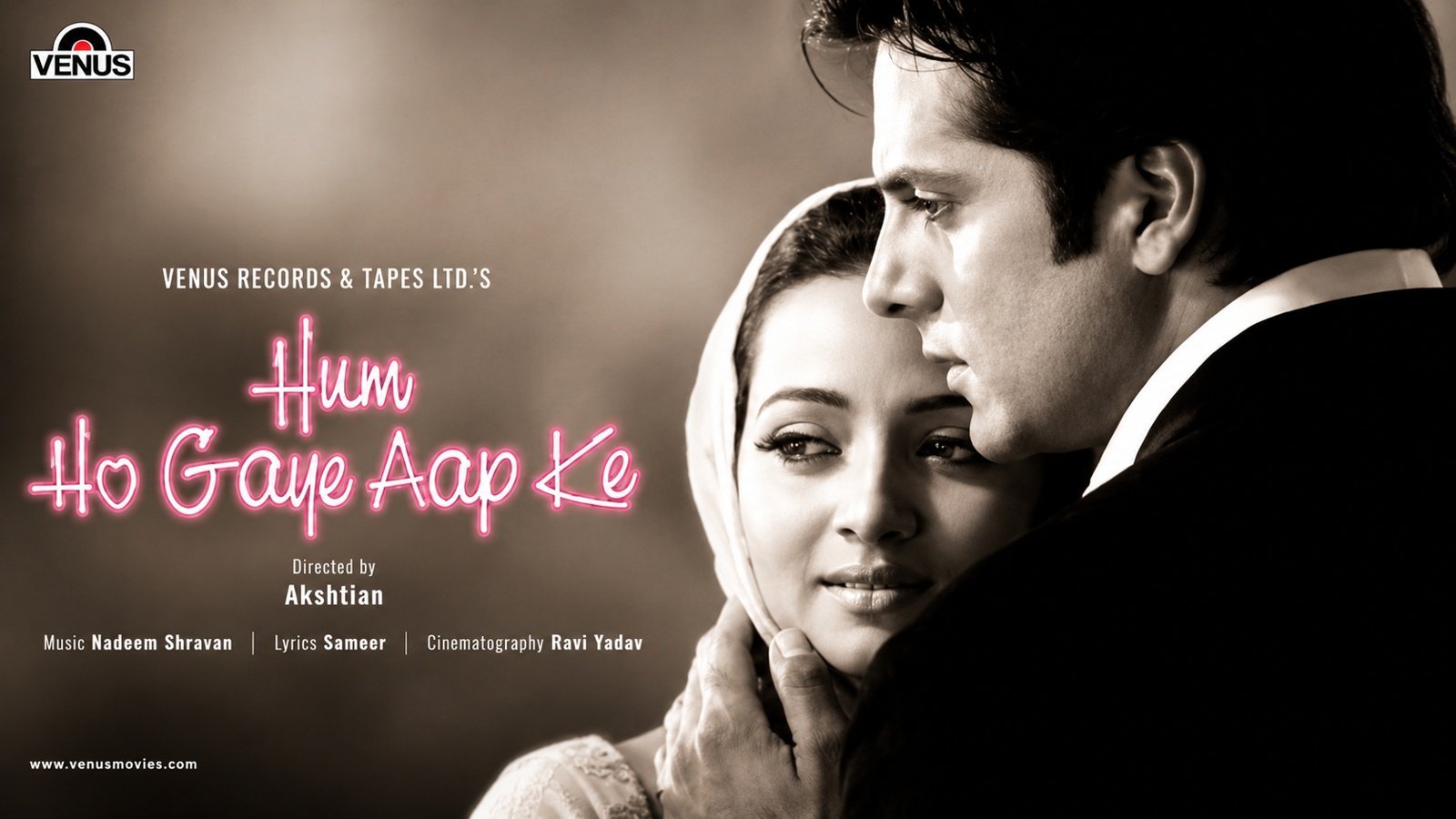
Hum Ho Gaye Aap Ke (2001)
Starring: Fardeen Khan, Reema Sen, Atul Agnihotri
Director: Athaiyan
Music Director: Nadeem Shravan
Synopsis: Fangled melodrama would have been more at home in the 70's
Reviewed by: Faiz Khan
Rishi (Fardeen Khan) is a Casanova who believes he can have any girl he sets his sights on. Love, to him, has no meaning whatsoever. Naturally, we are treated to the obligatory drunken song sequence, complete with beautiful girls flocking around him.
The rather foolish Suman Ranganathan imagines there may be something special about her relationship with Rishi, only to be very firmly put in her place when he bluntly tells her exactly how little she means to him.
Rishi's college friend, a poor—and dare I say it—rather pathetic cheapskate (Atul Agnihotri), works alongside him. The two head off to a beauty contest where Chandni (Reema Sen) is crowned the winner, and both immediately set their sights on her. The cheapskate, however, wins her heart through nothing more than his sincerity and simplicity, and before long love appears to have blossomed.
Rishi, meanwhile, attempts to buy her affections, only to be rebuffed, as any self-respecting girl would naturally do.
Chandni then returns to her village, where her widowed mother has already promised her hand in marriage to a doctor. The family is desperately poor and she is forced into the marriage against her wishes so that her younger sister may stand a better chance of finding a suitable husband. Chandni repeatedly tries to contact the cheapskate, but thanks to a jealous colleague, none of her messages ever reach him.
When the truth finally comes to light, the cheapskate persuades Rishi to help him win Chandni back.
Rishi duly arrives at the wedding. A note is delivered to the prospective groom (Mahesh Thakur), who turns out to be the very picture of common sense and decency. Rather magnanimously, he tells Chandni to run off to the man she truly loves and calmly announces that he will simply marry her sister instead.
So off Chandni runs to her beloved.
Unfortunately, she finds him begging his parents to allow him to marry the woman of his dreams. Since there is no dhan daulat to be gained from the marriage, they refuse outright, declaring that should he marry her, they will all commit suicide together. Our impoverished hero clings to his parents, everyone begins wailing in unison, and Chandni is once again left to fend for herself.
Fortunately, Rishi rides to the rescue and brings her back to his own home.
The inevitable transformation from carefree Casanova to decent human being is now only a matter of time.
The curious thing is that the path of love suddenly becomes difficult for no particularly convincing reason. Chandni is happily settled in Rishi's home; he has fallen in love with her, his father approves of her, and everyone appears perfectly content.
So where exactly is the obstacle?
Athiyan's film feels like an old-fashioned melodrama better suited to the 1970s than contemporary audiences. The director makes little attempt to inject freshness or vitality into proceedings, relying instead upon heavy-handed melodrama, ponderous pacing and scenes that are frequently unintentionally funny. Much of it is simply too crass to be remotely believable.
Nor do the leading characters possess enough charm to carry the material, and the climax is a considerable disappointment.
Fardeen Khan is thoroughly unconvincing as the swaggering Casanova. He appears somewhat more comfortable once the character softens later in the film, but this is such a dull role that there is very little any actor could have done to make it interesting.
Reema Sen makes a reasonably pleasant debut. She is neither outstanding nor particularly poor, but at least she avoids the wooden performances that often accompany first films.
Atul Agnihotri, however, desperately needs a complete makeover. He repeatedly seems to choose roles that portray him as passive, helpless and largely ineffectual—as in Kasoor and now here—and his permanently hangdog expression and floppy hairstyle are doing little to enhance his acting credentials.
Nadeem-Shravan provide a pleasant enough soundtrack, with the title song and "Der Se Hua" emerging as the standout numbers. Their music remains tuneful, but it has all become so familiar and interchangeable that very little of it lingers in the memory once the film is over.

0 Comments
Leave a Comment