
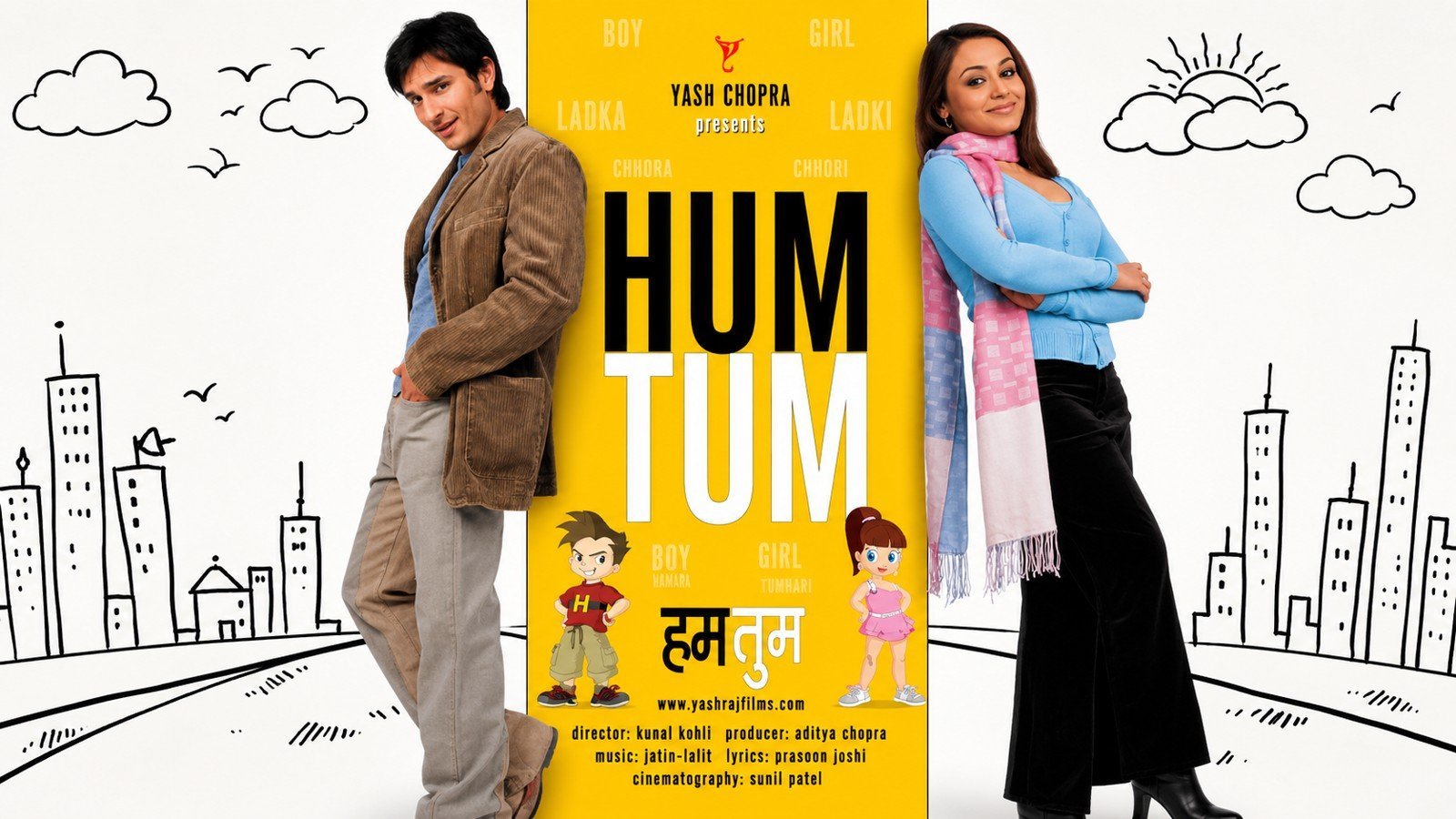
Hum Tum (2004)
Cast: Saif Ali Khan, Rani Mukherjee
Director: Kunal Kohli
Music Director: Jatin Lalit
Synopsis: Good intentions aside, poor direction and a dire script cripple this dull affair
Reviewed by: Faiz Khan
Hum Tum is Kunal Kohli’s second directorial effort, but there is little evidence that he has learnt from the mistakes he made in Mujhse Dosti Karoge. The film aspires to be a simple, witty and mature love story, but despite a promising premise, it fails to live up to expectations.
The film opens with cartoonist and now author Karan Kapoor (Saif Ali Khan) launching his book, Hum Tum, based upon his own experiences of love. Unshaven and rather forlorn, it is clear that his personal journey remains incomplete, true love having eluded him thus far.
We then move into flashback, ten years earlier, when Karan first meets Rhea Prakash (Rani Mukerji) as the two are travelling to New York for further studies. Karan belongs firmly to the school of thought that girls are there to be played around with and, finding himself seated next to Rhea, immediately begins trying to impress her. After a couple of false starts, the two spend their brief stopover exploring Amsterdam. The customary banter eventually ends with Karan planting a kiss on her lips and receiving a resounding slap across the face.
Six months later, they bump into each other again in New York. There is more banter and several additional cries of “You are sick!” from Rhea, apparently her favourite line whenever dealing with our bedraggled hero.
We then leap forward another three years—or is it months?
Karan’s mother is now a wedding coordinator and Karan, sporting what is meant to be a Tom Cruise hairstyle but looks nothing remotely like one, is helping her organise a wedding when the bride-to-be walks in.
Naturally, it is Rhea.
After a little discussion about the nature of true love, Karan bids farewell to her as she prepares to marry Sameer (Abhishek Bachchan).
Another year passes and, aboard a train in France, Karan once again encounters Rhea, who quietly tells him that Sameer is no longer in her life.
Time for the interval.
After the break, we discover that Rhea is now a widow. Tired of people’s sympathy and determined to avoid endless attempts by relatives to arrange another marriage for her, she has settled in Paris with her mother. By yet another extraordinary coincidence, Karan is also in Paris visiting his father, a fashion photographer who separated from his mother seventeen years earlier.
Karan now sets about rebuilding Rhea’s life in the only way he knows how, never imagining that he might be right for her—or that she might be right for him.
Does love triumph in the end?
Is the earth round?
It is all rather predictable, though one knew that from the outset. There are, after all, only so many variations possible within a conventional love story. The success of such a film depends entirely upon its treatment.
Kunal Kohli begins with a neat idea but fails to capitalise upon it because of a weak screenplay. The film moves along at an ordinary pace, wrapped in the familiar candyfloss appeal of most Yash Raj productions, but its superficial charm gradually proves more irritating than endearing.
Hum Tum requires far more wit than it actually possesses and eventually falls back upon the usual collection of romantic clichés. One never really sees Karan and Rhea develop a convincing friendship, and the bond between them remains surprisingly underwritten. Even the scene in which they pretend to be strangers meeting during an arranged-marriage interview falls rather flat.
There is also the unnecessary introduction of Karan’s father, included largely so that his son can realise that he must not repeat the mistakes of the previous generation. The greater problem, however, is that Karan himself shows very little emotional growth as the years pass. Perhaps the intention is to suggest that men remain commitment-phobic children at heart and continue behaving much as they did ten years earlier. Unfortunately, that idea never comes across with much clarity.
Instead, the character merely appears stagnant, with a succession of hairstyles serving as the principal indication that time has passed.
Simplicity itself is not the problem. Dil To Pagal Hai had the barest of plots, yet succeeded because beneath its glossy surface there was an unspoken passion and emotional yearning that Hum Tum entirely lacks. There is neither much novelty nor any particular vision in Kohli’s treatment—only clean, harmless entertainment that ultimately feels rather vacuous and excessively sanitised.
Saif Ali Khan plays the role competently, though he is less effective than he was in his previous two or three films. Perhaps the humour and comic timing displayed in Dil Chahta Hai and Kal Ho Naa Ho created expectations that the material here simply cannot fulfil.
Rani Mukerji is a consummate performer who invariably brings a certain class and dignity to her roles. This is hardly earth-shattering material, but she gives Rhea a quiet charm and emotional restraint that make the character considerably more appealing than she might otherwise have been.
Rishi Kapoor, in a special appearance, brings some welcome sparkle to his scenes.
Jatin-Lalit, after quite some time, contribute a pleasant and engaging soundtrack.
Hum Tum is harmless enough but ultimately rather inconsequential and thoroughly forgettable.
A shame.

0 Comments
Leave a Comment