
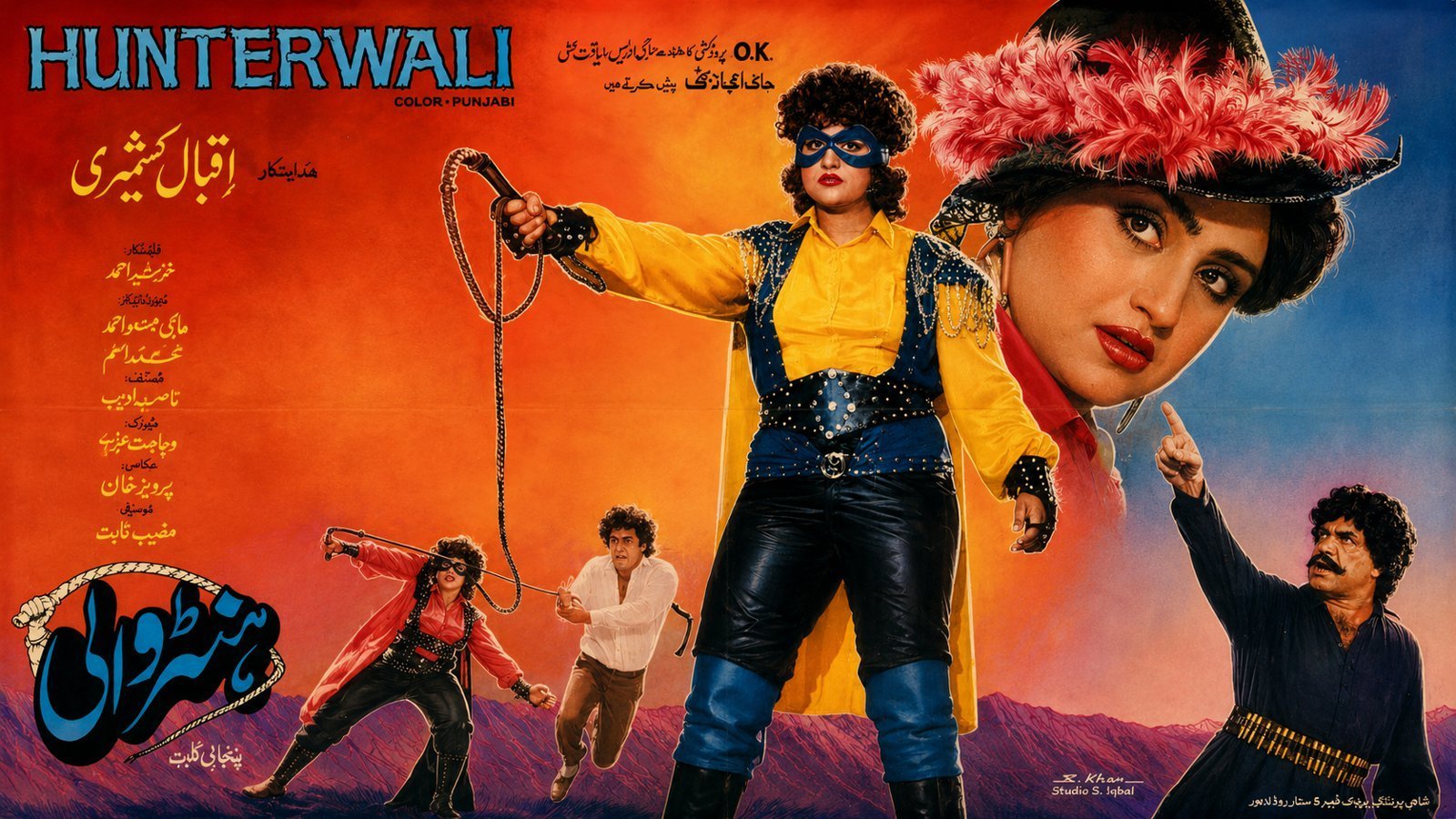
Hunterwali (1988)
Cast: Anjuman, Sultan Rahi, Mustafa Qureshi, Jameel Babar, Sushma & Bahar
Director: Iqbal Kashmiri
Synopsis: yet another twisted tale of warped feminism tailored for male audiences.
Reviewed by: Omar Khan
The film begins with an elderly, white-wigged sage riding along on his cart accompanied by his demure niece, along the dusty unpaved roads connecting the pinds of rural Punjab. As they approach Nurpur pind (Nurpur is to Punjab as Main Street is to America), they find their path obstructed by an unkempt-looking bed lying in the middle of the road. It should be remembered that this bed (the manjhee) within this fascinating culture is akin to male dogs’ territorial pissing, in that it is a distinct mark of a territorial zone. Just as a dog attempts to spread pee marking his domain, the village Chaudhary also marks out the boundaries of his turf by plonking his Manjhee at a specific spot as a mark of his identity and ownership. Thus, when the old fogey asks his four somewhat intimidating and well-paunched goons to consider moving the manjhee out of the way is regarded as an insult of the most humiliating kind.
The fogey reminds the goons that he did ask them politely, but they are adamant and refuse to let the oldie pass unless he hands over his daughter to them in exchange! The oldie loses his shirt and is thrashed to a pulp by the fat goons. Meanwhile, at the fogey’s home, the adoring parents of Umri (Sultan Rahi), are deriving utmost delight at the sheer brilliance of their son. 454
A proud father tells Umri how he wishes to tame the famous Hunterwali’s notoriously unruly horse. A mortal has never controlled this horse, and whom the Hunterwali’s super-wealthy father has offered massive rewards for taming. Rahi mocks the task as too easy for someone of his mighty talents. Later he is interrupted by his sister, who has returned without a dupatta on her head—never a good omen. She recounts the tale of the manjhee and the goons who thrashed poor old cha cha ji to a pulp.
Moments later, Umri is off on his freshly tamed horse to teach the goons of Nurpur Pind a lesson they will never forget. Meanwhile, he also sets his sights on taming the Hunterwali’s horse and maybe even the Hunterwali herself. The dashing Umri demonstrates to his cooing parents how he can easily tame the most obstinate horse with the sheer powers of his pure masculinity.
This is the film’s scintillating premise, which brings together the same old tried and tested (stale and worn out?) team of Sultan Rahi, Anjuman and Mustafa Qureshi for the zillionth time. The grand Raja (Talish) of a neighbouring village and the father of the infamous Hunterwali challenges all comers to try to ride Hunterwali’s wild horse, Moti. Still, no one can naturally dare to try to achieve the impossible. However, just as it looks like another annual Mela will draw to its boring conclusion, Umri arrives to take up the challenge and duly conquers Moti, much to the disgust of the Hunterwali. Raja Sahab had promised the man who tamed Moti anything he asked for, but when Umri asks for his daughter, Baali, the Hunterwali’s hand, he is more than a little taken aback.
However, being the town figurehead, he has to keep his word and force poor Baali to marry Umri, and that is when fate intervenes. Umri is attacked by the same goons who tried to rape his sister, and he kills the lot of them. Word spreads that Umri is a murderer, giving Raja Sahab a chance to get off the hook by calling off the wedding to his daughter Baali.
Hunterwali
It turns out that Baali has a twin sister, who is a world apart, being a timid, meek, subservient, domesticated type as opposed to the firebrand Hunterwali, who goes around town brutalizing criminals with the deadly crack of her lethal hunter (pronounced Hanter). Meanwhile, poor Umri absconds from the police, who want him for the murder of the rapist goons from Nurpur pind.
Hunterwali’s demure sister Bano gets married off to local DSP Mustafa Qureshi, and there is much festivity and spectacle as the wedding takes place a few weeks later.
Meanwhile, Baali, too, finds romance in a handsome young lad who saves her one fine afternoon from being ravaged by four more goons. She falls for this hunk, who she thinks looks just like Imran Khan and a romance starts to blossom, as they meet for afternoon frolics in the picturesque hills. When Baali Hunterwali learns of her father’s plans to wed her off to a friend’s son, she is horrified at the prospect of losing the lust of her life, the lad she has been romancing over the last few weeks. When the wedding day draws nearer, Baali absconds with her boyfriend despite a touching and highly symbolic scene while leaving the house. Her dupatta gets tangled with a photograph of her with her father. The picture frame crashes to the floor and clings to the dupatta, refusing to let Baali go, but she does.
Her boyfriend takes her to a distant cave, and suddenly, things turn nasty as the loving boyfriend turns out to be an accomplice of the four rapists, and now they plan on making up for lost time with Baali captured. Baali squirms away, but the goons catch up with her. As all appears lost, suddenly Umri shows up out of the blue and brutalizes the goons, sending them fleeing to distant corners of the forest. However, Baali has disgraced her family and herself by running away with her boyfriend. Hence, her father, Raja Sahab, does the “ghairatmand” (honourable) thing by taking a gun to his daughter. Still, he mistakenly shoots the virtuous sister Bano, as she leaps into the way of a bullet at a most inopportune moment.
As Bano lies squirming away with a bullet in her gut, Raja Sahab fires a shot into his head and splutters that he has sacrificed his life so that his daughter could live, as, after such a disgrace to the family, only one of them could have lived to face the world. As the meek and timid paragon of desi goodness lies bleeding to death, she makes a stunning final request: Baali Hunterwali, her identical twin, is to take her place as Bano, and carry on as the demure wife of the DSP. Baali agrees to her sister’s dying request and adopts the dead sister’s persona, but though the family is fooled, the dog is not. Later, she bonds with the German Shepherd in a touching scene and forms a lethal undercover team.
However, Baali’s Hunterwali urges begin to torment her, and she can’t shake these urges just as she can’t shake her newly discovered fondness for Umri. The man who had earlier tamed her horse, along with rescuing her from a dreadful gang rape. The film is a magnificent hotchpotch desi masala with a deluded yet brilliant plot, and performances that suit the farcical events on screen. The animals also lend great support, with Puppy stealing several scenes and even Moti the horse providing some highly charged emotion. There is also a delicious snake dance towards the end, and they consistently score high marks for artistic content.
Sultan Rahi has only a brief role, and it is an Anjuman show all the way—one that she carries off with her usual aplomb even if she is looking a touch too “healthy”, as they say. However, it is Puppy, the sleek-looking German Shepherd, who takes the top honours for his heroics, and at the end of the day, Hunterwali, Puppy and Moti could kick Zorro and Tonto’s behinds if ever there were to be a showdown.
If there is one major weakness, the film has introduced a new starlet in Sushma, who is not up to scratch, neither in the required voluptuousness nor in acting skills. Matters come to a stunning climax, as Hunterwali dishes out her brand of justice with each lash of her magnificent hunter. However, in another plot twist, Sushma falls for the same dastardly devil that tried to snare Baali.
The film is the most entertaining, formulaic nonsense, even if it is the usual socially regressive stuff, promoting honour killing and depicting the ultimate evil as the woman who thinks and behaves independently. To quote directly, in a pivotal scene, Anjuman turns to Sushma and tells her, “Remember that those women who chose their own husbands end up with the most horrifying fate.” Yet another twisted, regressive, demented form of jumped-up feminism that is quite the opposite, entirely shaped by men for their gratification.

0 Comments
Leave a Comment