
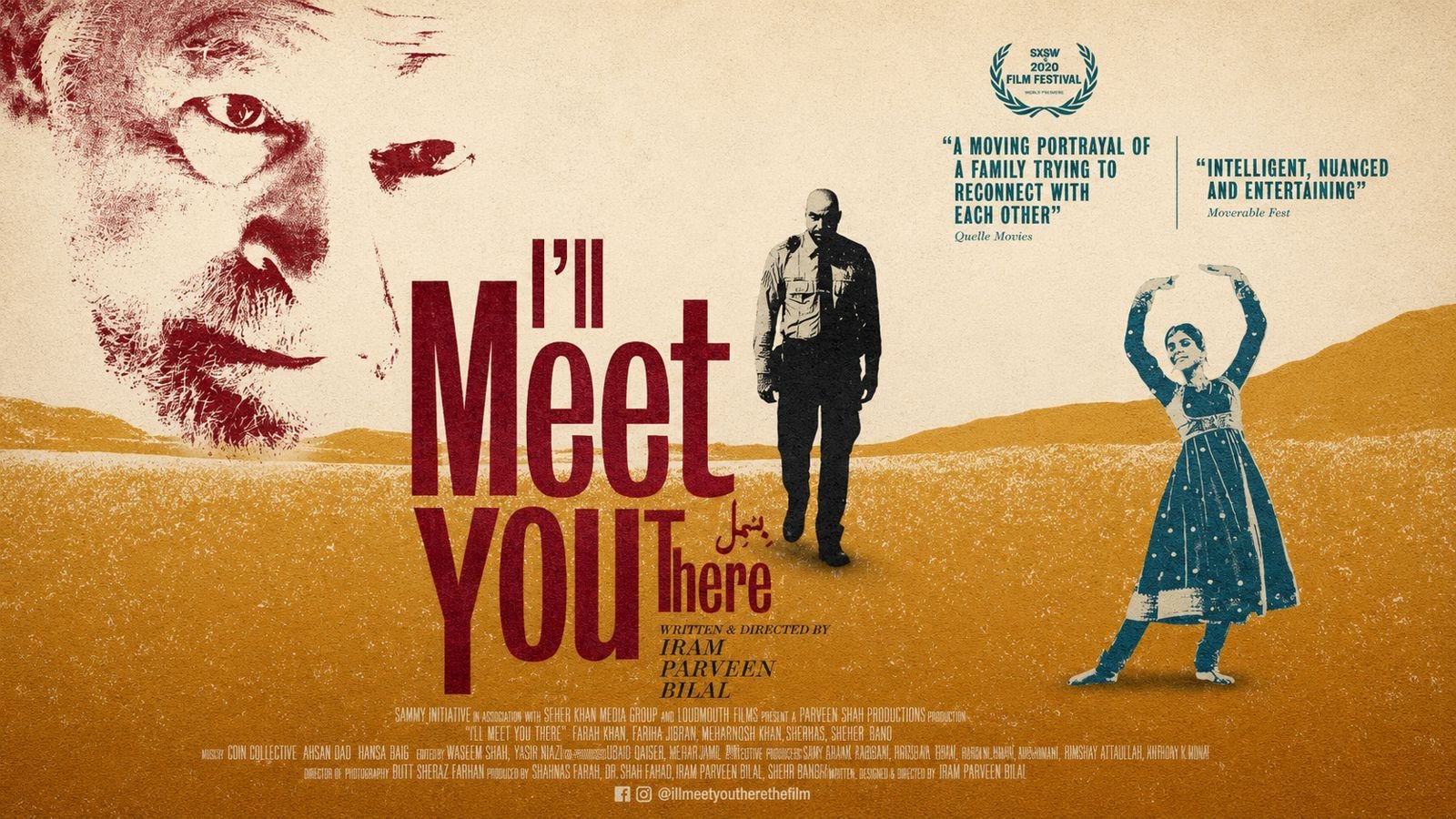
I'll Meet You There (2020)
Cast: Faran Tahir, Qavi Khan, Nikita Tewani
Director: Iram Parveen Bilal
Nutshell: An American family of Pakistani origin must confront past and present demons with the arrival of a visitor from Pakistan.
Review by Omar Ali Khan
It's been a long time since I felt any real inclination to watch a new Pakistani film. Personally, the more our cinema tries to imitate Bollywood instead of forging its own identity, the less appealing it becomes.
Far too many recent productions seem desperate to recreate a Bollywood formula that itself expired well over a decade ago. We continue recycling Dabangg-style antics after reducing our cinema to that level (with the notable exception of Kamli). Contemporary Pakistani cinema appears trapped between two equally uninspiring extremes: mindless, brain-dead romantic comedies featuring ageing Kala-Colaed actors behaving like overgrown adolescents (apparently this isn't considered obscene), and glorified, flag-waving feature-length advertisements for the war machine.
Audiences have become starved for something with even a hint of substance, and whenever a mildly cerebral film does appear, the Censor Board kindly steps in to protect us from the danger of thinking too much.
This, despite happily certifying depraved Punjabi and Pashto films filled with grotesque violence, warped sexuality, gang rape and honour killings as suitable entertainment for audiences of all ages. Films in which women are murdered for being "dishonourable" stage dancers somehow pass without objection, yet a film depicting ordinary Pakistani Muslims living ordinary, complicated lives suddenly becomes a threat to public morality.
Mindless garbage, crude propaganda and the glorification of honour killing are apparently acceptable viewing for children and adults alike. But any film daring to portray Muslims as ordinary human beings, with the same hopes, fears and contradictions as anyone else on the planet, is condemned for "depicting Pakistan in a negative light."
That, sadly, tells us far more about the censors than it does about the filmmakers.
I'll Meet You There centres on Majeed (Irfan Tahir), a respected Pakistani-American police officer living in Chicago with his teenage daughter, Dua. Her greatest ambition is to earn a coveted place at the world-famous Juilliard School. She dreams of becoming a professional dancer, just as her late mother once did.
Her father supports her ambitions—with one important exception.
Kathak is strictly forbidden.
The obvious question immediately presents itself: what connection does Dua's late mother have with Kathak?
Before long, Majeed's elderly father unexpectedly arrives from Pakistan to spend time with his granddaughter. Panic immediately sets in. Majeed hurriedly orders Dua to remove every trace of dancing from the house, and it soon becomes apparent why.
Qavi Khan's quietly authoritative grandfather introduces an entirely different worldview into the household. Traditional, conservative and deeply religious, he nevertheless encourages Dua not to reject her faith, but to understand it.
Running parallel to this family drama is another dilemma. The FBI pressures Majeed into infiltrating the local mosque after suspicious financial transfers to questionable "charities" attract official attention. As family tensions, questions of faith and conflicting interpretations of religion begin to collide, the film raises complex issues without ever resorting to sensationalism or cheap melodrama.
Nothing about the film is remotely offensive.
The only conclusion one can draw from the Pakistani Censor Board's decision to ban it for "depicting Pakistan in a negative light" is that some people would rather live like ostriches, heads buried firmly in the sand, blissfully insulated from reality.
A population fed an endless diet of cinematic junk is far easier to manage than one leaving the cinema asking uncomfortable questions.
Think less.
Question less.
Obey more.
I'll Meet You There may not be the most groundbreaking film ever made, but it is an honest one. It deals with genuine people confronting genuine dilemmas rather than inhabiting the make-believe universe of buffoonery inhabited by films like Dabangg or the countless local imitations that continue to clog our cinemas.
Meanwhile, the current Pakistani Censor Board strikes me as the most insecure since the days of General Zia-ul-Haq.
For decades our cinema has routinely mocked dark-skinned people, dwarfs, disabled people, minorities, East Asians, Africans, overweight people, the poor and anyone unfortunate enough to fall outside an absurdly narrow definition of acceptability. Select almost any ten Pakistani films from any decade and the casual prejudice becomes painfully obvious.
Yet films encouraging audiences to think critically—or simply presenting Muslims as ordinary, flawed human beings—are somehow considered dangerous.
The irony is difficult to ignore.
Director Iram Parveen Bilal approaches the material with admirable restraint. The performances feel unusually natural and refreshingly free of the exaggerated dialogue delivery, theatrical pauses and melodramatic excess that continue to dominate so much Pakistani cinema and television.
Irfan Tahir gives a quietly affecting performance as Majeed, while Nikita Tewani, an American actress of Indian heritage, is equally impressive as Dua.
It is worth noting that many South Asian female characters in British, American and Australian productions continue to be portrayed by Indian, Sri Lankan or Caribbean actresses of South Asian heritage. Pakistan still labours, to some extent, under the Zia-era mentality that acting is somehow an immoral profession, leaving comparatively few internationally recognised Pakistani actresses.
Qavi Khan, one of the few surviving legends from the golden era of Pakistani cinema, delivers one of his finest later performances. Mercifully free from the exaggerated clichés so often mistaken for "good acting" in our industry, he brings warmth, dignity and quiet humanity to a character that could easily have become a stereotype.
Contrast this with the commercial formula that still dominates much of mainstream Pakistani cinema, where men are expected to shout loudly, swagger theatrically and solve every problem with violence, while women are encouraged to resemble heavily made-up Bratz dolls before throwing themselves enthusiastically at the hero. Saima, Sana, Meera, Resham and countless others perfected that particular formula years ago because audiences—and producers—kept demanding it.
Strong, independent female characters who exist beyond their relationship to men remain surprisingly uncommon.
One of the film's greatest strengths is its recognition that Pakistan is not a single, monolithic culture.
Religion undoubtedly forms an important part of our identity, but so do language, music, clothing, customs, food, weddings and centuries of regional traditions. Punjabi, Sindhi, Baloch, Pashtun and Urdu-speaking communities each possess distinctive cultural identities that enrich the country rather than diminish it.
To pretend otherwise is simply to deny reality.
Perhaps the most thought-provoking aspect of I'll Meet You There is its exploration of faith itself.
The film gently reminds us that sacred texts written in Arabic have been interpreted in countless different ways by generations of scholars, each shaped by their own experiences, politics, cultures and historical circumstances. Every interpretation claims authenticity.
The obvious question therefore becomes:
Which interpretation is the correct one?
Is disagreement the product of political convenience, cultural influence or the inevitable ambiguities of language itself?
The film never pretends to possess all the answers. Instead, it quietly suggests that good intentions, compassion and humanity may ultimately matter more than rigid certainty. There may be one God, even if different cultures use different words and different traditions through which to understand Him.
You may agree with that conclusion or reject it entirely.
That is precisely the point.
A mature society should welcome thoughtful discussion rather than fear it. Banning a film as intelligent, measured and humane as I'll Meet You There does not demonstrate confidence. It suggests insecurity—and a remarkably condescending lack of faith in the intelligence of the very audience the Censor Board claims to protect.

0 Comments
Leave a Comment