
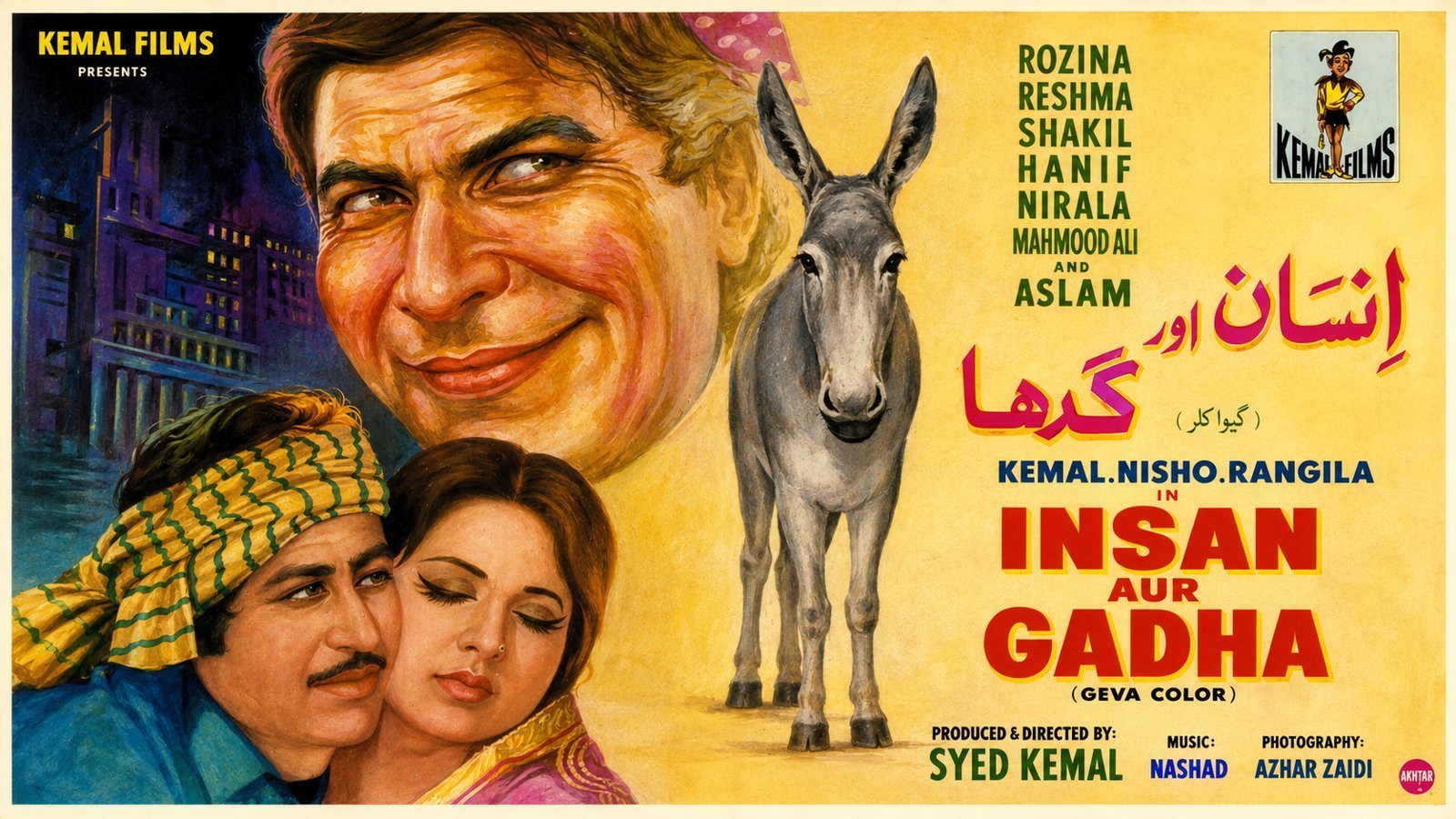
Insan Aur Gaddha (1975)
Cast: Kemal, Nisho, Rozina, Rangeela, Aslam Parvez
Director: Kemal
Synopsis: Attempted Fable cum satire about Man’s inhumanity misses the mark. Lollywood’s version of Raj Kapoor (looks, if not talent-wise), Kemal wrote, produced, directed and starred in this ambitious attempt at social satire.
Reviewed by: Omar Khan
The film follows the tale of a simpleton Kemal who barely earns a living through his donkey-driven cart. He is secretly adored by his pretty but desperately poor neighbour Rozina, who is forced by the local goon to dance in the streets.
Aslam Parvez is the evil mastermind at the centre of a gang of criminals who use whatever means to extort money from the innocent and the weak. Thrown into the mix is a wealthy landowner whose young nephew is tricking him into signing away the inheritance in his name.
One day, Kemal, the donkey man, gives one of his two donkeys to a fellow suffering worker who begs and pleads with him for the second donkey Mangoo. Later we see that poor Mangoo is treated horribly by his new keeper, desperately unhappy and yearning to return to his original master Kemal.
One day, Rangeela (Mangoo the donkey) happens to rescue the wealthy landowner from a murder attempt and subsequently inherits the old man’s millions. Then he begins to thwart the evil designs of Aslam Parvez and his cronies one by one. In sheer desperation, Mangoo, the donkey, prays to the heavens to allow him to live like a human being, and lo and behold, his wish is granted, and Mangoo is turned into Rangeela—the human donkey!
Meanwhile, Nisho abandons her rich and scheming father’s millions for a life with simpleton Kemal, but only after she makes sure he has made millions in a share of the inheritance, which his donkey, Rangeela, decides to share with his master.
Kemal’s story attempts to show the inhumanity in which man deals with his fellow humans, let alone animals, and how humanity’s added intelligence doesn’t amount to anything if put to harmful use. Despite its noble message, the film is unfortunately totally infantile in how it has been presented.
The film panders to the lowest common denominator. Therefore, the humour is mainly of a silly, funny visual nature rather than the sharp-edged, wickedly undercutting spirit of Rangeela’s own Aurat Raj. Unfortunately, this movie’s humour caters to an infantile audience with its imbecilic sight gags and situational comedy. Kemal is irritating as the idiot with his lisp, and Rangeela’s antics in trying to behave like an ass are precisely that— stupid and not particularly funny.
Nisho does her job reasonably well as the love interest, but Rozina steals the acting honours as the poverty-stricken dancing girl. Aslam Parvez, as the sleazy, slimy, scheming creep Dilawer, is the pick of the performers by a mile—exuding slime and menace as only he could. The film has some severe problems besides being infantile and moronic in its approach. There is a highly objectionable scene where it is evident that the animals used in the film are being treated in a way that goes against the very point the film is trying to make. There is one scene in particular where a donkey is being thrashed. It is visible that the donkey on film is cowering in terror and is being struck by the actor, however lightly—it is clear that the animal was terrorized. In
Insan Aur Gaddha another scene, Kemal takes a small dog from his owner and physically throws it outside—negating his film’s point about treating people and animals humanely as they are all created by God.
However, Kemal focused more on making his financial profits than trying to make a statement about how the lesser privileged are treated in our society. The film fails to make its point as another farce that should have been so much better. Insaan aur Gaddha was undoubtedly a good idea for an effective satire, but it ends up as a mundane and painfully puerile slapstick farce of the most avoidable kind. A world apart from the masterful Aurat Raj, which followed a few years later.

0 Comments
Leave a Comment