
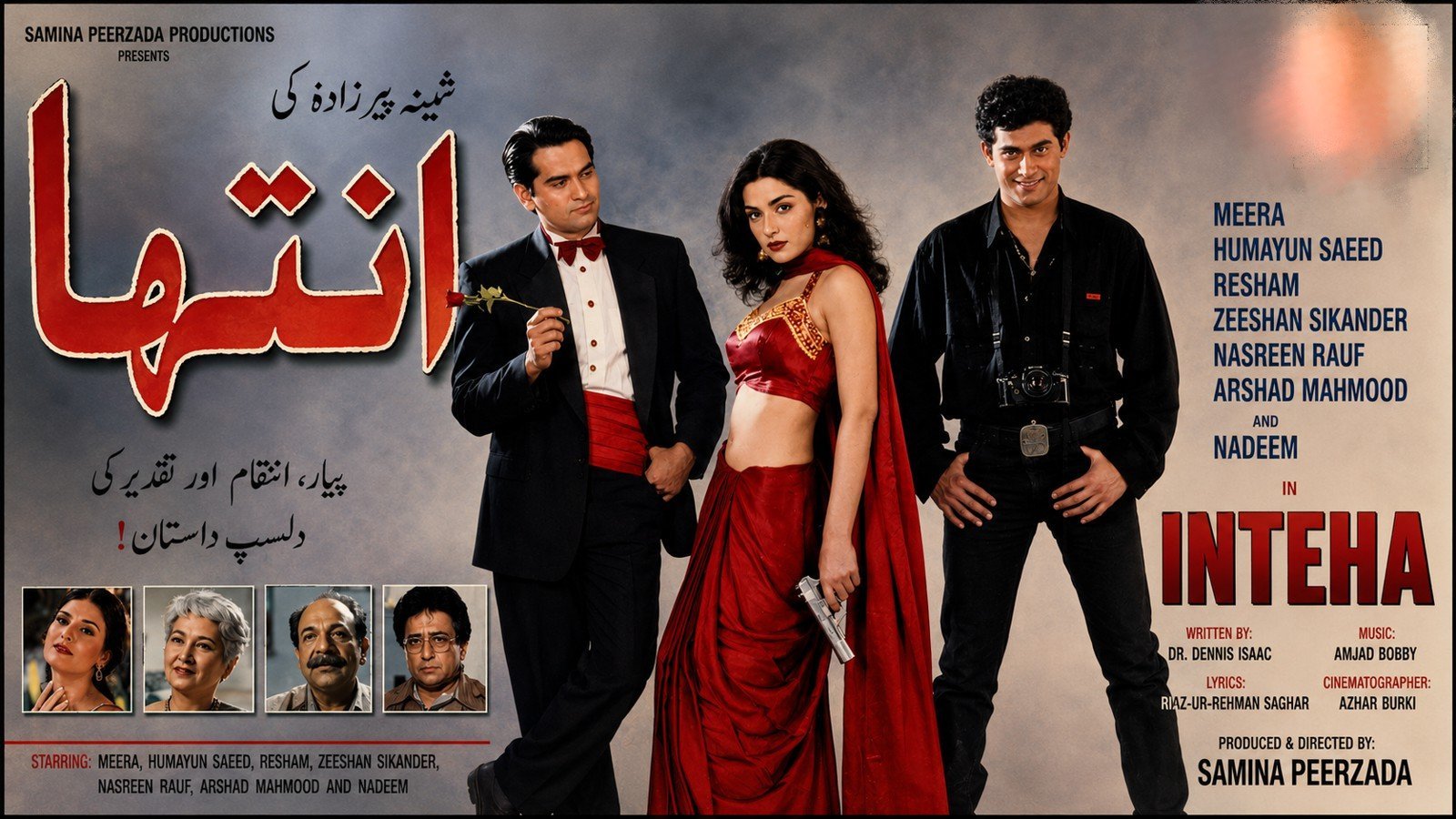
Inteha (1999)
Cast: Meera, Humayun Saeed, Resham, Zeeshan Sikander, Nadeem, Arshad Mahmood
Director: Sameena Pirzada
Synopsis: "Charba" is a term applied to films, songs, and dramas lifted from Bollywood or vice versa. Sadly, this film falls into that category, though a highly rated one with solid performances. It's a film indulging wholeheartedly in intellectual theft and undeserving of its elevated status in Pakistani cinema.
Reviewed by: Omar Khan
Inteha is a film that arrived in 1999 in an era that followed Sultan Rahi's death when Urdu films had a short-lived revival (the most overused word in Pakistani cinema history?). The film received rave reviews and drew audiences back to the cinema from those who had long abandoned Pakistani cinemas for the comfort of watching Bollywood movies on the VCR in their living rooms rather than the filthy, rat and roach-infested cinemas sprinkled nation.
Sameena Pirzada had made a name for herself on the TV screens and made quite a splash with the success of her debut feature that also launched the movie careers of Humayun Saeed and Zeeshan Sikandar. Saeed has enjoyed a long and fruitful career that still flourishes decades later. Zeeshan Sikander was on the scene for a while but couldn't make the same impression as Saeed, nor of Meera or Resham, the leading ladies.
Veteran Nadeem also stars, and some well-respected TV artists are graduating to the big screen. The music is by Amjad Bobby, and the story is by Dennis Isaac. 1999 was when the internet was in its infancy and still a few years before the public became much more aware of and in tune with the plagiarised films crossing back and forth between the Pakistani and Indian borders. As the internet era grew, intellectual property thieves such as Nadeem Shravan found their cheating ways increasingly vulnerable to exposure. Savvy producers such as Shah Rukh Khan's production company began to seek protection by applying copyright laws that were previously alien to South Asia.
In Pakistan, the censorship rules explicitly state that films stolen from Bollywood would not be certified for public exhibition. Yet, this rule was hardly ever enforced before the internet emerged. It was not always Pakistan borrowing from Big Brother India. Often, lazy Indian producers would sanction the full-scale theft of Pakistani films but more so from the pop and folk music scene. Nusrat Fateh Ali Khan's hit Masst Masst song was ripped off, and Indian music directors stole scores of Pakistani songs without fear of reprisal.
This cross-border pilfering was in full swing until the turn of the century when Bappi Lahiri sued Dr Dre for not crediting him and lifting his song "Thora Resham Lagta Hai" and won. A tune from the hit Bollywood film Race was found to have been aped from a Korean pop song. Soon, stealing wasn't as straightforward as in previous times, and now, there would be a real threat hanging in the air of legal proceedings if caught red-handed.
Inteha follows almost exactly the template of Shahrukh Khan and Sunny Deol's film Darr diligently from start to finish, with Humayun Saeed playing the role that Shahrukh Khan had. Aside from being a blatant copy, the production values were far more polished than most films hitting the local screens in Pakistan. Pushto films had reached a level of hideousness that The UAE and other Gulf states banned entirely.
Punjabi movies post-Sultan Rahi were on auto mode, with Shaan made to recreate the Rahi persona as best he could. Urdu films found Inteha a lease of life with the success of films like Haathi Mere Saathi, Munda Bigra Jaye and Inteha. Production appeared to be picking up pace again for a year or two, but the euphoria soon evaporated as piracy dug deep. Bollywood films spearheaded by The Khans replaced local films in popularity, sending the entire Pakistani cinema industry into a spiral.
The world's political landscape was changing rapidly, with events in Iraq transforming characters like Osama Bin Laden to new heights of popularity as a champion of the disenfranchised. There was a discernible shift towards radicalism, which also profoundly affected cinemas in Pakistan. Enraged anti-western mobs torched several cinemas in Karachi and elsewhere for promoting "Western vice." Soon, the much-trumpeted "revival" was more about survival.
With apps such as Shazam in operation, copying music has become much more of a legal minefield, and composers have had to be far warier, like films. Bollywood, which used to steal from Hollywood on a massive scale, has had to take the legal route with their remakes, paying vast sums buying rights and operating within international copyright parameters. It could be conceivable that a film like Inteha would find itself falling foul of local laws on "intellectual theft", but in 1999 it was still a free-for-all all.
The Hollywood film Sleeping With The Enemy was perfect for desification for local audiences. It hit screens in fangled versions in the late 1990s, with many scoring big critical and commercial success. Hit films feted with awards and accolades and were among those "inspired" by Sleeping with The Enemy on both sides of the border. By 2020, Bollywood producers would undoubtedly have to buy the rights to such a remake or risk legal action. The internet has removed the camouflage that the plagiarisers would try to hide. Now, there is little escape.
There seems little point in discussing the merits and demerits of Inetha’s plot and storyline as it is plagiarism. However, there are some positives among the apparent criticism. Meera turns in a career-best performance and looks beautiful while doing so. Humayun Saeed shows enough ability to emerge as an enduring star. Resham also turns in what many would claim is her finest work, and Zeeshan Sikander is reasonably good for a debut. The music is putrid, sounding like a Bollywood score from an era best remembered by Kumar Sanu's dreadful imitation of Kishore Kumar. Sadly, A. Nayyar follows suit, with neither he nor Sanu able to hold a candle to Kishore Da. Nadeem performs a crucial role with expected professionalism, while the remaining supporting cast is equally solid. Sameena Pirzada's film is handicapped by too many songs that negatively impact the tempo.
Inteha has found acceptance as a landmark Pakistani film, but its impact nullified by plagiarism is more than enough to discount it as an artistic triumph. The cold, hard, undeniable fact is that it is a "charba" film, like it or not.



0 Comments
Leave a Comment