
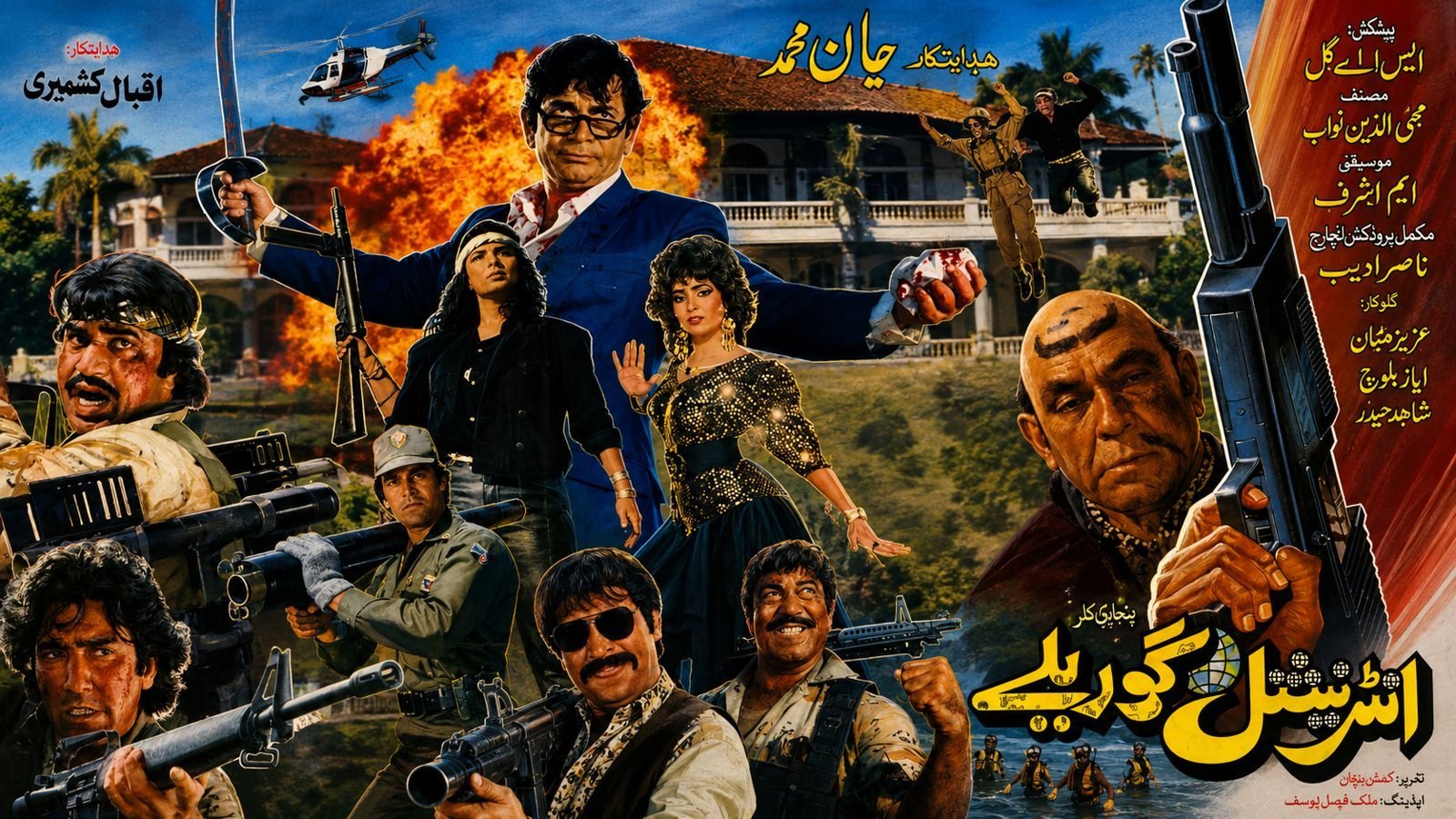
International Gorillay (1990)
Cast: Mustafa Qureshi, Babra, Ghulam Mohiudin, Javed Shaikh, Neeli, Afzal Khan
Director: Jan Mohammad
Synopsis: Sensational epic where dastardly Salman Rushdie sets out to destroy Islam.
Reviewed by: Omar Khan
This epic creation made headlines when the British censors refused to allow it a certificate, thus officially banning the film outright, along with the infamous video nasties. However, a month later, following a letter by Salman Rushdie himself, the ban was lifted, and Gorillay became perhaps the first film from Lollywood to be screened on primetime mainstream British television.
The film is a fabulous concoction and shows the Islamic world tottering on the brink of an abyss. Rushdie is leading the assault on Islam with his Satanic Verses. He is targeting Pakistan (the “fortress” of modern-day Islam) because the rest of the Islamic world will hardly stand a chance once Pakistan is dealt with. Rushdie plans to drive the final nails into the coffin of Islam by opening a new chain of Casinos and Discos, spreading contemptible vice and debauchery.
Mustafa Qureshi, hen-pecked to death by his demented wife, decides to call it a day with his day job at the Police station and induct his unemployed brothers to create a Mujahid (God’s soldiers) trio. Their sole aim is to seek out and destroy the despised Salman Rushdie before he manages to destroy all virtue and decency on the planet.
The trio has a personal axe to grind as Rushdie’s men recently slaughtered their beloved family cherub while he was protesting Satanic Verses.
Mustafa Qureshi is superb as the vengeful elder brother and a leader of the Mujahids. Ghulam Mohiuddin delivers a typically charismatic performance, charged with raw power and brooding machismo (!). Javed Shaikh is at his very best—meaning barely tolerable, but Gulloo shines with his spectacular dialogue delivery.
Neeli provides a little sparkle and delivers her punch lines with oomph and vigour. Salman Rushdie, played with great relish by Afzal Khan, is a man of unsurpassed evil and tortures his hapless victims by forcing them to listen to chapters from his fatwa-inducing book! —a fate worse than death itself.
Babra plays Dolly, Rushdie’s evil moll, who eventually sees the light and embraces the righteous path in a spectacular scene of dazzling special effects that will have Hollywood turning green with envy.
The film is a maniacal high farce and a laugh-a-minute caper as the three Mujahids go undercover to discover the evasive Rushdie. Showing up in Batman outfits on one occasion to outwit their nemesis—very appropriate secret gear, as nobody would find it odd to see three rather portly middle-aged men wandering around in Bat suits!
There are numerous spectacular fight sequences with stunts, explosions, and rocket launching. Neeli and Babra perform atrocious dances to dire sub-disco numbers though Madame Noor Jehan is irresistible when she coos “Oh no” in her inimitable sultry manner.
The film moves along at a rollicking pace and sizzles with sheer intensity and dynamism. The direction is sledgehammer-subtle, as is the norm for Punjabi cinema. The one-liners must be delivered slowly, deliberately, and sometimes repeatedly to avoid missing their point.
It is a quite masterful and brilliantly opportunistic film that expertly manages to fictionalize the entire Salman Rushdie Satanic Rites
International Gorillay issue. Presenting it as a demented pseudo-religious fairy tale—a stroke of rare genius. A historic Lollywood masterwork not to be missed at any cost.
Years later, after the world has witnessed geo-political calamity and polarization and the advent of The Islamic State, it would not be beyond the realms of possibility to claim that International Gorillay, absurd though it seems, avidly encourages Jihad against the kafirs.
However, the film has almost vanished since its rights holders fought the case in Britain to have its ban lifted. The story goes that Famous Video, who owned the rights, lost plenty of money fighting their claim that they managed to have overturned in their favour (thanks to Salman Rushdie) and then refused to renew the film’s release in any format after that. This has only added to the film’s allure. A film that, in retrospect, would make for a fascinating study of the psyche behind popular opinion in Pakistan and elsewhere in the context of perceptions and resulting reactions. The film may appear overtly comical and absurd, but it contains a fascinating subtext that has become increasingly relevant in a Post 9/11 world order.



0 Comments
Leave a Comment