
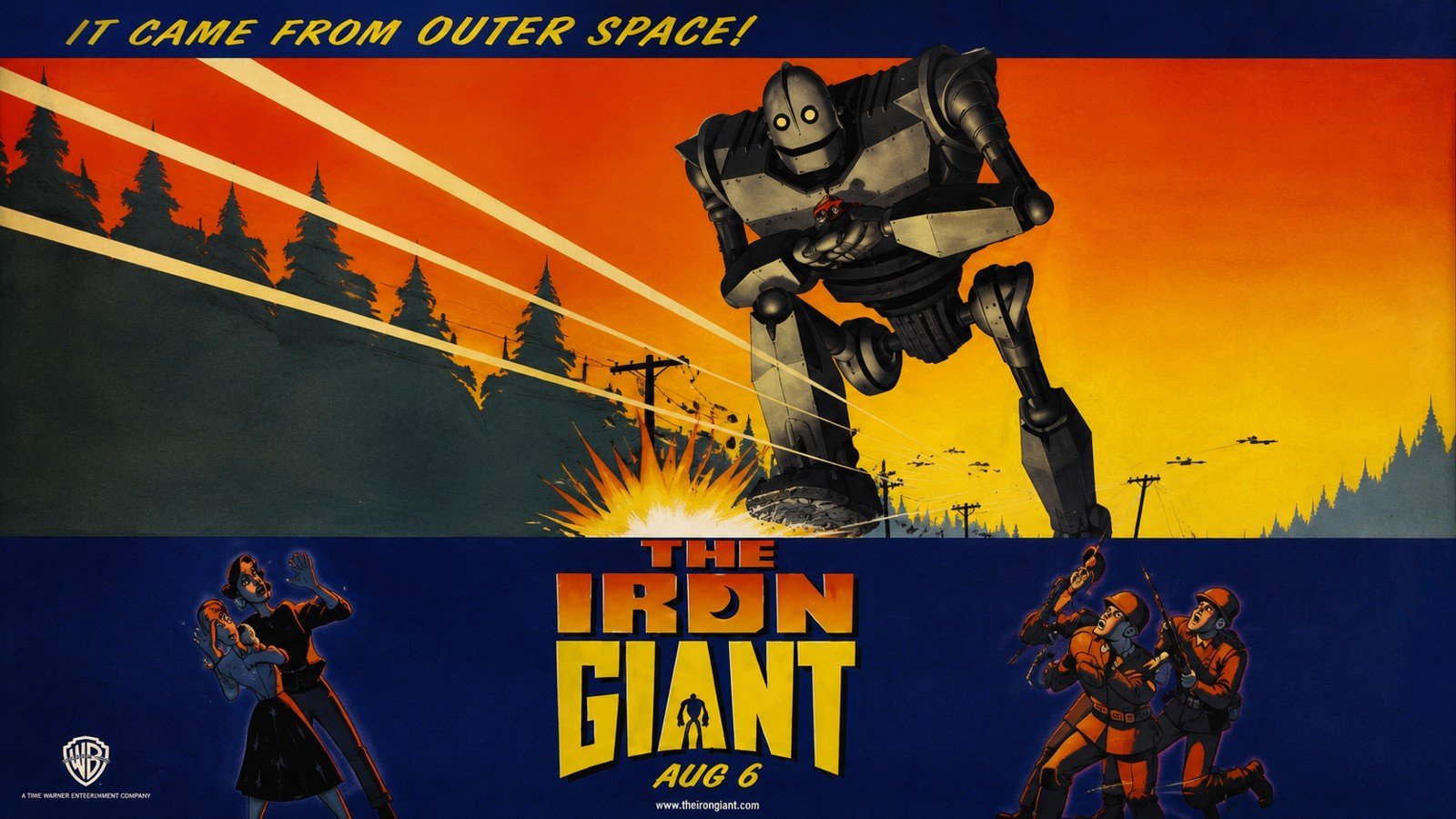
Iron Giant, The (1999)
Starring: Voices of Jennifer Aniston, Harry Connick Jr., Vin Diesel
Director: Brad Bird
Synopsis: Delightful animation with a pacifist message
Reviewed by: Omar Khan
"a delightful surprise... refreshingly pacifist" Empire
"laughs, tears and food for thought" Total Film
"a modern classic... will enthral children without making their parents gag" Film Review
It is 1957, the height of the Cold War, an era riddled with hatred, suspicion and political doublespeak. The Soviet Union has successfully launched Sputnik, shattering America's smug sense of technological superiority and triggering a wave of mass hysteria across the United States. Suddenly, the Communist menace no longer seems a distant threat but one capable of reaching American shores. The result is an all-consuming paranoia.
The Korean War, the Berlin Crisis, the Vietnam conflict and, later, the Cuban Missile Crisis were just some of the flashpoints that kept the world teetering on the brink of nuclear holocaust throughout the Cold War years.
It is against this backdrop that The Iron Giant unfolds. Warner Bros. deserves considerable credit for daring to venture into the animated feature market, a domain which Disney had monopolised for what seemed like an eternity. Sadly, The Iron Giant proved a disastrous failure at the box office, playing to largely empty theatres before disappearing after only a few short weeks. It is, however, a film that richly deserves a far wider audience and now hopes to find that audience through video and DVD.
The story bears more than a passing resemblance to Spielberg's E.T. The Iron Giant is the benign visitor from outer space—or, if you prefer, a metaphorical stand-in for Communist Russia—which crash-lands in the American heartland. Although capable of immense destructive power, the Giant is programmed to unleash that power only when threatened.
The Giant wanders through the forests of Maine, happily devouring anything metallic that catches his eye. While attempting to feast upon some particularly appetising electrical cables, he is badly electrocuted and rescued by a lonely nine-year-old boy who, like so many children in family films, desperately needs a friend. Naturally, the two develop an affectionate bond and, in true Lassie fashion, the Giant faithfully follows the boy home.
The real problem, of course, is concealing a one-hundred-foot metal giant from the boy's mother, not to mention the suspicious government agent who becomes convinced that an alien visitor—read Soviet invader—has landed on American soil and is determined to destroy it before it can pose a threat.
The animation, created in a realistic style with more than a hint of Japanese influence, is quite simply magnificent. The rich colours and striking imagery are an absolute delight and provide a refreshing alternative to the increasingly CGI-dominated visuals of films such as Antz and A Bug's Life, both released the previous year.
Even more impressive is the characterisation. The personalities are considerably more complex than one normally expects from an animated feature and, thankfully, there are no irritatingly cute woodland creatures or endless sing-along musical numbers in the Disney mould. This belongs very much to the more grounded school of animation, and the result is all the more refreshing for it.
It is perhaps a rather sad reflection on modern audiences that many younger viewers appeared to respond most enthusiastically to the scenes in which the Giant transforms into his fearsome war-machine mode and unleashes his devastating arsenal. Ironically, the film's strongest pacifist message seems almost to have backfired, with audiences finding the violence far more exciting than the plea for peace. It is, perhaps, a rather depressing sign of the times.
The film is well worth seeking out and can be enjoyed by viewers of all ages, although its themes are likely to resonate far more strongly with adults than with younger children. It is thoroughly entertaining, beautifully animated and mercifully free from the cloying sentimentality, talking animals and sugary songs that have become almost obligatory in so many animated films. More importantly, it actually has something worthwhile to say, even if its idealistic view of human nature is rather more optimistic than reality would suggest.
Perhaps, too, the film's distinctly pacifist and vaguely left-leaning outlook struck an uncomfortable chord with American audiences still basking in what many regarded as their victory in the Cold War. The prevailing mood of self-righteous triumph—the familiar "we told you so" mentality—may well have made The Iron Giant a more difficult film for audiences to embrace than its makers had anticipated.
Directed by Brad Bird, one of the creative forces behind the enormously successful television series The Simpsons, The Iron Giant stands as one of the finest animated features of its era and remains one of the most undeserved box-office casualties of the modern age.

0 Comments
Leave a Comment