
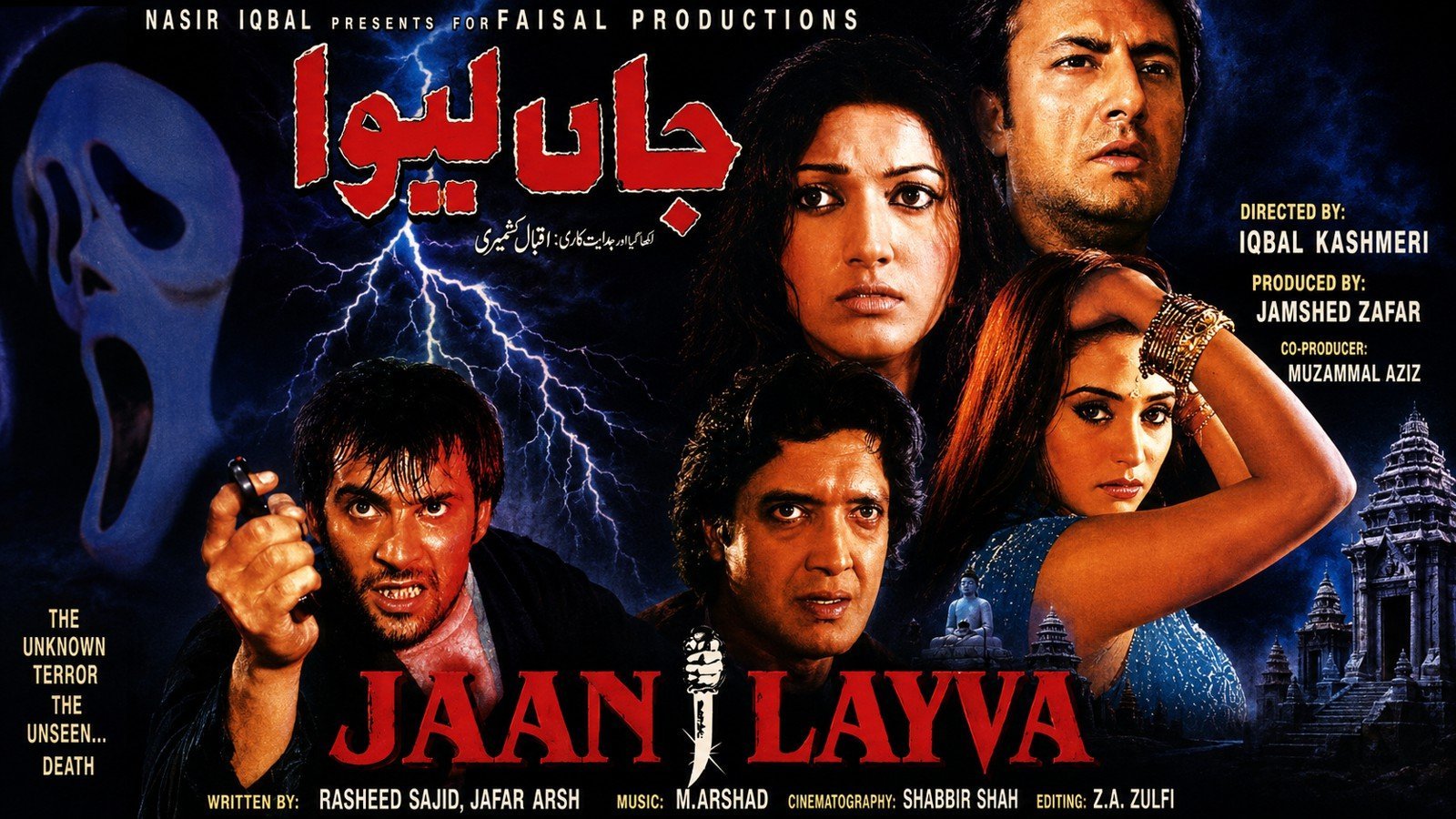
Jaan Layva (2004)
Cast: Moammar Rana, Sana, Babar Ali
Director: Iqbal Kashmiri
Synopsis: Serial Killer with a Ghost Face mask on the rampage in the backdrop of some severe Oedipus complex, with the only salvation being a one-way ticket to Pakistan, the land of bliss.
Reviewed by: Omar Khan
Years after the whole Scream thing died out, here in Pakistan, some canny producers decided to flog a horse that had already been dead and buried, as trends often take a little time to drift this way from the West. The Scream mask and figure feature prominently on the movie’s posters, promising a terrifying experience unlike you have ever witnessed before: “The unknown terror, the unseen…death” is the tagline on the poster. With many worried faces suggesting a slasher film on the lines of Scream and I Know What You Did Last Summer kind—unique for Lollywood.
Jaan Layva stars Moammar Rana, Sana and Babar Ali, and is partially shot in Nepal, which is crucial to the storyline and the events as they unfurl before the viewer. The action begins in Pakistan, where a hugely successful and wealthy businessman, not unlike Donald Trump, has his hands in pies across the globe. When not busy counting his zillions, he is also a doting father who sings joyous songs to his daughter about the wonders and benefits of a Father-Daughter relationship. Passionately, they sing to each other regularly the “Oh Daddy” song that bonds them perfectly.
Daddy is planning his annual trip to Nepal, and it turns out that he has been harbouring a secret from his beloved daughter Sana for all these years. The dark secret of having another wife stashed away in Nepal. He also reveals that Sana has a half-Nepali sister, which propels her into heights of delirium, and as she gushes love for her unseen sister, she cannot but celebrate by bursting into the “Oh Daddy” song. A touching phone call to the sister in Nepal ends with both professing undying love for each other and a yearning to be together.
Daddy flies off to Nepal, where he is dismayed that his Nepali wife, Jenny, is not the dutiful goodie two shoes that so many Pakistani wives are. Despite being in her 40s, Jenny loves the nightlife and the “raaton ki aazadi,” which translates to the “Freedom of the night,” which again translates to imply a “sex life.”
Days later, Daddy decides he has had enough of his Nepali wife and her errant ways and warns her that if she doesn’t reform, he will leave Nepal for good and take his daughter back to Pakistan with him. He informs her of an impending divorce and his relocation from Nepal. These intentions trigger a wave of insecurity among his workers who hoped to make it big, riding on the crest of success. Then, quite out of the blue, a dark, shadowy figure appears wearing a “Ghost face” Scream mask and proceeds to stab Daddy to shreds and then attacks and kills the resident servant girl.
Meanwhile, the Nepali daughter of Daddy frolics around the parks of Nepal, flirting with her father’s company manager while also professing love for another by the name of Prince (No, not the Legendary Prince). There follows a tussle between Sana and her stepmother as Sana insists on taking her sister back to Pakistan, and the mother is adamant that she remains in Nepal. Of course, the underlying reason is the inheritance she is due, making her flavour of the season with the scheming mother and various suitors, any one of whom could perhaps be the masked killer or the Jaan Layva.
Jaan Layva Ghost face makes a second appearance when he attacks Sana, but her boyfriend saves her. The movie then heads for a thrilling climax. Eventually, the killer’s face is revealed, but by then, the audience is lost in tedium and least concerned about the killer’s motives. The shock twist is anything but a shock, and the climax is anything but climactic. Jaan Layva may have started as a horror film but ends up as just another mess of confusing patriotism and dubious morality where “Pakistan” is spoken of as heaven on earth where everyone lives blissfully without worry or care in the world.
Conversely, Nepal is a den of evil and low morals where middleaged married women spend their nights flaunting themselves at the local dance and drink club. No sense of “proper spirituality” exists because they don’t follow righteous faith! Then there is the whole “O Daddy” scenario, a case of a malicious Oedipus relationship that turned a little weird. The song reappears during the movie no less than five times, including the climactic life-changing showdown of a climax. The direction is sloppy and lazy, while the acting is ridiculously overwrought, with only the evil debauched Nepali wife making any impression. Jaan Layva, in conclusion, can only be recommended to insomniacs.

0 Comments
Leave a Comment