
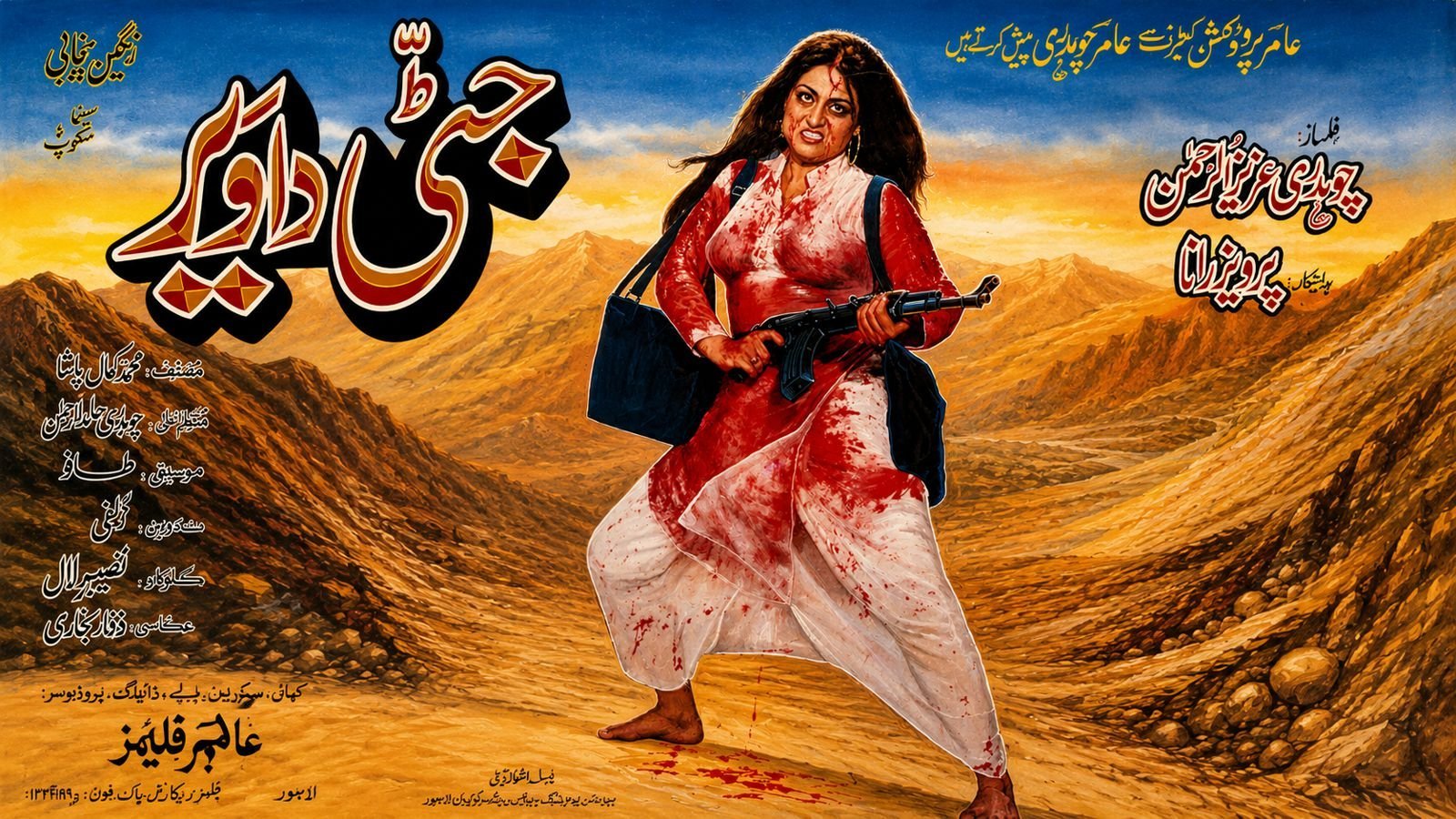
Jatti Da Vair (2000)
Cast: Anjuman, Saud, Sana, Arbaz Khan, Khushboo, Deedar
Director: Parvez Rana
Synopsis: A loud, moronic, violent, misogynistic tale of bloody revenge and righteousness.
Reviewed by: Omar Khan
I remember being entranced by the billboard artwork for Parvez Rana’s Anjuman vehicle Jatti Da Vair in the sticky summer of 2000. The Billboard, outside, featured a 75-foot Anj drenched in blood, wielding a mean-looking AK 47, and the filthiest of looks, as well as a handbag because you never know when a girl might take a time out for a bit of shopping—hanging around the lobby of the Naaz cinema in Rawalpindi, pretending to take pictures of the lobby cards and posters, avidly loitering, hoping to catch an eyeful of the pyrotechnics on screen.
Jatti da Vair struggled at the Box Office (despite a good run at the above-mentioned Naaz), causing losses to all concerned with the film. After the deliciously warped chunk of feminism that director Rana unleashed earlier in the year in the shape of Jug Mahi, one was drooling in anticipation of more maniacal happenings with the majestic Anjuman at the helm. Alas, Jatti da Vair was so run of the mill that even Anjuman’s die-hard fans stayed away, forcing her to reconsider her proposed comeback.
The film’s story is the same old turgid nonsense about village rivalries and demented machismo. Jatti suffers on several counts; firstly, there are far too many plot threads to disentangle. Secondly, there is far too much padding in the form of endless stretches of “comic relief”; thirdly, the film looks like a very dated, faded piece of celluloid crap from the early ‘80s—though perhaps that’s being too polite! The twist is that Anjuman plays the strongman character that used to be reserved for Sultan Rahi throughout the ‘80s—but it just doesn’t work.
After her excellent performance in Jug Mahi, Anjuman goes way over the top this time. Her dialogue delivery, which is supposed to pack a mighty punch, has the audience giggling in embarrassment.
Sadly, in this film, far more so than in Jug Mahi, it appears that age has genuinely caught up with Anj, in a sense that not only are the wrinkles showing through, but she has also seriously bulked up,and the layers of fat oozing from all the wrong places.
Meanwhile, young Sana shows why she is being tipped to take over from the sagging Saima in years to come. She has everything that Lollywood requires—she may be unable to act to save her life, but that is of little concern. Sana features in a couple of saucy numbers and displays her mastery of the super-cheap, Lollywood bum-wriggling twostep. Sana is paired with Moammar Rana in this film. Though she has been given the sleazy numbers to perform, Rana has nothing to do but pretend to be fascinated by Sana’s pelvic gyrations and heaving bosom.
The songs are perhaps the most substantial aspect of an otherwise lame effort. The film doesn’t have a cohesive plot, and characters seem to drift in and out of proceedings. Saud has a crush on Anjuman
Jatti Da Vair but doesn’t have much to do in the film, until he returns for one of the most hysterical court scenes ever to be filmed. He also looks young enough to be Anjuman’s son, and you get why the Lahoris shouted down last year’s Peengan, in which the two were paired romantically.
Arbaz Khan has a short role with little to do. Nobody has much to do besides the girls who have been given plenty of cheap numbers to perform (Sana, Deedar and Khushboo doing the honours) and Anjuman, who turns in undoubtedly one of the ugliest performances of her career.
There is quite an appalling and reprehensible scene in Jatti da Vair, making it an unacceptable film, even for a bit of a laugh.
There is a scene when a young bride is forced to marry Arbaz Khan (Jatti Anjuman’s brother), and she runs away with the man she has always loved on the night of her wedding. When the two are fleeing, they are met by a demented Jatti, who shows them precisely the honourable” thing to do to a woman who chooses to take her destiny into her hands. The fleeing girl and her beau are lacerated and bludgeoned to death by the “ghairatmand” Jatti—an act which the audiences are supposed to clap and cheer at for being heroic and representing a culture that preaches tolerance and compassion. It is a despicable scene, sickening to the pit of the stomach—and so disappointing that a person of the stature of Anjuman could ever have accepted such a piece of misogynistic garbage.
So, the lesson at the end of the day is never to judge a movie by its Billboard art, for even the finest artwork can lead to an utterly repellent stinker within! The film’s catchphrase sums it up nicely; “Jatti da Vair, Allah Khair, Allah Khair“! (Heaven Help Jatti da Vair).
0 Comments
Leave a Comment