
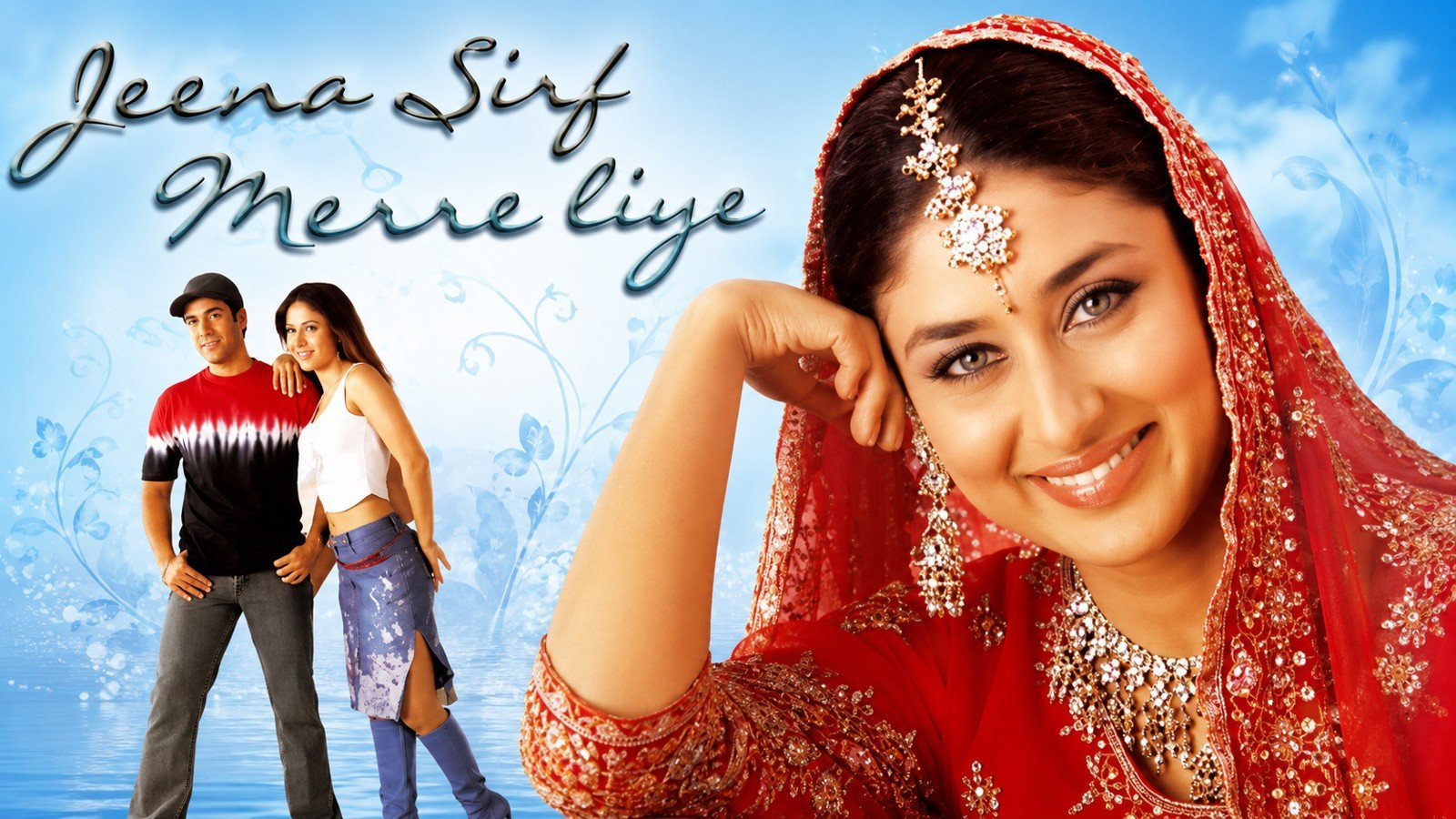
Jeena Sirf Mere Liye (2002)
Cast: Tusshar, Kareena Kapoor, Malaika
Director: Talat Jani
Music Director: Nadeem Shravan
Synopsis: a sequel cum retread of last year's putrid but successful formula
Reviewed by: Faiz Khan
Jeena Sirf Merre Liye is simply a bad film. Reuniting the lead pair from Mujhe Kucch Kehna Hai, a film I found utterly ordinary, this one desperately tries to recreate the same "magic" that apparently worked the first time around—and falls spectacularly flat on its face.
Karan and Pinky are little children, barely eight and ten years old, who are supposedly hopelessly in love. They solemnly vow that they will "jeena sirf mere liye."
Naturally, Pinky happens to be the stinkingly rich daughter of Vijayendra Ghatge, who strongly disapproves of his daughter's friendship with this poor orphan. After administering the obligatory slap, Father bundles Pinky away from Ooty, not to return for another twelve years.
Meanwhile, Mr Malhotra (Kader Khan) arrives at the temple where young Karan works. Learning that the boy is an orphan, he promptly adopts him and takes him back to Mumbai.
Twelve years later, Karan (Tusshar Kapoor) is working for his adoptive father, while Pinky—now rechristened Pooja—is studying at Oxford, apparently spending much of her time promoting Indian culture to delighted expatriates.
If you haven't succumbed to the corniness and absurd plot by now, don't worry.
Your time will come.
Pooja returns to India determined to find her childhood sweetheart. Naturally, she misses him by a whisker; we cut to a song, and before you know it we're back in Mumbai.
Meanwhile, Karan appears to have acquired a girlfriend in the form of the thoroughly irritating newcomer Malaika, who seems to possess an extraordinary fondness for dressing down at every conceivable opportunity, particularly before climbing into auto-rickshaws.
Pooja publishes the story of her childhood romance in a newspaper. Everybody in India appears to read it—
Everybody except Karan.
Naturally.
Eventually, Pooja realises that Karan is indeed the man she has been searching for, only for the tartish Malaika to inform her that Karan is her "bwai-frant."
Fortunately, that misunderstanding doesn't last long, and the truth emerges—that Karan has spent years pining for his first love.
Instead of ending matters there, Pooja decides to prolong proceedings by concealing her true identity from him.
By now, however, Malaika reveals to Karan that Pooja is in fact Pinky, whereupon his heart leaps with joy...
...only for thunder and lightning to strike because dear old Dad still refuses to approve of the match.
Karan therefore strikes a noble bargain with Pooja's father, agreeing to sacrifice his own happiness in exchange for permission for his sister's marriage to go ahead.
The sacrificial hero approaches Pooja, tells her he loves her—which naturally fills her heart with joy—
—and then spoils everything by adding that he has loved her only since meeting her recently at a party.
Oops.
Pooja sees red.
The lovers separate once again.
This weary drudgery continues until the mercifully half-baked conclusion. Thank heavens it is only half-baked because another half-hour of this film would have had audiences pulling out their fingernails—and that might actually have proved the more entertaining experience.
Talat Jani makes a complete mockery of this loose remake of Anmol Ghadi. What could easily have become a pleasant contemporary romance instead turns into one long, shapeless mess. Songs bounce in and out for no apparent reason, slowing the proceedings even further.
The film also suffers from a huge hangover from Mujhe Kucch Kehna Hai. Tusshar's introductory song here is "Pyaar Maange," remarkably similar in conception to "Pyaar De" from the earlier film. Another "dupatta" number reappears, while one of the romantic duets is staged in a manner uncannily reminiscent of "Maine Koi Jaadu Nahin Kiya."
There is no genuine romance to speak of. Everything feels laboured, mechanical and strangely lifeless.
Nor are there any surprises whatsoever.
Tusshar Kapoor makes virtually no impression. Kareena Kapoor delivers much the same performance she seems to give in every film these days.
Are we perhaps beginning to suffer from an overdose of Ms Kapoor?
Newcomer Malaika remains an irritation throughout.
Nadeem-Shravan's score must rank among their weakest in a very long time.
Released during Ramzan as supposedly enjoyable festive entertainment, I would honestly recommend staying at home and having a good snooze instead.
It would be a far better use of your time than venturing out to watch this drivel.

0 Comments
Leave a Comment