
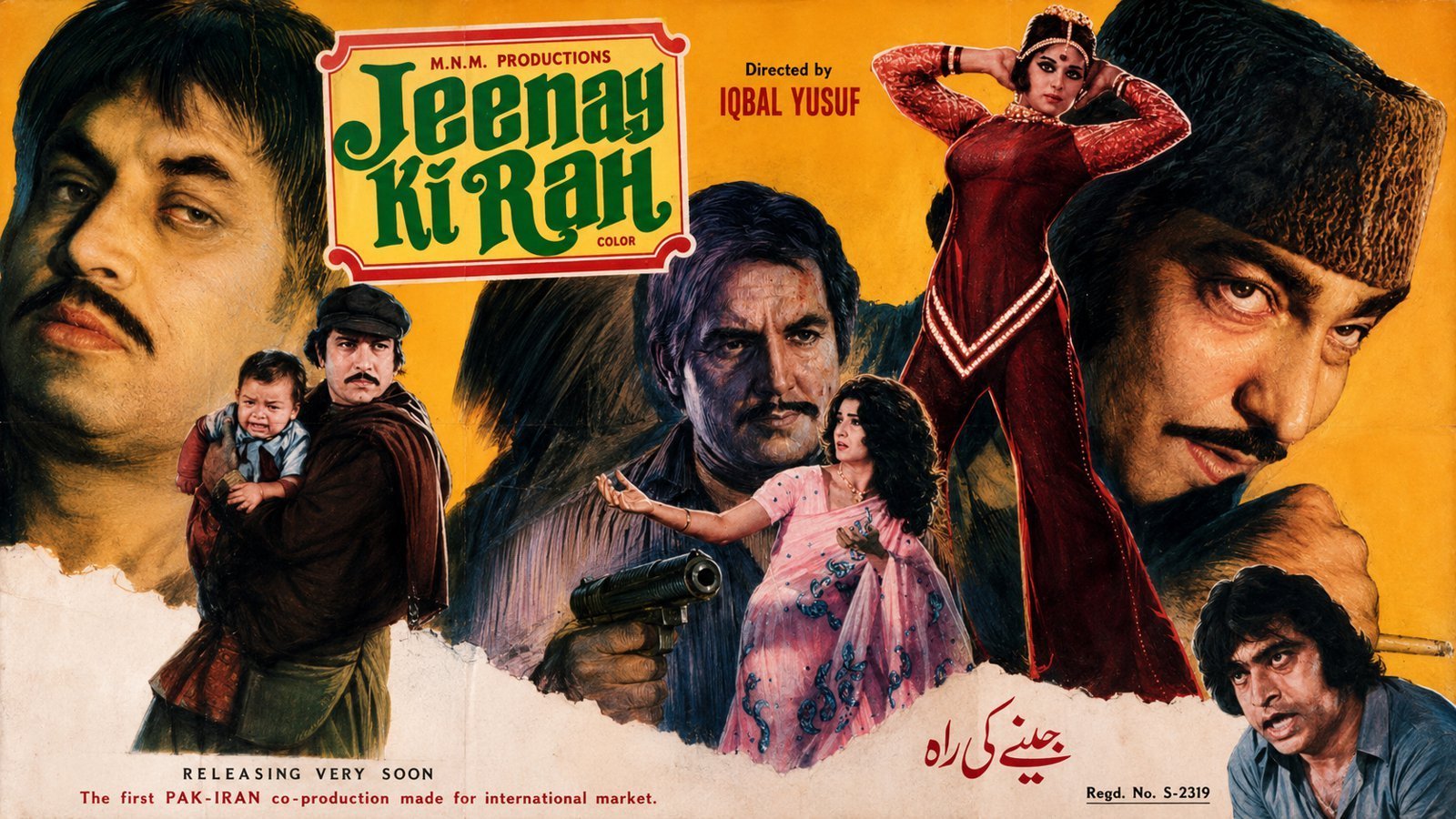
Jeenay Ki Rah (1977)
Cast: Sudhir, Mohammad Ali, Mumtaz, Ghulam Mohiuddin, Aasiya, Salma Mehmboob, Mustafa Qureshi, Seema, Lehri
Director: Iqbal Yusuf
Synopsis: The director goes for a similar theme using several of the same stars as his super hit Andaata, but the tepid box office results are far from what he intended.
Reviewed by: Omar Khan
In 1976, just before the military coup, Iqbal Yusuf directed a box of-fice smash named Andaata. Like Bollywood’s Dharmatma, the film was an adaptation of The Godfather. Iqbal Yusuf was much in demand to strike gold once again, and 1977’s Jeenay Ki Rah brought together ingredients of Andaata to attempt another Box Office smash.
The first half-hour of Jeenay ki Rah has Mohammad Ali careering around his locality as the good-hearted thug “dada”. He is an artful dodger with a good heart, even if his methods are occasionally questionable. He is amiable, but if a shopkeeper overcharges or a landlord is unreasonable, he sorts things out the way he has learned from the harsh streets. Meanwhile, his best mate is the simpleton Sudhir who is laid off from his menial job and is at a loss about providing for his mother (Salma Mehboob) and his pretty young sister, played by Aasia.
Mohammad Ali learns about his friends’ predicament. He coaxes him to a lavish do at a wealthy business tycoon’s den of vice where alcohol flows freely and women like the sultry Mumtaz dance up a storm to songs like Tararampa Tararampa.
Mohammad Ali wins a considerable amount of gambling at cards, which he hands to an inebriated Sudhir to take home. When Sudhir arrives home sozzled, he informs his mother that the moral upbringing she taught him is out of touch with today’s reality. “To survive and thrive in the modern world, you must go down a new Jeenay ki Rah.” Otherwise, you are doomed to failure.
A furious Najma Mehboob stomps off to Mohammad Ali’s home to complain about her son being corrupted and becoming a thug. A stung and sobered Mohammad Ali is enormously apologetic and promises he will never again lead his friend astray and abide by her lofty standards. Indeed, he is so shaken that he decides to hang up his ghunda tax, wind up and head out of town. With golden-hearted ghunda out of the way, the greedy landlords and profiteers start a wave of extortion. Poor Raja (Sudhir) and his family are threatened with eviction, and with Badshah (Mohammad Ali) out of the picture, things start looking very grim for the exploited underclass.
Raja pleads with his landlords to wait for their rent for a few days, but they are uncompromising and insist on throwing out their tenants by force. An Enraged Raja takes matters into his own hands, bludgeons the landlord fatally, and is dragged to prison. While in prison, a good deed to a fellow inmate wins him the chance to escape and take over the lucrative shady business run by the man they call Boss. Boss conveniently keels over, and Raja steps in as the new Boss, eliminating a couple attempting to seize control.
Later, Raja, disguised cleverly in a white suit and sporting a stickon beard, returns to his old home with memories of his mother and sister. He finds the brother of the greedy landlord he had murdered and asks where his mother and sister are. He is told they were humiliated and flung onto the streets, but not before he enjoyed himself
Jeenay Ki Rah with the daughter. Rage gets the better of Raja again, and his fancy white stick suddenly extends to fire a lethal bullet, killing the landlord.
As Raja rises from an honest simpleton into a kingpin Boss of the city, Badshah (Mohammad Ali) has also turned full circle and given up all his thuggery for a career as a secret officer of the police. Jeenay Ki Rah is a film about people’s circumstances and choices to survive in an ugly, unfair world.
One night, Raja is out for a hit job, but when he discovers the target is his old friend, they stop and greet each other amicably but ruefully inform each other that their paths have changed, and conflict is inevitable.
Raja decides to relocate hastily with his girlfriend Mumtaz, who he reckons will be a perfect fit as the leading dancer of his Club. A Sleazy hanger-on, Mumtaz’s brother Mustafa Qureshi also tags along.
Old friends Badshah and Raja are foes now, but the audience knows they are both good, decent men, though they are on conflicting “Rah’s”. The malice will take shape in Mustafa Qureshi, whose influence increasingly shapes the film’s second half.
Meanwhile, Badshah bumps into Raja’s sister Aasia begging in the city and follows her and meets Raja’s dying mother. She has Badshah promise to support Aasia if she passes away. Seconds later, she drops stone-cold dead.
At Raja’s Club, Mustafa Qureshi has taken to keeping the punters happy, taking care of all their needs at a price. Sensing his growing fortune, he turns arrogant in his tone with brother-in-law Raja.
Two weddings coincide. Raja and Mumtaz get hitched while Anwar and Aasia also tie the knot, producing babies in record time. Mumtaz has a daughter, who Mustafa Qureshi views as his inheritance, while Aasia has a son.
Mumtaz meets tragedy as Qureshi attempts to abduct her baby daughter. Once again, Inspector Anwar is made to promise to look after the baby if her mother dies, and seconds later, Mumtaz passes away. So, Mohammad Ali takes his friend Raja’s daughter home as he promised Mumtaz.
Aasia adopts the little girl as her own, but soon Mustafa Qureshi arrives and makes off with a baby, but by mistake, he abducts the boy and not the girl he wants to turn into a money spinner at the Club.
Raja’s path leads to Anwar’s home, where he finds his sister, and finally, the two friends, despite their differences, find the same “Jeenay ki Rah” even if Raja must pay for his crimes. Now it remains to be seen how the drama will resolve itself.
Aasia is a broken woman after her son’s abduction, and the guilt of his criminal life torments Raja. When the abducted boy is sick one day, Mustafa Qureshi’s wife Seema takes the child away to the hospital and then, in a fit of hysteria, takes him into Aasia’s house and returns him to his biological mother. Qureshi is desperately annoyed that he has stolen the wrong child but still has a plan. The Questions now that need answering are the following: Will Qureshi’s plans of blackmail and extortion be thwarted? Will Raja have to die or face going to jail? Will both friends be reunited as they once were? Will the young Mumtaz and Ghulam Mohiuddin (Aasia’s son) junior marry each other? Anything is possible at this stage.
Things get increasingly messy before getting resolved in the last third of the movie as Ghulam Mohiuddin plays the role of Aasia’s son, keeping her from going insane. He turns to blackmail, demanding increasing cash to keep the façade of being Aasia’s son. But does Ghulam Mohiuddin know who his biological parents really are?
Jeenay Ki Rah All is revealed in time; which child belongs to whom and the fate of the doomed friendship between Badshah and Raja, which must revive to thwart Qureshi’s evil plans. Jeenay Ki Rah has all the ingredients of a typical melodrama with shades of Bollywood’s Deewar thrown in for extra dramatic impact. There is a mix of joy and tragedy, but at least the lost baby issues are smoothly sorted out as the film reaches its intriguing if somewhat expected, climax.
Though the film manages to hold together reasonably well, and the performances are adequate, it didn’t click with the ‘fickle’ masses. Jeenay Ki Rah bombed at the box office, running just three weeks in Karachi and not faring much better elsewhere. To its credit, the film didn’t need extensive use of the Fast Forward button and managed to keep the audience engrossed, if barely. Yet, it didn’t pull any surprises and failed to recapture the magic of Andaata.



0 Comments
Leave a Comment