
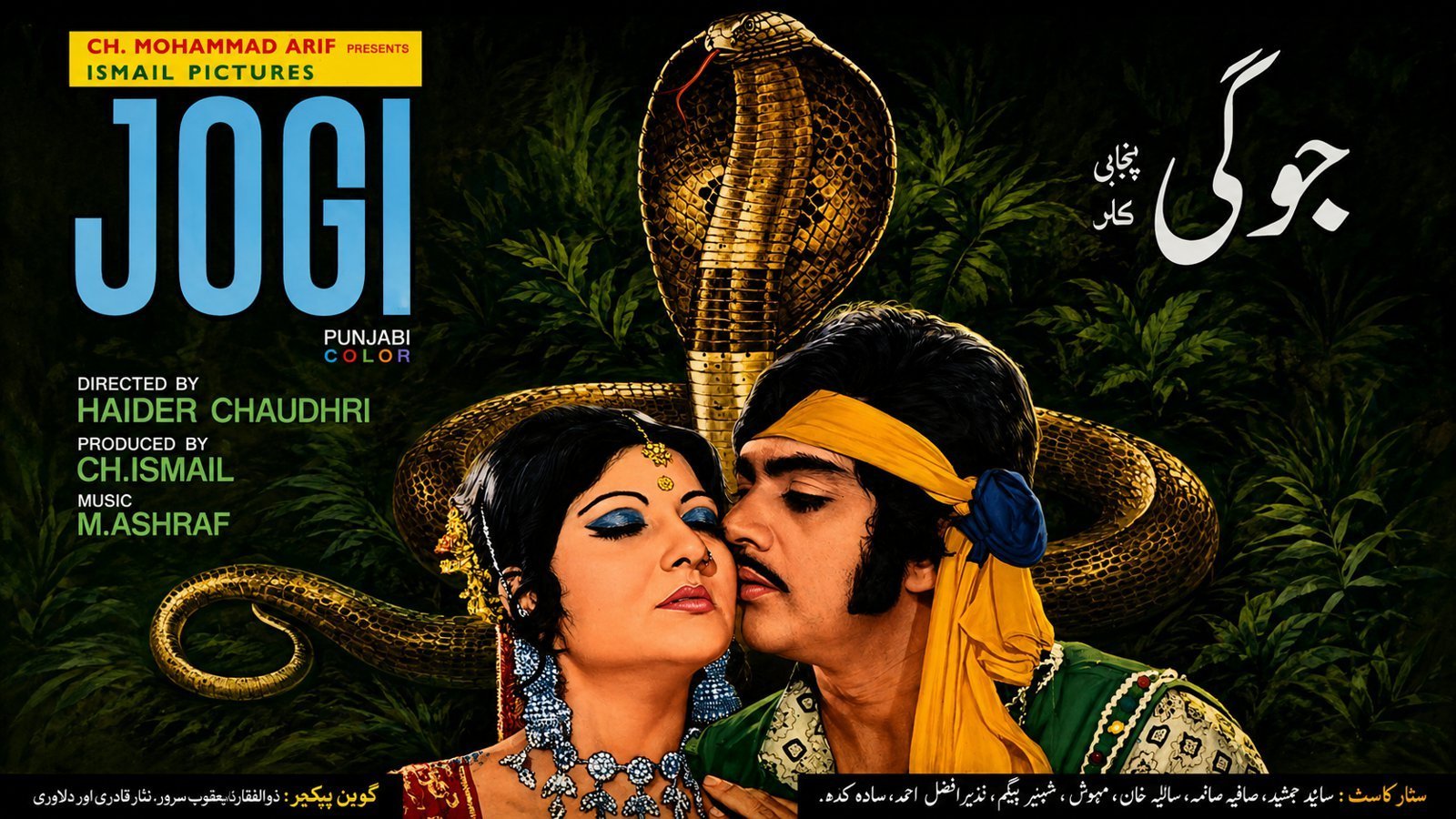
Jogi (1975)
Cast: Waheed Murad, Aasia, Bahar, Afzal Ahmad, Munawar Saeed, Saiqa, Ishrat Chaudhary, Nazli, Saqi
Director: Haider Chaudhary
Synopsis: Fangled tale of Snake folklore with much melodrama embellished with numerous scintillating dance numbers.
Reviewed by: Omar Khan
Jogi was a runaway box office smash upon release on the 2nd of April, 1975. Aasia was paired with Waheed Murad, who was experiencing a severe downswing in his fortunes as a leading actor in Urdu cinema, and made another foray into Punjabi movies, often considered a step down for an “A” List star such as Murad.
However, he had already scored a massive hit with Mastana Mahi at the height of his popularity, so there appeared to be no reason why he shouldn’t have another dabble. Aasia was reigning supreme in Punjabi films in 1975 as the previous guard of Firdous, Naghma, Neelo, and Aalia began to fade.
The film has a convoluted story based on local snake folklore, a South Asian genre that has survived the test of time. Afzal Ahmad plays an evil, power-lusting Jogi (Snake-man), who kidnaps rich town Chaudrani’s little boy and presents it to his wife to look after.
He has seen the child has a birthmark which will one day provide him with a gateway to the riches and the power he craves. The Jogi teaches his son all the tricks of the trade, and soon, the young man is mesmerizing all with the sounds of his “been”.
Bahar is left bereft at losing her son and has her niece, Aasia, live with her for company. One day, the young Jogi visits the locality, and both mother and daughter are utterly charmed by his handsome looks and extraordinary talent. Complications soon arise as the neighbouring Snake Princess demands to marry the Junior Jogi, whose father rejects her offers repeatedly, causing her a tremendous loss of pride.
Soon the evil Senior Jogi hatches a plan to grab all the wealth and land of the Chaudrani by promising to reunite her with her son. The Chaudrani is mortified when a sleazy, lecherous Munawar Saeed is introduced to her as her long-lost son, and she recoils in horror. Still, when shown the birthmark, she has no choice but to accept him with the gushing love of a typical Lollywood mother.
The fake son, Munawar Saeed, soon shows his true colours and attempts to rape some local girl, after which his attention turns to his “cousin” Aasia. The Chaudrani, previously loved and respected by her subjects, is now under pressure to provide justice, knowing that the perpetrator of the crimes against the local people is her son.
Will poor Bahar be taken for the ride of her life and relieved of all her power, respect, land and money, or will Waheed Murad come to find that he is not the son of the Jogi but the future and rightful Chaudhary in waiting of the charming locality? Will the feisty Aasia be united with the man of her dreams, or will Saiqa, the local queen, plot, scheme, and dance her way into Waheed Murad’s heart?
The film is the usual nonsensical, fairytale hodge-podge that most snake-oriented movies tend to be. Still, it is deftly interspersed with some majestic and sultry crowd-pleasing numbers, belted out by The Melody Queen, Madame Noor Jehan.
There is an Ishrat Chaudhary dance number within the first three minutes of the film’s start, and the rest of the film’s running time is peppered with frequent saucy dance numbers, which propelled the movie to significant success. Otherwise, it has very little to offer of interest.
Jogi
Bahar turns in her usual “Malka e Jazbat” performance, and Aasia is her usual efficient self. Waheed looks like a sore thumb in his Punjabi persona, and his delivery style is that of somebody who doesn’t speak the language. Afzal Ahmad huffs and puffs and gets stuck into his ridiculous wig and his role with equal gusto, while Munawar Zareef and Nanna provide some chuckles.
The show’s star is Madame Noor Jehan, and the dance numbers litter this otherwise utterly drab and moronic film. Kothe Utte Sutti Saan was a considerable smash picturized on Nazli, while the number Ja Aj to main teri had the public swooning.
Madame Noor Jehan had to concentrate mainly on sexy Punjabi songs as the new wave of Urdu film heroines didn’t match her mature voice. Actresses like Babra Sharif were often paired with the voice of newcomer Nahid Akhtar. M. Ashraf was the most in-demand music director on the Urdu scene, and he had reportedly fallen out with Madame Noor Jehan and started a boycott of her in the films he composed for.
Madame Ji put all her considerable efforts into the Punjabi scene and scored many a sultry, saucy hit during the ‘70s, after which came the Disco horrors of the ‘80s and ‘90s.
The film also contains a notorious little interlude where Munawar Saeed is taken to see a saucy young thing. She bounced on the bed semi-naked, giving the public a comprehensive look at her assets in full swing, while the camera swooped in and out in a typically gratuitous style. The scene ends with Saeed humping her on the bed, fully clothed. In this film, the two other elements that can be seen to drive the film’s considerable success are the songs sung by Noor Jehan, and the fetching dances accompanying them.
Another element that cannot be overlooked is that in a society where a large swathe of the movie-going public is deprived of an education, a fangled and utterly loopy snake melodrama can go a long way.



0 Comments
Leave a Comment