
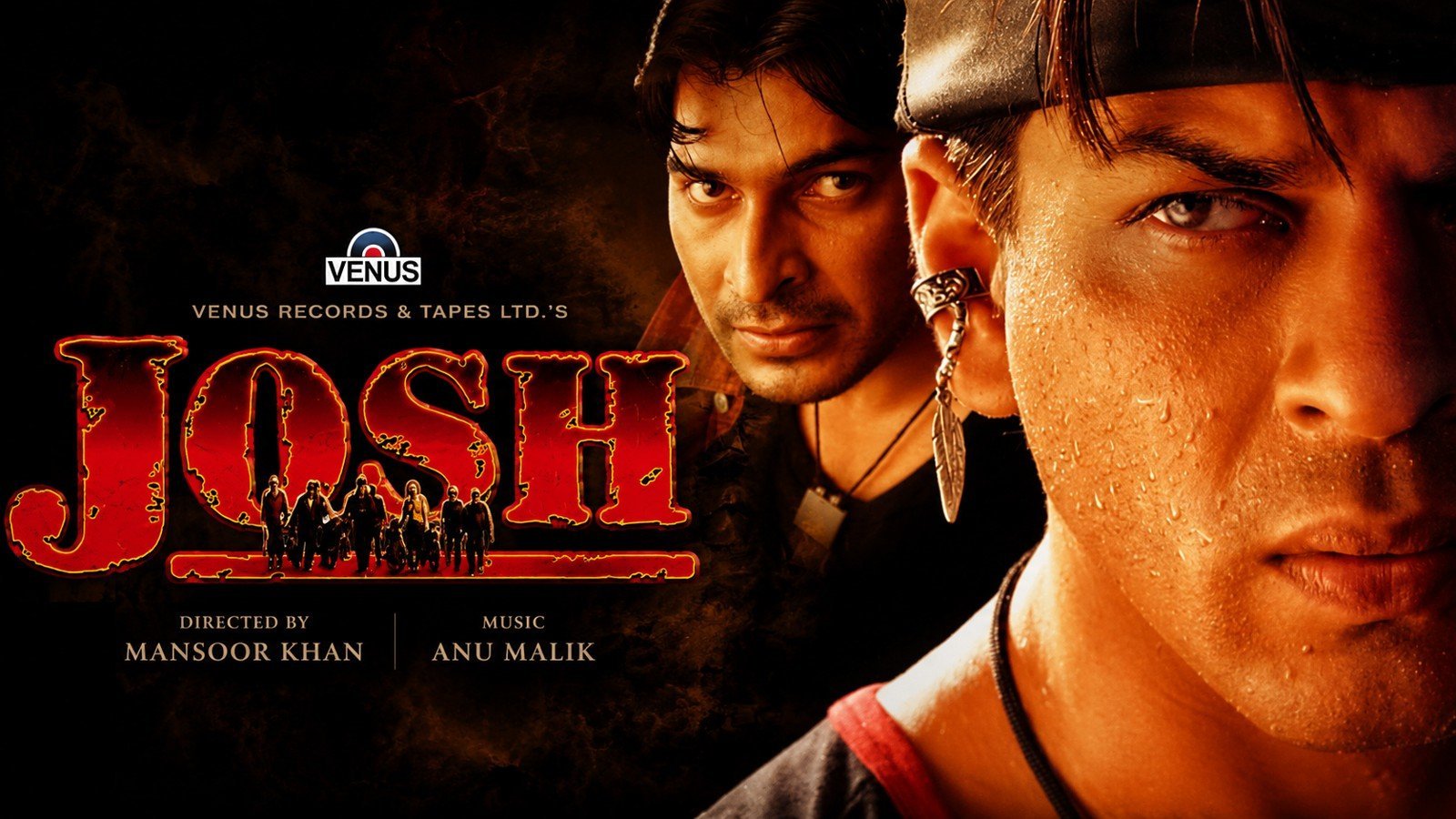
Josh (2000)
Starring: Shahrukh Khan, Aishwarya Rai, Chandrachur Singh, Sharad Kapoor
Director: Mansoor Khan
Synopsis: Yet another West Side Story rehash fails to live up to expectations, alas.
Reviewed by: Faiz Khan
Three years in the making, Josh draws obvious inspiration from West Side Story, transplanting the tale of rival gangs to the coastal town of Vasco in Goa.
Max (Shah Rukh Khan) and his twin sister Shirley (Aishwarya Rai) belong to the Eagles, one of two local gangs locked in a seemingly endless feud. Their rivals, the Bichhoos, are led by Prakash (Sharad Kapoor). Quite what the two gangs are actually fighting over is never made entirely clear. There appears to be no territorial dispute or long-standing grievance of any substance, leaving one to conclude that mutual dislike is reason enough.
The situation becomes more interesting when Rahul (Chandrachur Singh), Prakash's brother, returns from Bombay and falls in love with Shirley. Although she initially dismisses his advances, romance soon blossoms between the pair. This should have provided the film with the emotional heart of its conflict and a convincing reason for the rivalry between the gangs to intensify.
Surprisingly, Mansoor Khan leaves this potentially rich dramatic thread largely unexplored until the closing stages. Instead, the narrative drifts from one gang confrontation to another, most of them revolving around little more than bruised egos, trespassing and the desire to score points over the opposition.
Running alongside this is a subplot concerning abandoned Portuguese property and the attempts to reclaim land occupied by illegal tenants, which eventually assumes importance during the climax.
Josh arrives burdened by enormous expectations, making its shortcomings all the more disappointing. Mansoor Khan has assembled an attractive package but neglected to provide it with a sufficiently compelling story. One waits patiently for the film to gather momentum, yet despite the occasional promising moment it never quite catches fire. The screenplay meanders where it ought to build steadily towards an inevitable confrontation.
Shah Rukh Khan is handed a surprisingly thankless role. Max is written as an almost entirely one-dimensional character whose perpetual sneer soon becomes repetitive. Only in his quieter moments with his sister does the character reveal any real depth, but such scenes are too infrequent to leave much of an impression. It is difficult to fault Khan's performance when the screenplay gives him so little with which to work.
Aishwarya Rai, on the other hand, is thoroughly natural and effortlessly charming. She looks radiant throughout and already displays the confidence and screen presence that suggest a considerable career lies ahead of her, provided she continues to choose her roles wisely.
The film's pleasant surprise is Chandrachur Singh. After the comparatively underwritten role he received in Kya Kehna, he is finally given a substantial character and responds with one of the strongest performances in the film. Rahul is, in many respects, the emotional centre of the story and the character responsible for moving the narrative forward. Indeed, his role almost rivals Shah Rukh Khan's in terms of importance.
Sharad Kapoor suffers from much the same problem as Shah Rukh. His character begins promisingly but gradually fades into the background, and the film is unlikely to do much to advance his career.
Priya Gill, despite receiving a special appearance, is almost entirely wasted. One suspects the attraction lay more in sharing screen space with Shah Rukh Khan than in the role itself, which leaves scarcely any lasting impression.
Musically, the film fares rather better. "Sailaru Sailare" is already a deserved hit, while the Shah Rukh Khan duet is both catchy and surprisingly well sung. "Hai Mera Dil" is another pleasant number, although during the screening I attended it proved the ideal opportunity for a sizeable portion of the audience to head for the foyer in search of cigarettes or a convenient toilet break.
Whether they all returned is another matter.
0 Comments
Leave a Comment