
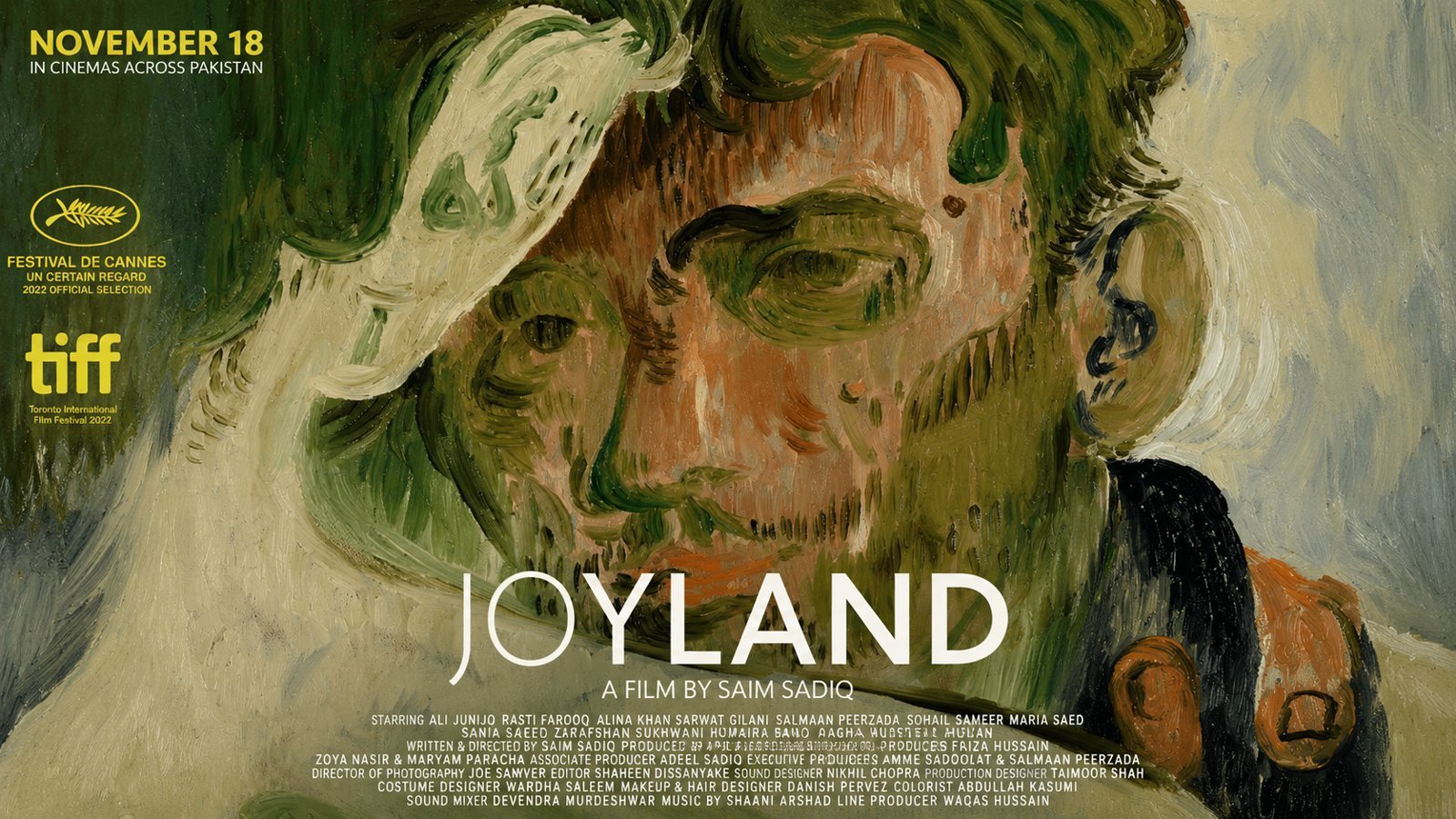
Joyland (2022)
Cast: Ali Junejo, Rasti Farooq, Alina Khan, Sarwat Gilani, Salmaan Peerzada, Sohail Sameer, Samia Saeed
Director: Saim Sadiq
Synopsis: An exceptional film that dares to focus on the oppressive nature of conformity in an unforgiving and regimented society.
Reviewed by: Omar Khan
Joyland (2022), a film embraced at several prestigious International Film Festivals, including Cannes, is the latest Pakistani film to fall foul of the authorities and end up with a ban just days before its release (November 18) in Pakistan. On the positive side (for the film), a ban will probably increase its viewership tenfold because now, those with little or no interest in the film, will seek to discover why it was deemed offensive. However, what could hurt Joyland more is its chances at the Oscars, for the film has to release in its mother country to qualify for consideration. The cruel irony of this is that it is Pakistan’s official entry at the Academy Awards. What’s more tragic is that the film was cleared by the censors in Pakistan, only for the country’s Ministry of Information and Broadcasting to revoke the film’s censor certificate.
Joyland, directed by Saim Sadiq, continues a disturbing pattern that seems to have become the norm in Pakistani cinema. Over the last few years, there appears to be a clear ordinance that if a film doesn’t reflect the much-peddled and prescribed ‘soft and righteous image’ of the nation, it would not be allowed to be released for public consumption. Subsequently, any film that has veered from mindless rom-com territory, propaganda or gratuitous violence, has been deemed a threat to the country’s fragile sensitivities.
Not just Joyland, but any film that dares to depict reality is branded as offensive and is thus denied a certificate by the so-called custodians of morality. Gangsterism, extreme violence, and vulgarity bordering on soft pornography seen in the Pashto films of the 1990s and beyond, and movies, which appear to be elongated advertisements for the war machine, are perceived to be perfectly suitable for audiences. However, anything that dares to depict a world that makes the authorities confront some harsh home truths is immediately regarded as offensive and unsuitable for screening in the country.
Recently, several films have fallen foul of peddling the rose-tinted virtuous image of Pakistan. Sarmad Khoosat’s film Zindagi Tamasha (2019) has been watched and admired at numerous Film Festivals worldwide, but its contents were deemed unsuitable and corrupting for local consumption, with Khoosat also being accused of blasphemy. The assumption is that it is a film that forces us to look ourselves in the eye, something we are not mature enough to handle evidently. Javed Iqbal: The Untold Story Of A Serial Killer (2022), a film by Abu Aleeha about a notorious child murderer, Javed Iqbal, has suffered the same fate even though it is based on a factual case and isn’t some made-up fantasy. The ugly truth is that this killer, who confessed to the murder of 100 boys between the ages of 6-16, existed among the people of Pakistan.
Meanwhile, a film depicting violence of the most gratuitous kind (Bilal Lashari’s The Legend of Maula Jatt (2022)) has found universal
Joyland acclaim as a masterpiece and a giant step forward for Pakistani cinema. The brainless fodder, however enjoyable, that is dished out has a definite motive, one laced with an insidious attempt at keeping audiences in line. A brain-dead audience is much easier to control and less likely to stray from the path prescribed by the powers that be.
I’ll Meet You There (2020), directed by Iram Parveen Bilal, was also banned for not reflecting ‘true Pakistani culture’ just because it depicted a young American girl of Pakistani origin, who has a boyfriend and a white non-Muslim one at that. No doubt, had I’ll Meet You There been allowed to screen in Pakistan, the film would have threatened the country’s existence as a ‘morally superior’ bastion of faith. Imagine its daughters being in control of their destinies. It would have undermined a society where every decision is in the hands of senior men with dollops of hair dye.
Joyland dares to depict transgender people as human beings, and thus vilified and condemned as an attempt to eviscerate Pakistani men and lead the nation’s children astray. Some claim “it is not our culture,” while others scream that their little boys will suddenly want to turn into girls if we allow the film’s screening. The truth is transgender people have been part of the South Asian spectrum for centuries. Still, it is acceptable in Pakistan if they remain beggars on street corners as targets for mockery, ridicule and brutality. They are, however, shunned the minute they dare to cross over into mainstream life. Most double as sex workers and have men lining up for their services. A film that dares to depict transgender people in a positive light and speaks out against patriarchy is naturally playing with fire and threatens local genteel and upright virtues, critical appreciation worldwide notwithstanding. The most disturbing aspect of this culture of selfdenial and banning is that it leaves no room for a coherent debate or discussion.
Google has stated that Pakistanis search for ‘gay sex’ more than any other part of the world. Yet, this is treated as a Western conspiracy by LGBTQ-loving liberals. They can dream on, as the Soviet Union used to claim, homosexuality and the LGBT are an ailment of the decadent, liberal West, and this twisted ‘nonsense’ has no place in our society. Let it be very clear that Pakistan is the ‘Land of the Pure’, and anyone who dares to suggest otherwise can visit the country and see for themselves.
0 Comments
Leave a Comment