
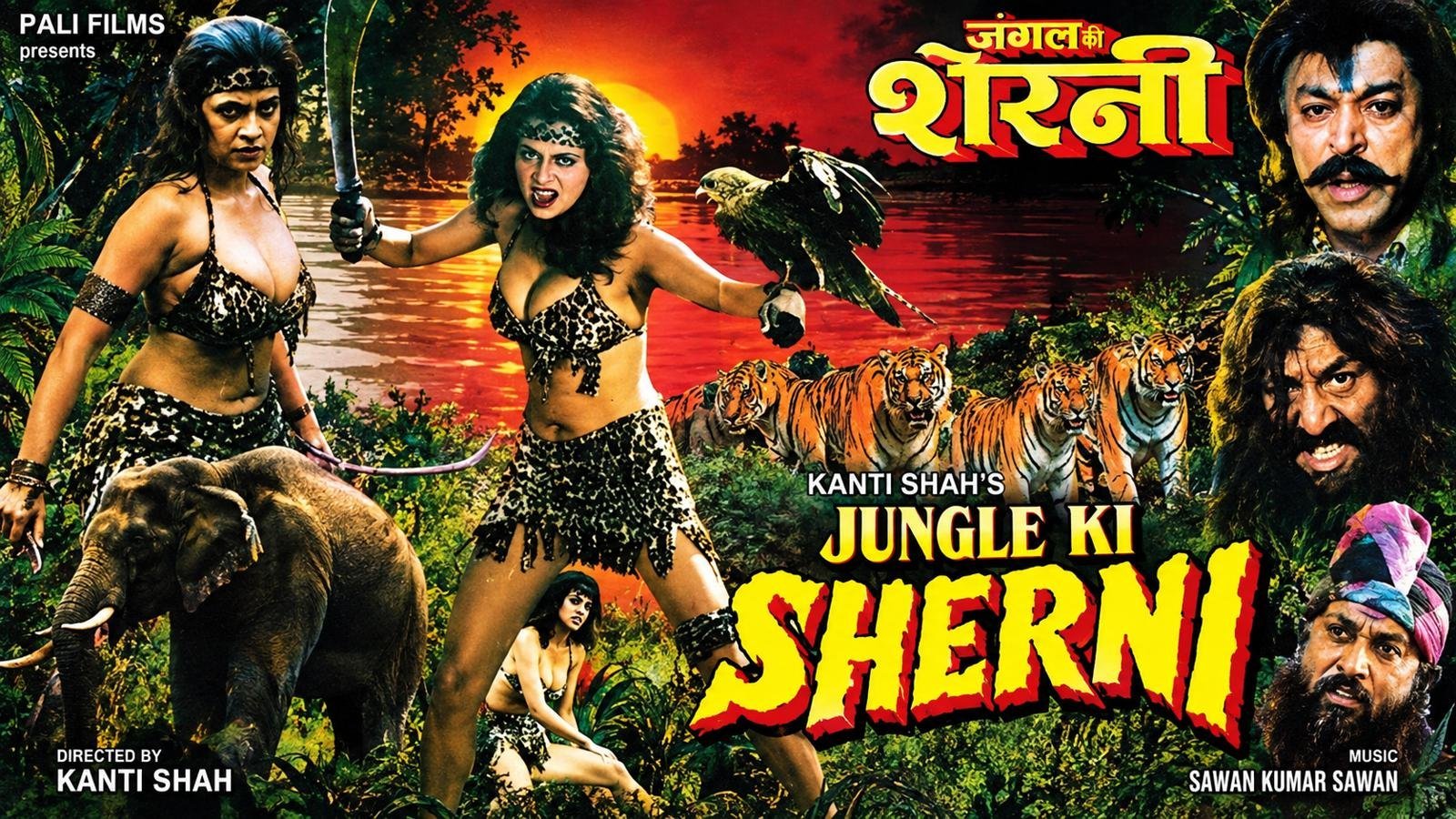
Jungle Ki Sherni (2001)
Cast: Joginder, Sapna Sappu, Amit Panchori, Vinod Tripathi, Dimple, with dialogues by Bashir Babbar
Director: Ankit Patel and Kanti Shah
Nutshell: Stirring fusion of female Daku with the Jungle Jane genre that breathes the same fiery air as Gunda and Munnibai.
The protagonists wage their jungle turf wars in scintillating epic style, with Bangroo (Joginder) pitted against the fearless warrior Sherni, formerly known as Morni, who must also contend with Nageena — “the one who makes her opponents shed paseena” — and, somewhere in the mix, Sherni’s mysterious doppelganger, Rupa Daku.
Into this lawless wilderness comes the dashing Inspector Shankar, newly posted to the jungle precinct. He has deep ties to the area, having been born and raised there, and was once madly in love with Morni before she transformed herself into the fearsome Sherni.
Naturally, questions abound.
Why did the once beautiful Morni — the Peacock — become Sherni, the Lioness? Can Shankar win back his childhood sweetheart from her new incarnation as Lady Boss of the Jungle? And who exactly is Rupa Daku, who somehow happens to be the spitting image of Sherni?
The police have been running around in circles, unable to make any headway, but with Shankar’s arrival some of the pieces finally begin to fall into place.
The film opens in a blaze of glory with Bashir Babbar’s patented dialogue, complete with rhyming threats and couplets that would have Eminem and Drake green with envy. The lines come thick and fast: innuendo, vulgarity, bombast and masala hurled at the audience in the grand tradition of Gunda and Munnibai.
Babbar’s dialogue is gloriously excessive, packed with punch lines and delivered with such confidence that resistance is futile. Absolutely “mindblowing”, to borrow that most dependable of Indian-English expressions. Some might even call it “fanta-fabulous”.
The first confrontation is between Sapna Sappu, Queen of the Z-grade Bollywood scene, and the legendary Joginder. Before the fists start flying, the couplets do. Sherni’s flashing blade soon clashes against Bangroo’s defences and she gets the better of the encounter, slashing his arm.
News travels fast in the jungle, and within moments Bangroo’s daughter is informed of her father’s injury. Spitting venom and firing off excellent couplets of her own, she sets off to avenge him and destroy Sherni — no small task at the best of times.
Their showdown is interrupted by the arrival of the police, who accuse Sherni of actually being Rupa Daku. Sherni dismisses the allegation with suitable fury before she and Nageena disappear into the undergrowth to fight another day.
The first twenty minutes are exhilarating, ridiculous and enormously entertaining, promising a rare treat for anyone who likes their B-grade pulp juiced up to the maximum.
Then something very strange happens.
Anyone who has seen Munnibai will begin to experience an increasingly powerful sense of déjà vu.
At first it feels as though Jungle Ki Sherni is simply following the same general template. Then familiar scenes start appearing. Then familiar dialogue. And eventually the truth becomes impossible to ignore.
The film is practically Munnibai all over again.
Not merely inspired by it, not loosely based upon it, but duplicated to an astonishing degree. Scenes are recreated almost word for word, with much of the same cast appearing in slightly different costumes and playing only marginally altered versions of the same characters.
Anyone who has already watched Munnibai would therefore be perfectly entitled to wonder why they are being charged to see it again.
It is quite remarkable that the filmmakers could take an earlier production, rearrange a few surface details and essentially present the same movie as something new.
There is, however, one notable sequence that does not come from Munnibai, and it is so catastrophically ill-judged that it deserves special mention.
A group of Sherni’s followers arrive at the hut of a comic witch doctor played by Jagdeep, claiming to have contracted AIDS. What begins as a tasteless comedy routine becomes far worse when Jagdeep is sexually assaulted by them one after another.
The scene is appalling.
Even by the standards of low-budget exploitation cinema, it displays an extraordinary level of insensitivity. AIDS is treated as a punch line, while sexual assault is used as the joke itself. The result is not merely offensive but grotesquely tone-deaf, and it is difficult to imagine what anyone involved thought was funny about it.
After that unpleasant detour, the film returns to its principal occupation: being Munnibai.
From roughly the halfway point onwards, it becomes a scene-by-scene echo of the earlier film, with virtually the same actors delivering the same lines in almost identical situations.
For anyone familiar with Munnibai, the second half therefore becomes an exercise in recognition rather than discovery.
You have seen it all before.
Quite literally.
Even the fabulous baby-dropping scene is repeated.
If, however, you have never seen Munnibai, then Jungle Ki Sherni may well prove entertaining enough on its own terms. It has the dialogue, the posturing, the outrageous characters and the relentless pulp energy one expects from this particular school of Hindi exploitation cinema.
But for those who have seen both films, the question remains irresistible:
How many times did this team intend to make Munnibai?
I still cannot decide whether the repetition is inspired recycling or an act of laziness so brazen that it almost becomes admirable.
0 Comments
Leave a Comment