
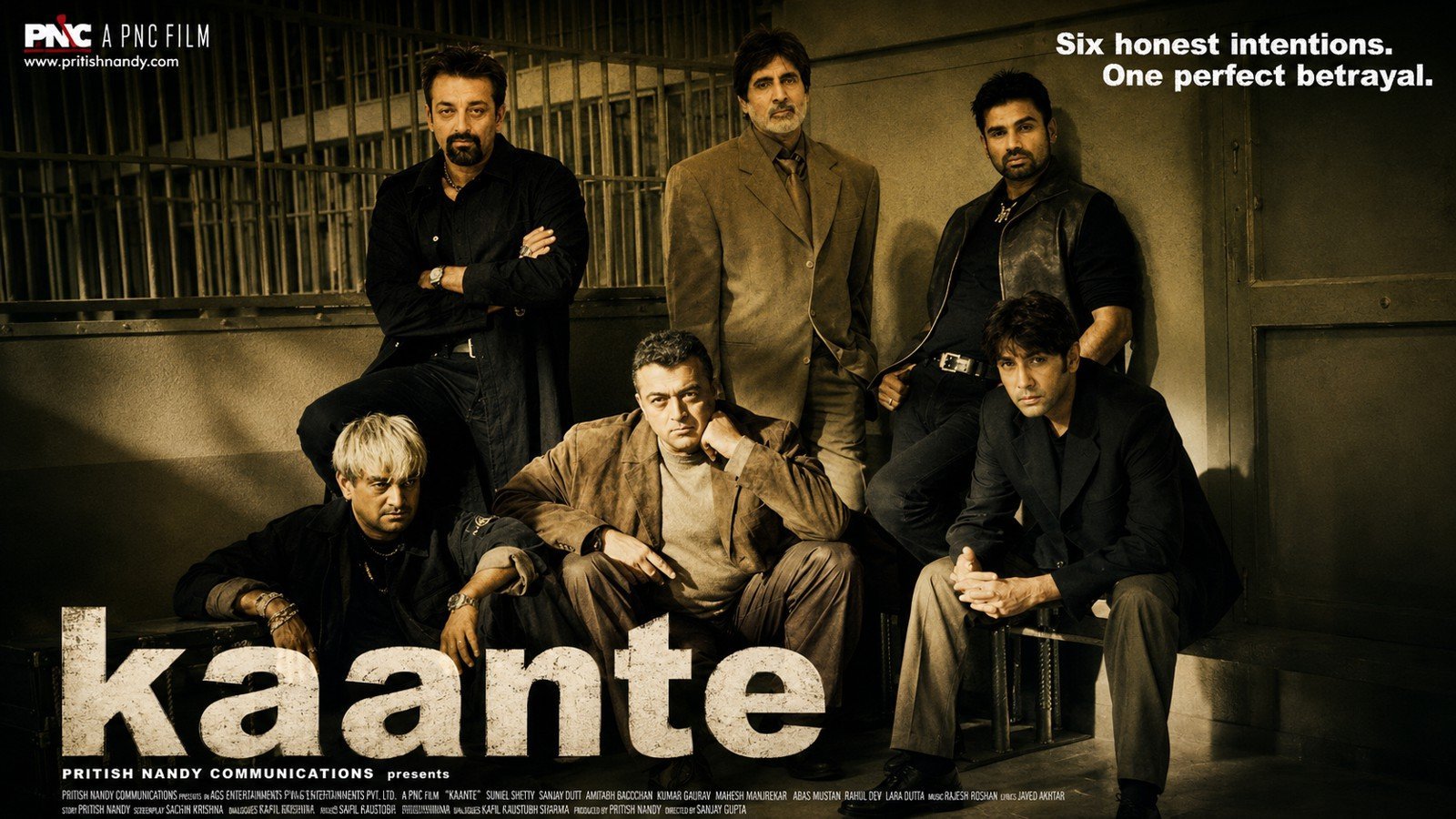
Kaante (2002)
Cast: Amitabh Bachchan, Sanjay Dutt, Sunil Shetty, Lucky Ali, Mahesh Manjrekar
Director: Sanjay Gupta
Synopsis: Slickly produced and strongly acted thriller
Music: Anand Raaj Anand
Reviewed by: Faiz Khan
Kaante arrives amid great excitement and expectation and I can almost hear the knives being sharpened for the feast that most critics would like to have, because anything BIG must be reduced to rubble; such is our mentality. I would admit that I too was ready to crucify the film because Sanjay Gupta has never held much allure for me as a director. Thus far, he has produced little more than sub-standard rip-offs of foreign films, be it Aatish, Khauff, Kartoos or Jung. My biggest grouse has always been that there seemed to be nothing original about any of his films and therefore, where is the creative achievement in "directing" a film when the entire concept has simply been lifted from Hollywood? I have had to rethink that position somewhat in light of Abbas-Mustan's work, who are no better when it comes to borrowing foreign thrillers and adapting them for Bollywood. Why then are their films generally more accessible than Gupta's? The answer perhaps lies in the fact that Gupta's earlier efforts have largely been poor adaptations, whereas Abbas-Mustan have often succeeded in reshaping their source material into something that works for Indian audiences.
But there is hope. Pritish Nandy states that Kaante is not inspired by Reservoir Dogs, a claim which had me chuckling at the sheer audacity of staring the audience in the face and making such a statement. Perhaps what he really meant was that it also borrows generously from The Usual Suspects. For anyone who has seen Tarantino's cult classic, Kaante is far more than a mere inspiration of Reservoir Dogs. It is an adaptation, but one that Gupta has mounted with tremendous style, confidence and energy.
The film opens with close-ups of six men: Major (Amitabh Bachchan), Ajju (Sanjay Dutt), Mak (Lucky Ali), Balli (Mahesh Manjrekar), Mark (Sunil Shetty) and Andy (Kumar Gaurav). They are engaged in a discussion about Indians living in America, about discrimination, persecution and being treated as outsiders. These are men already on the margins, not merely because they are immigrants in a foreign land but because each carries his own burden and private tragedy. The voice-over tells us that this is not a journey of hope, but one in which doom hangs over every one of these characters. These outsiders are destined never to find their way home.
As the camera slowly pulls back, we discover that all six are sharing the same jail cell, planning an audacious bank robbery. It is Ajju's idea to strike back at the very institution where the American police keep their money—the American Services Bank. If anyone is interested, they are to meet again that evening. Gupta then rewinds events to show how these six very different individuals came to occupy the same prison cell.
Each has been arrested and interrogated over the disappearance of a truck.
Major is desperately trying to secure financial backing for a proposal that will earn enough money to take his ailing wife (Rati Agnihotri) back to India, only to find himself treated with disdain before being hauled in for questioning. Balli and Mak are arrested while negotiating a drug deal. Balli survives by his wits, dreaming of making enough money to care for his mentally impaired sister back in India, while Mak is his quiet, resigned and rather hopeless partner who simply drifts wherever Balli leads him. Andy is a software engineer trapped in an acrimonious marriage but devoted to his young son. Ajju is reckless, impulsive and forever living on the edge, while Mark works as a bouncer in a seedy strip club where his girlfriend Lisa (Malaika Arora) performs as a pole dancer. Each of them needs money to escape the lives they currently lead, and the bank robbery appears to offer the perfect solution.
Planned with military precision, the robbery proceeds almost flawlessly until the gang emerges from the bank to discover an entire convoy of police vehicles waiting outside. Blasting their way through the barricade in a hail of bullets, they eventually regroup at the warehouse where they were meant to divide the money. Mak has been wounded during the escape, while Ajju returns with a captured policeman who confirms their worst fears: one among the six is an undercover cop. Suspicion immediately poisons the group and what follows is an increasingly tense search for the mole, culminating in an appropriately bloody finale.
Gupta has put together a taut and thoroughly engrossing thriller, very much in the Hollywood mould but refreshingly free of unnecessary characters, comedy tracks or irrelevant diversions. Its structure is unlike anything previously attempted in mainstream Bollywood, while the interactions between the six men remain consistently absorbing. Gupta succeeds in combining substance with style without reducing the film to little more than an extended MTV commercial. More importantly, he conveys the desperation and hopelessness that permeate these men's lives without resorting to melodrama or heavy-handed sentimentality.
The film briefly loses its footing when the meticulously planned robbery goes awry. Gupta momentarily indulges his fondness for deafening explosions, trucks smashing through vehicles, and Sanjay Dutt sliding across the ground with guns blazing. The extended shoot-out threatens to overwhelm everything that has been so carefully established beforehand, and for a few minutes one fears that the film is about to descend into just another noisy action spectacle. Thankfully, Gupta regains his composure almost immediately and returns to the far more interesting game of suspicion, paranoia and betrayal. What is particularly commendable is that this is precisely the sort of prolonged action sequence that would have appealed enormously to the average Bollywood audience, yet Gupta resists the temptation to litter the remainder of the film with similar excesses. Instead, he remains focused and delivers the polished thriller that he clearly wanted to make rather than one dictated by obvious commercial compromises.
The performances are uniformly excellent. Not one member of the cast puts a foot wrong, although Mahesh Manjrekar and Lucky Ali come perilously close to stealing the film with two wonderfully understated performances. Amitabh Bachchan has finally begun choosing his projects wisely after his return to cinema, and this is exactly the sort of character role that suits him perfectly. He is magnificent. Sanjay Dutt delivers one of his most relaxed performances and, despite also being the producer, never attempts to dominate proceedings or inflate the importance of his own character. Sunil Shetty is restrained and effective, while Kumar Gaurav contributes solidly as the software engineer whose expertise makes the robbery possible. Mahesh Manjrekar is outstanding as the opportunistic low-life who appears to possess no redeeming qualities whatsoever, while Lucky Ali underplays beautifully as Balli's quiet partner in crime.
Technically, the film is first-rate. The dialogue crackles, while the cinematography captures the grittier side of Los Angeles without turning the city into a glossy tourist brochure. Some may argue that Gupta's nightclub sequences border on vulgarity, but they serve a purpose. Most of these men inhabit the seedier fringes of society, Major being the lone exception with a degree of dignity still intact. The editing is superb, and Anand Raj Anand, together with the guest composers, provides an excellent soundtrack. Ironically, music lovers might be better off closing their eyes during "Maahi Ve", a superb composition that is unfortunately accompanied by pole dancing and lingering close-ups of anatomy that we could quite happily have lived without. "Rama Re", "Socha Na Tha", "Yaar Mangiyasi" and even "Chhod Na Re" are all excellent tracks in their own right.
With such an outstanding cast, memorable music and a lavish canvas, one might assume this is a film aimed squarely at the masses. I certainly hope it succeeds because it deserves to. Yet Kaante is not a conventional action film at all. In fact, I would hesitate even to describe it as an action film. It is first and foremost a thriller, and I suspect that its urban style may limit its appeal in smaller centres where more traditional masala entertainers tend to flourish. Even so, the early signs are encouraging. The film has opened strongly in America, where Media Partners and Bollywood Pictures released it on just 26 screens yet grossed an impressive $425,975, giving it a sizzling per-screen average of $16,384.

0 Comments
Leave a Comment