
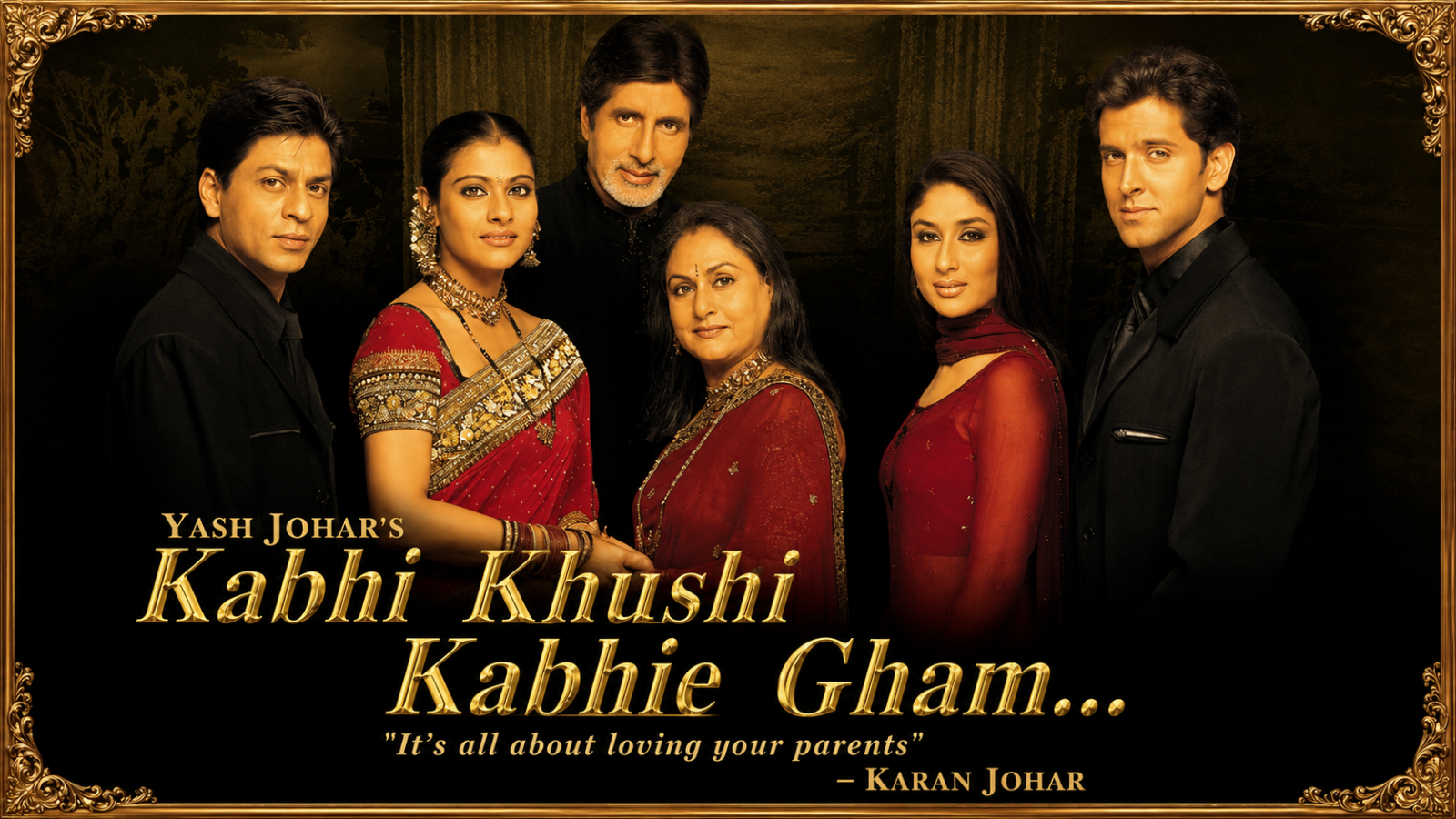
Kabhi Khushi Kabhi Gham (2001)
Starring: Amitabh Bachchan, Jaya Bhaduri, Shahrukh Khan, Kajol, Hrithik, Kareena
Director: Karan Johar
Music: Jatin Lalit, Sandesh Shandilya, Aadesh Srivastva
Synopsis: Old-fashioned family drama has its finger totally on the pulse
Reviewed by: Faiz Khan
Karan Johar's follow-up to Kuch Kuch Hota Hai is a lavish magnum opus boasting a cast impressive enough to justify the price of admission before the film itself has even begun. It arrived burdened with enormous expectations and, by and large, it delivers. Johar is completely in control, moulding his film in the grand tradition of classic, overblown Bollywood melodrama. This is no path-breaking work, nor does it aspire to the realism of Dil Chahta Hai or even the ambitions of Lagaan. It was never going to propel Bollywood into the realms of world cinema in the way those films promised to do, nor is it a film of profound thematic depth. Kabhi Khushi Kabhie Gham is simply an old-fashioned family drama, magnificently mounted and superbly executed.
The film opens with Yash Raichand (Amitabh Bachchan) and his wife Nandini (Jaya Bhaduri) reflecting on love, parenthood and the difficulty fathers often have in expressing their affection for their children. A father may not always say what he feels, but that does not mean he loves any less. Nandini dotes on her son Rahul, who learns at a young age that he is adopted. Worshipped by his mother, Rahul grows into Shah Rukh Khan, a son who, in turn, worships both his parents, particularly his father. Completing the family is the much younger Rohan.
Something, however, is clearly amiss.
Years later, a grown-up Rohan (Hrithik Roshan) visits his grandmothers and accidentally uncovers the family secret—not only Rahul's adoption but also the mystery of why he vanished from the household years earlier. We are thrust into another flashback where Rahul returns from his studies to the delight of both parents. Yet this is a household governed by parampara—tradition—and tradition reigns supreme.
Nandini is the dutiful, loving and quietly submissive wife who keeps the household running smoothly, fusses over her husband, straightens his tie and stands beside him in everything. Yet hers is ultimately a supporting role, because it is Yash who makes the decisions and whose word is final. One such tradition concerns marriage. Nandini herself was chosen for him, and he fully expects to choose Rahul's bride as well. Rahul's childhood friend Naina (Rani Mukherjee) appears to be the perfect match, both socially and culturally. Unfortunately for Yash, Rahul has already been bitten by the love bug, and the object of his affection is Anjali (Kajol), the loud, earthy daughter of a humble sweet-shop owner.
Naina realises Rahul's heart belongs elsewhere and withdraws with admirable grace. Yash, however, is far less accommodating. Deeply disappointed, he crushes Rahul's resolve and the dutiful son decides to sacrifice his own happiness in order to honour his father's wishes. But when Rahul goes to break the news to Anjali, he discovers that her father has died, leaving her and her younger sister orphaned. Unable to abandon her, Rahul marries Anjali and brings her home.
Yash responds by telling him that this is no longer his home.
Powerless to intervene, Nandini watches helplessly as her son is cast out. Rejected by the family he adores, Rahul leaves.
Returning to the present day, Rohan vows to reunite his broken family and sets out in search of his long-lost brother and sister-in-law.
Karan Johar has assembled a film that represents mainstream Hindi cinema at its most polished. Apart from the odd scene and perhaps one or two songs that could easily have been dispensed with, Johar rarely puts a foot wrong. His greatest achievement lies in balancing such an enormous ensemble cast without reducing anyone to mere decoration. Every character serves a purpose, every actor receives memorable moments, and each performance adds something distinctive without overshadowing the others.
Amitabh Bachchan portrays Yash as a fundamentally decent but uncompromising patriarch, a man shaped by tradition and determined that succeeding generations should follow the same path. Bachchan is superb, resisting the temptation to dominate the film despite the strength of his role. His scenes with Shah Rukh Khan alone justify a second viewing.
Jaya Bhaduri is equally magnificent as the quietly devoted mother. Never once does she descend into melodrama, the finest example being her climactic confrontation with Bachchan, where she finally speaks her mind without ever raising her voice. It is a beautifully restrained performance that lends the film a dignity few actresses could have achieved. It is also perhaps the first genuinely glamorous role she has been offered in years, and she carries it with tremendous grace.
Shah Rukh Khan is charming and deeply affecting, even if he occasionally borders on the overly sentimental. Nevertheless, he has that rare ability to elevate a film simply by his presence. His performance is understated, his scenes with Bachchan and Jaya genuinely moving, while the relationship between the two brothers is handled with surprising sensitivity.
Kajol, true to the demands of her character, is loud, impulsive and occasionally exhausting, yet injects enough warmth and spontaneity to prevent Anjali from degenerating into caricature. Hrithik Roshan has an excellent role and more than holds his own opposite actors of the stature of Bachchan and Shah Rukh Khan. There appears to be genuine affection between the two younger male leads, and it translates effortlessly onto the screen. He is also, of course, required to provide eye candy for the younger audience, which results in three elaborate song sequences, one of which contributes very little to the overall narrative. Kareena Kapoor arrives only after the interval yet immediately injects freshness, humour and infectious energy into the proceedings. It is difficult to imagine another actress bringing the same sparkle to the role. Rani Mukherjee, despite limited screen time, leaves an equally lasting impression.
That is not to say the film is without flaws.
It is difficult to believe that Rahul would choose someone like Anjali over the elegant and beautiful Naina, particularly when the romance between Rahul and Anjali is never developed with the conviction it requires. Their relationship lacks the irresistible sweep of romances such as Bobby. Rahul then disappears for ten years, yet we are expected to accept that nobody seems capable of finding him. Rohan, despite promising never to question his brother's disappearance, scarcely appears affected by losing the sibling he idolised. The emotional breakdown of Yash and Nandini's marriage is referred to repeatedly but is never explored in any meaningful way, while Rohan's eventual search for Rahul proves remarkably straightforward.
Then again, this is Bollywood—a modern fairy tale whose central message is simply that it is all about loving your parents. Within those terms, the film succeeds so completely that such shortcomings become surprisingly easy to forgive.
Visually, the film is sumptuous. Every frame reflects extraordinary attention to detail, while the cinematography is consistently breathtaking. If there is one genuine disappointment, it is the music. The title song possesses a certain warmth but feels strangely familiar. "Suraj Hua Maddham" towers above the remainder of the soundtrack. "Bole Chudiyan" is infectious, beautifully picturised and deservedly popular, even if it is hardly a timeless classic. "Deewana Hai Dekho" is surprisingly ordinary, while "Yeh Ladka Hai Allah" feels like a leftover from Kuch Kuch Hota Hai. "You Are My Soniya" is energetic and visually attractive but ultimately unremarkable.
No, I doubt many of these songs will still be remembered decades from now.
Putting that aside, however, Karan Johar deserves enormous credit for delivering another beautifully crafted film. It tugs unapologetically at the heartstrings, celebrates family values without embarrassment and reminds us why, when Bollywood embraces melodrama wholeheartedly, it can still be an enormously rewarding experience.

0 Comments
Leave a Comment