
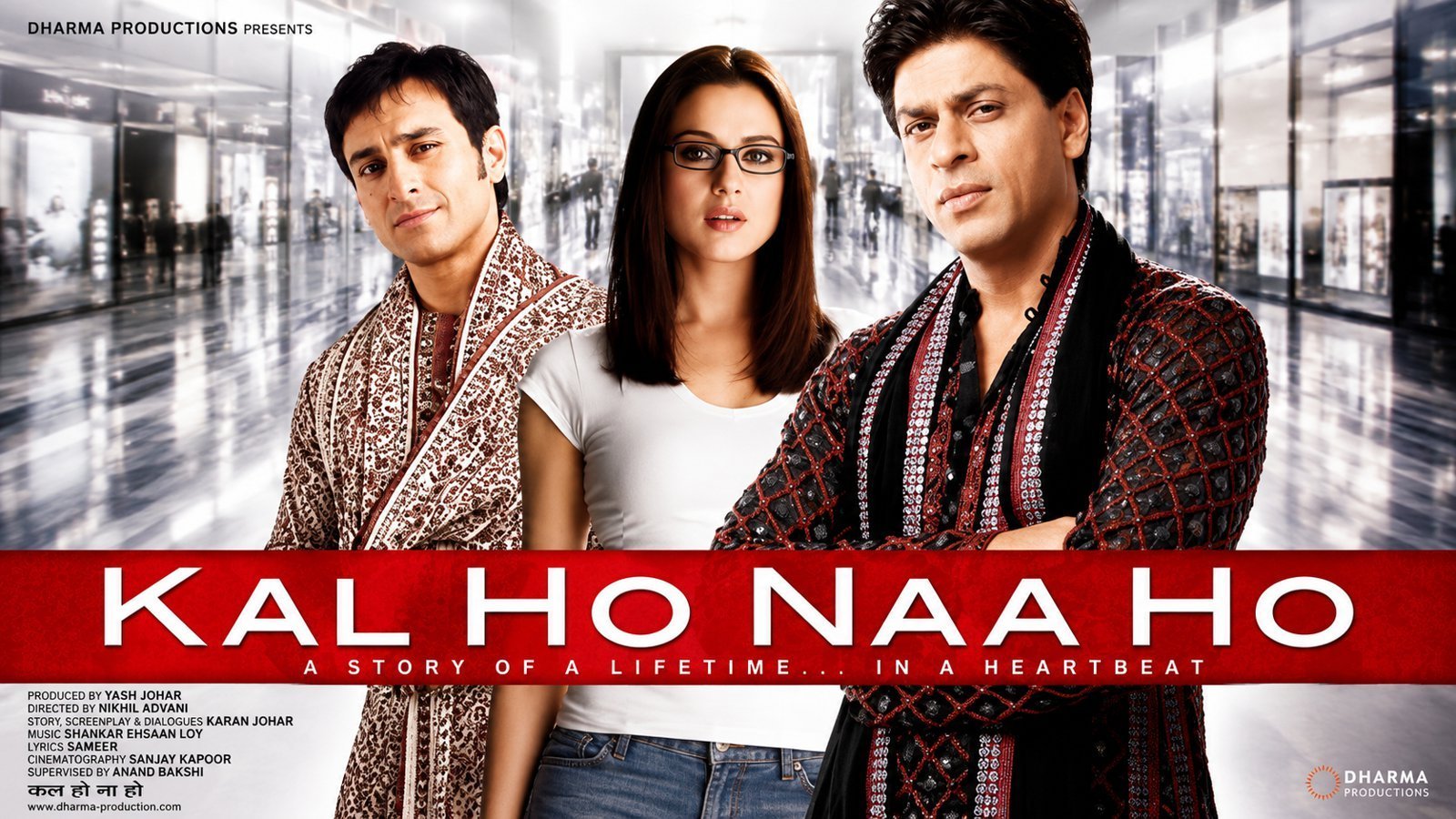
Kal ho na Ho (2003)
Cast: Shahrukh Khan, Preity Zinta, Saif Ali Khan
Director: Nikhil Advani
Music: Shankar Ehsaan Loy
Synopsis: Promises a lot more than it ultimately manages to deliver
Reviewed by: Faiz Khan
Kal Ho Naa Ho—a zingy title that leaves very little to the imagination regarding what lies in store. We certainly aren't talking about another conventional love triangle here, because the publicity has already told us that this is supposedly a reworking of Anand, meaning that our protagonist is destined for heaven before the final reel. Let me say immediately that this is neither a remake nor even a true reworking of Anand. It merely borrows the central idea. In fact, if anything, it feels rather closer to Safar than Anand. There is no harm in that whatsoever, and therefore comparisons with Hrishikesh Mukherjee's classic are both unfair and unnecessary.
The credits bring us to New York. A voice-over introduces us to Naina Catherine Kapur (Preity Zinta) and the assorted collection of eccentric characters inhabiting her life: the stereotypical Punjabi grandmother (Sushma Seth), belting out songs with her trio of elderly companions in a transparent attempt to attract the attention of neighbour Dara Singh; Jennifer (Jaya Bachchan), Naina's widowed mother, struggling to raise her children after her husband apparently committed suicide—for reasons never satisfactorily explained; a disabled younger brother; and an adopted sister, cruelly rejected by the grandmother simply because she is not of their bloodline.
Then there are the neighbours, also surnamed Kapur, complete with a lusty mother (Lillete Dubey) and an overweight daughter. Life for Naina is one long struggle. There is little joy, no romance and precious little hope. Her only real comfort comes from her friendship with Rohit (Saif Ali Khan), whom she meets during their MBA course. The relationship is purely platonic. Naina dresses plainly, hides behind her spectacles and projects a dowdy seriousness, while Rohit, clad in designer clothes and carrying Louis Vuitton briefcases, spends his time chasing the next attractive girl.
One evening, worn down by life's endless disappointments, the family settles down to pray for some divine intervention. They ask for an angel.
The following morning, one arrives in the shape of Aman Mathur (Shah Rukh Khan).
Watching over the family from afar, Aman immediately decides they need rescuing and promptly bursts into their lives, accompanied by the rather risible "Pretty Woman". Before anyone has had time to object, he has invited himself into the Kapur household for tea. Naturally, the children adore him, Jennifer warms to him immediately and only Naina finds the intrusion irritating.
Before long we are expected to believe that Aman has fallen hopelessly in love with this rather unremarkable young woman. Enter Rohit once again, and after a carefree evening in which Naina finally loosens up and even ventures onto the dance floor, Aman realises that the two friends are actually meant for one another. Being the resident guardian angel, he sets about bringing them together.
Unfortunately, matters become rather complicated when Naina herself falls in love with Aman, while Aman continues pushing Rohit towards her and Rohit, believing Aman to be the better man, graciously steps aside. Aman then produces the rather convenient revelation that he is already married, shattering Naina's hopes completely. From this point onwards, Aman devotes himself to coaching Rohit in the correct method of winning Naina's heart, all the while beginning to suffer mysterious bouts of pain and breathlessness, known only to his saintly mother.
Nikhil Advani directs the film with considerable freshness and confidence, but there is only so much he can do with Karan Johar's screenplay. The biggest weakness is that Johar never seems able to resist his Kuch Kuch Hota Hai hangover. Simplicity is apparently an alien concept. Instead, he stuffs the narrative with a multitude of unnecessary characters and subplots that merely clutter proceedings.
The greatest flaw, however, lies in the character of Aman himself. Ironically, he would have worked far better had Johar simply treated him like Bruce Willis in The Sixth Sense rather than asking us to accept the rather implausible explanations eventually provided. Aman repeatedly appears at impossible moments, overhears conversations he could never realistically have heard and seems almost supernatural throughout much of the film. The scene in which he somehow materialises to witness the emotional conversation between mother and daughter by the waterfront is particularly absurd.
More importantly, Aman never develops into a fully realised character. Despite the tragic circumstances surrounding him, there is remarkably little emotional depth. Everything feels oddly superficial. Consequently, one never truly believes in the love between Aman and Naina. Their scenes together consist largely of bickering, with precious little chemistry or passion. The director is therefore left with the impossible task of convincing us that this is a great love story when very little on screen actually supports that notion.
There are several scenes which should have reduced audiences to tears but instead leave one strangely unmoved. Aman reading Rohit's blank diary to Naina, clearly intended as an emotional high point, falls almost completely flat. Johar's tendency to overpopulate his films with colourful eccentrics, which worked beautifully in Kuch Kuch Hota Hai and to a lesser extent in Kabhi Khushi Kabhie Gham, becomes tiresome here. The screenplay repeatedly resorts to familiar clichés to move the plot forward, the disco sequence being perhaps the most obvious example.
Even worse is Johar's extraordinary resolution regarding the adopted sister. The grandmother finally accepts the girl only after discovering she is, in fact, the illegitimate daughter of her own son. Far from being touching, the entire revelation is both offensive and completely implausible.
Where Advani—and indeed Johar—ultimately fail is in generating genuine emotion. This is a story built around sacrifice, mortality and unfulfilled love, yet somehow it rarely touches the heart. Ironically, Kabhi Khushi Kabhie Gham contains far more genuine feeling than anything found here. Fortunately, Advani avoids overplaying the final illness or lingering excessively over Aman's death, but even then the emotional impact remains disappointingly muted.
Shah Rukh Khan has been handed what must have seemed a dream role, almost certainly conceived with him specifically in mind by his close friend Karan Johar, who appears to view him as an angel in every sense of the word. Frequently dressed in white, all he really lacks is a pair of wings. Yet Shah Rukh fails to bring either subtlety or genuine charm to the part. Everything is pitched too broadly and ultimately becomes rather grating.
Preity Zinta, by contrast, delivers a measured, balanced performance that strikes exactly the right note. She has matured considerably as an actress, evolving from a spontaneous performer into an intelligent one with consistently good judgement.
The film's greatest asset, however, is undoubtedly Saif Ali Khan. After spending years playing second fiddle in film after film, often emerging with the rawest of deals, he finally receives a role worthy of his talents. If Dil Chahta Hai previously represented his finest work, he surpasses it here with ease. His Rohit feels entirely natural despite his privileged upbringing. He never degenerates into the typical cardboard Hindi film hero, and there is an effortless sincerity to his performance that elevates every scene he appears in. This is no supporting role. In many respects, it is the film's true leading performance, leaving Shah Rukh a rather distant second.
The film is handsomely photographed and Shankar-Ehsaan-Loy provide a pleasant if largely uneventful score. Much of the humour shared between Saif and Shah Rukh is genuinely amusing, even if Johar occasionally pushes it a little too far.
As the final instalment in Johar's unofficial trilogy, this is undoubtedly the weakest of the three. Watching Kal Ho Naa Ho reminded me rather of ordering an expensive steak. With all the excess fat trimmed away, it might have been a truly delicious meal. Instead, what remains is an attractive, costly dinner which somehow never quite delivers the flavour it promises.

0 Comments
Leave a Comment