
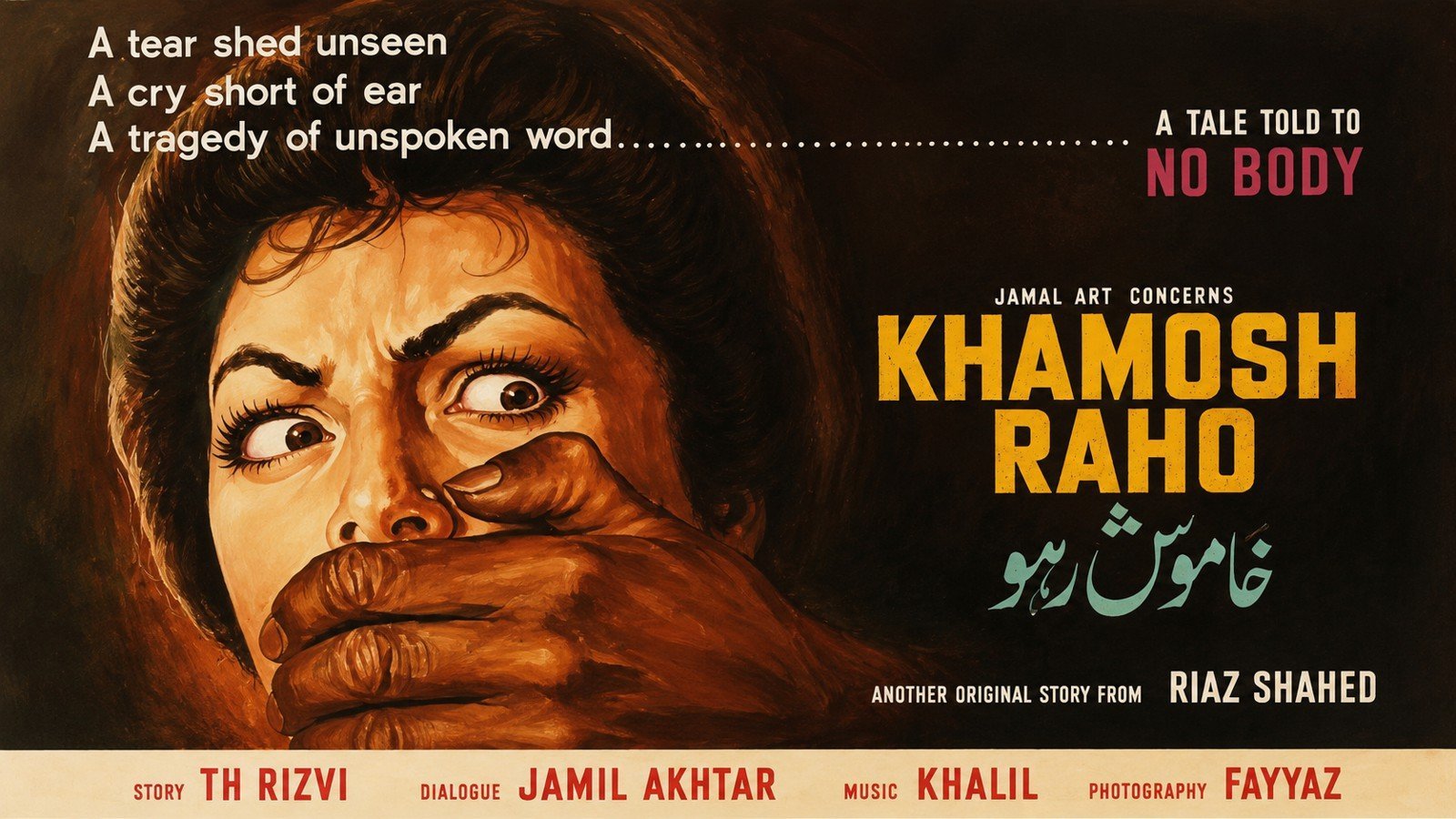
Khamosh Raho (1968)
Cast: Deeba, Yusuf Khan, Mohammad Ali, Meena Shorey, Aslam Parvez, Zeenat
Director: Jamil Akhtar
Synopsis: Shines a light on the ugly exploitation of the rich and powerful upon the desperately defenceless poor and their circumstances in the most subtle, yet searingly powerful manner— one of the finest films ever to emerge from Pakistan.
Reviewed by: Omar Khan
The film starts with the music of marriage festivities in the country’s far reaches. On land where people survive off the earth without access to medicine, law, education, or any protection. They live off the elements and community spirit. A flashy modern car is parked ominously outside a villager’s hut, and a bride hustles out on her journey to the city. Seemingly good fortune has struck the dwelling of the desperately poor souls, and the bride is to be whisked away by her handsome husband and glamorous, wealthy mother-in-law to a world away from the hardships of country life.
Meena Shorey, playing the mother-in-law, is all smiles and sweetness, while Mohammad Ali, her aide and the groom, seems strangely muted and unmoved upon the event of his lovely new bride being transported away to her new home. The dynamic between the proud mother-in-law Khanam (Shorey) and the handsome groom (Faraz) is oddly lopsided, with most enthusiasm coming from the triumphant mother-in-law.
Khanam is in a festive mood and glowing at her son’s “acquisition,” yet her eye wanders to a beautiful young village girl on the way, and she slows her car to a halt to engage in some friendly banter asking for water. As the young girl Raji (Deeba) politely brings her the water, Khanam asks her name and that of the village while making a friendly conversation. Her eyes light up at the fine young woman whose beau lurks a few steps behind, looking on with disdain.
As Khanam graciously thanks the girl and drives off, Bahadur (Yusuf Khan), is suspicious of the city folk. He immediately questions their motives, wondering why some rich folk from the city would travel to the poverty-stricken mountains to seek out a bride. He suggests with mistrust that the city people have bought the bride. Raaji pays little attention and heads home with Bahadur to her home, which she shares with her blind mother. A mother whose views on life are tainted by some dreadful calamities she has faced along her journey. She scolds Raaji never to see Bahadur again and threatens Bahadur with dire consequences if he dares to see her daughter again.
Bahadur is crestfallen and shies away from seeing Raji, but their bond is more robust than that, and soon she convinces him that all will be well and they can look forward to a happy future together. Bahadur is a soldier with impending duty on the war front, and he must go and fight for his people but assures Raji that upon his return, he will confront the old battle axe and ask for her hand in marriage.
Meanwhile, the young bride reaches her city home and is shown into her room by Khanam, while it seems her groom has little interest or intention of consummating the marriage. Faraz seems a tormented soul, trapped by circumstance, emasculated and robotic, following Khanam’s orders. He tells her of his torment and also his inability to fight his demons. He tells her of his bridal clothes haunting him, which he has repeatedly used to trap innocent young girls at her instruction, bringing them back to a life of misery, degradation, and despair.
Khanam is wily, though, trying to justify her actions by explaining how she is trapped by circumstance. She claims she has learned to
Khamosh Raho cope and justify her actions, and that the girls brought home to her brothel are not because of her flourishing trade, but more to do with the wheels of fate. The young bride waits all night for her groom, who never appears.
On the next day, Khanam informs her that he is terribly sick, that she should confine herself to her room, and that when he feels better, he will see her and consummate their marriage. She also tells her that evil surrounds them in cunning and conniving neighbours, and that she must not step out of her room at any cost.
Finally, that night, the door opens to the bride’s room, and a man she believes is her husband stumbles forth, and the marriage is consummated. In the morning, though, she finds to her horror, that it was a regular client who regularly uses the other girls in the brothel. Soon enough, like the other girls, she is informed that now she has been branded, her parents will never take her back, and though she tries to escape, she is brutally dealt with by Khanam’s guard and thrown back into her room.
Five or six other girls have been duped the same way. They carry on their roles cheerfully but only because they have learned to resign themselves to their fate, knowing that society will never accept them as they are. They are trapped, and the best they can do is to exist as slaves. The only other option is brutality by Khanam’s guard or rejection by the world outside. Over time, they have conditioned themselves to their fate; some girls are even trusted enough to visit clients outside the brothel. Their customers are often wealthy and influential members of society who are powerful enough to crush them at a whim if they dare to step out of line.
Faraz’s world starts to cave in on him, especially after the girl he helped abduct confronts him about his lack of morals and his total disregard for the misery he has caused. He tries blocking out the horrors that torment him each time he catches his reflection in a mirror.
The young bride’s words devastate him, yet he can’t summon the strength to confront the evil to which he is an accomplice.
Khanam now starts to capture young Raji in her web of evil, and Faraz is informed to get his bridegroom’s clothes together for another deception. She makes a trip to the village, where she meets Raji’s mother and prepares the groundwork for her imminent abduction. A desperate Raji sends a letter to Bahadur at the battlefront, but time is not on her side. Bahadur is in the middle of a battle and can’t disengage. Meanwhile, the evil Khanam has schemed Raji’s demise, and abduction and wedding festivities have begun.
Sensing doom, Raji wires a message to Bahadur; this time, he manages to get some leave and hurries back to save an increasingly desperate situation. Raji confronts Khanam only to be smothered by her evil, and the abduction is underway with Faraz driving to the city. His inner demons finally clash with buried morality, and a fuse is finally lit. Bahadur tries desperately to reach the village in time, but when he does, he finds Raji already whisked away. In a frenzy, he heads for the city to save his beloved from doom, but time is against him. Khamosh Raho finally reaches its climax with Faraz confronting the evil within and his hand in the destruction of several lives of helpless, impoverished young women. There is bloodshed and murder, and then finally, a courtroom where Mohammad Ali takes centre stage and reveals the ugly truths and shocking details.
The director has been able to extract top-quality performances from the cast. Mohammad Ali was to go on to a very successful career with courtroom scenes his forte. Deeba has never been better, nor has Yousuf Khan. Meena Shorey is brilliant as the scheming Khanam. Aslam Parvez plays a short cameo transitioning from the dashing romantic hero he often played to a villain of the finest calibre. Of the cast, Zeenat hams excessively, but the rest are flawless. There are no
Khamosh Raho tedious comedy sequences nor excessive violence, and the songs are kept to the minimum and blend perfectly into the story. The director, Jamil Akhtar, has done a remarkable job, not overdoing the melodrama as is often the case.
The storytelling is subtle and effective, and the symbolism is judiciously used. One or two of the songs are haunting in the context of the film, packing a powerful emotional punch.
The film, released in 1964, clearly illustrates that creativity in Pakistani cinema peaked during that era. But it was brutally stifled, and cinema was rendered brain dead with the arrival of General Zia ul Haq’s legacy from which sadly neither this nation nor its art has ever recovered, merely regressed with every passing year.
In 2023, any film that dares to shed light on some ugly realities was shunned by the Censor Board, as is any enlightened discussion about the social evils of the society. We prefer to pretend the nasty truth away and live in a state of delusion, pretending we exist in a rose garden where everything is as perfect as can be. Reality and truth are now shunned for brainless fodder, mindless Rom-coms, propaganda films, and glorified violence. Audiences are endlessly fed a diet of puerile, infantile, offensive, and insulting garbage. Anything thought provoking or self-critical is outright shunned.

0 Comments
Leave a Comment