
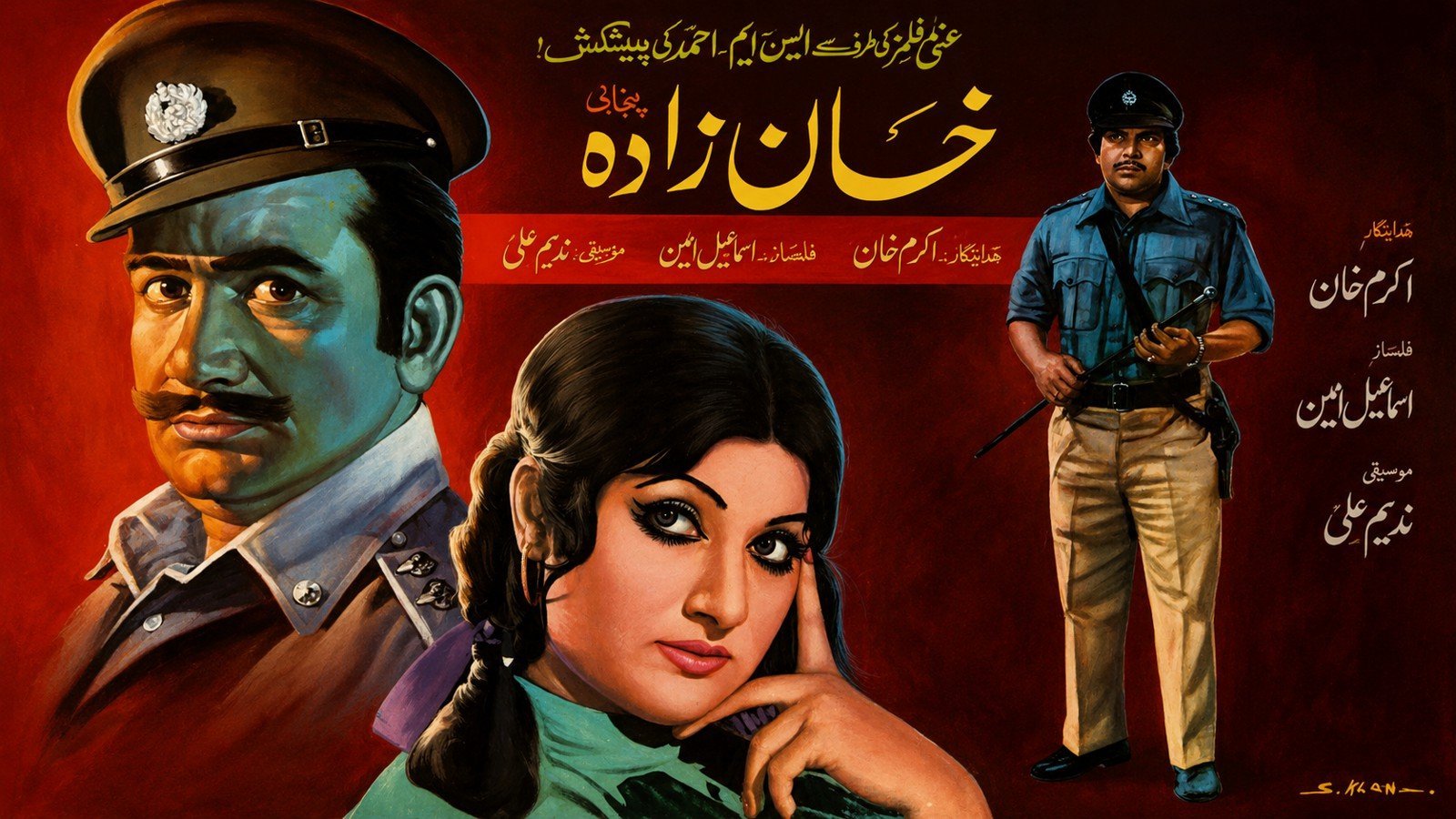
Khan Zada (1974)
Cast: Asad Bukhari, Aasia, Iqbal Hassan, Afzal Ahmed, Najma, Naghma, Habib
Director: Akram Khan
Synopsis: Brutal city life turns mild-mannered Akram into feared crime kingpin Khan Zada.
Reviewed by: Omar Khan
Producer-director Akram Khan believes that given enough time, lightning can strike the same spot twice, or so he hopes. Twenty-seven years after his original scored a bullseye at the Box Office, Khan has decided to resurrect his crowd-pleasing pot-boiler with an updated version that retains the same title: Khan Zada.
While the new version featuring Shaan in the title role has just opened, it’s worth checking out the original to see what all the fuss was about, to begin with—and why the film became a monster success.
First, Akram assembled a stellar cast of big guns for his Punjabi feature, including stalwart veteran Matinee idol, Asad, who was paired with ‘70s siren, Aasia, at least half his age. The supporting cast includes The People’s (c)hunk Iqbal Hassan and a fresh Heera Mandi recruit, Najma. She shot to fame with a brief but telling contribution of a stunningly saucy dance number to the chart-topping Nahid Akhter song Akh Lade te Ladai ja. This smash hit song played a significant role in the film’s success. People went wild, showering the screen with coins whenever the number appeared on screen, and by all accounts, the highlight of the new Khan Zada is this very song lifted from the original. The hit was also a breakthrough for Nahid Akhter, who challenged and surpassed the great Madame Noor Jehan for popularity during the Babra Sharif era.
Other notables lending weight to the cast are another ‘60s and early ‘70s siren, Naghma, whose most alluring attribute other than her shapely bum was her notably bushy moustache.
Habib, who looks remarkably sophisticated, soft-spoken and polished to act a Punjabi film hero, also briefly appears before disappearing as suddenly as he appeared. The ‘70s/’80s idol, Shahid, of the trademark mutton chop sideburns and paunch of affluence also makes a brief guest appearance. The film begins with an errant husband stealing his wife’s few remaining jewels for the nightly round of Satta (gambling), which he loses. There is a scuffle, and the idiot ends up murdering his adversary. So, the bushy-haired hubby flees the village and ends up at an old mate’s place, who advises him to go to the city and borrow from his elder brother, who has amassed a fortune. When refused, he murders his brother in cold blood and takes off into the cover of the night. Meanwhile, his simpering wife Nasira takes refuge at a kindly business magnate’s house, where the couple with a young daughter gives her shelter. Nasira’s daughter grows into Zarina (Aasia), the college-topping Ms. Goody Two Shoes. Little does she know that the child the business magnate has adopted is her lost son from the night they fled the village all those years ago. Fate will bring everyone together by the conclusion, but for the moment, the usual bunches of tangled relationships will slowly untangle as the film goes on
Zarina demands that her mother, Nasira, tell her about her father, but she discovers he murdered someone and ran away. Later, Zarina
Khan Zada starts looking for a job and is nearly conned into working at a sleazy club, run by none other than her father, whom she doesn’t recognize.
Then, the action switches to the village once more, where we learn about the plight of Zarina’s Aunt, who is about to keel over from some illness or the other (or just boredom). Her son, a distinctly craggy, paunchy and wrinkled Asad is desperately worried about Mom and consults the local wandering minstrel for advice. The village sage tells Asad to head for the big city, where medicine and hospitals are all free, as are doctors.
The sage has slurped one bhang too many, but Asad heeds his loopy advice and waddles off to the city with ailing Mum hoping to find free hospitals, doctors and medicine.
When Asad discovers that medicine and hospital care cost money, he lapses into pseudo-Bhuttoist socialist soliloquies, sobbing profusely and wallowing in pools of self-pity. His mother does keel over, and instead of burying her, Asad takes the corpse back to the village in a taxi (how did he afford it!?). He returns home with the corpse of the decaying corpse of his mother, far more concerned about exercising his socialist diatribes than burying her. Just as he delivers a particularly potent lecture about the evils of the big city, he is told that his little sister, Naghma, had gone off to the same den of sin in his search. She arrives in the town and is promptly run over by a dashing young prince, who falls madly in love with her despite the bandages. He vows to help her find her mother, not knowing she’s back in the village being denied burial by her demented son.
Asad returns to the city looking for Naghma and finds the city a most unwelcoming and nasty place full of mean-spirited people, who haven’t hot the time of day for a village bumpkin like him. He is treated with disdain wherever he goes. After taking one knock after the other, he slowly realizes that his mild-mannered, village idiot act won’t get him very far.
He transforms himself (primarily by wearing a rather camp black cape) into the notorious underworld kingpin known in hushed tones as Khan Zada. Meanwhile, he discovers that his sister has jumped to her death trying to escape Jack, the nasty scarred henchman who works at the club where innocent young babes fresh from the village are duped into “performing”.
The film winds its way to its predictable conclusion, and one waits for the various tangled threads of the plot to unravel in the way that we all know they will. The policeman goes to arrest the woman’s beau, only to find his picture in their living room and discovers that the old lady living there is his long-lost mother. He also discovers that the woman dating the beau is his sister. The problem is she’s in with the dreaded criminal known as Khan Zada, but they all don’t yet know that Khan Zada is the son of the (deceased) Village dwelling Aunt.
To call the plot of Khan Zada convoluted would be a huge disservice—it is way beyond that. The film is a typical masala pot-boiler with a tangled web for a plot that miraculously manages to hold together till the end when all strings come together, and all ends as it should.
The film is carried on the sagging shoulders of Asad, who shows his aptitude for delivering high-voltage, passion-arousing diatribes and turns in a crowd-pleasing performance that had us in fits of giggles with its overwhelming levels of ham. The quivering lips, impassioned speeches, wailing, and ranting are all construed as superlative acting. It is no surprise that Asad’s career spanned several decades. Iqbal Hassan is another man who surely couldn’t have been famous for his looks. Still, his acting isn’t much to write home about either, so it must have been that bulbous, well-rounded
Physique, bubbly nature and those roly-poly cheeks that the audiences found so endearing over the years. Aasia doesn’t have much to
Khan Zada do, but Najma, the new starlet in her debut feature, shines and fizzles in her dance number even if she doesn’t have much else to do.
It’s pretty average fare but with one of those plots that people can sink their teeth into and with fiery, lecturing diatribes about nasty rich city folk to satisfy the local cinema-going audiences.
Asad’s dramatics have a certain je ne sais quoi about them and an old-world charm, and all in all, the film at least has a semblance of a plot, however, fangled and nonsensical that may be

0 Comments
Leave a Comment