
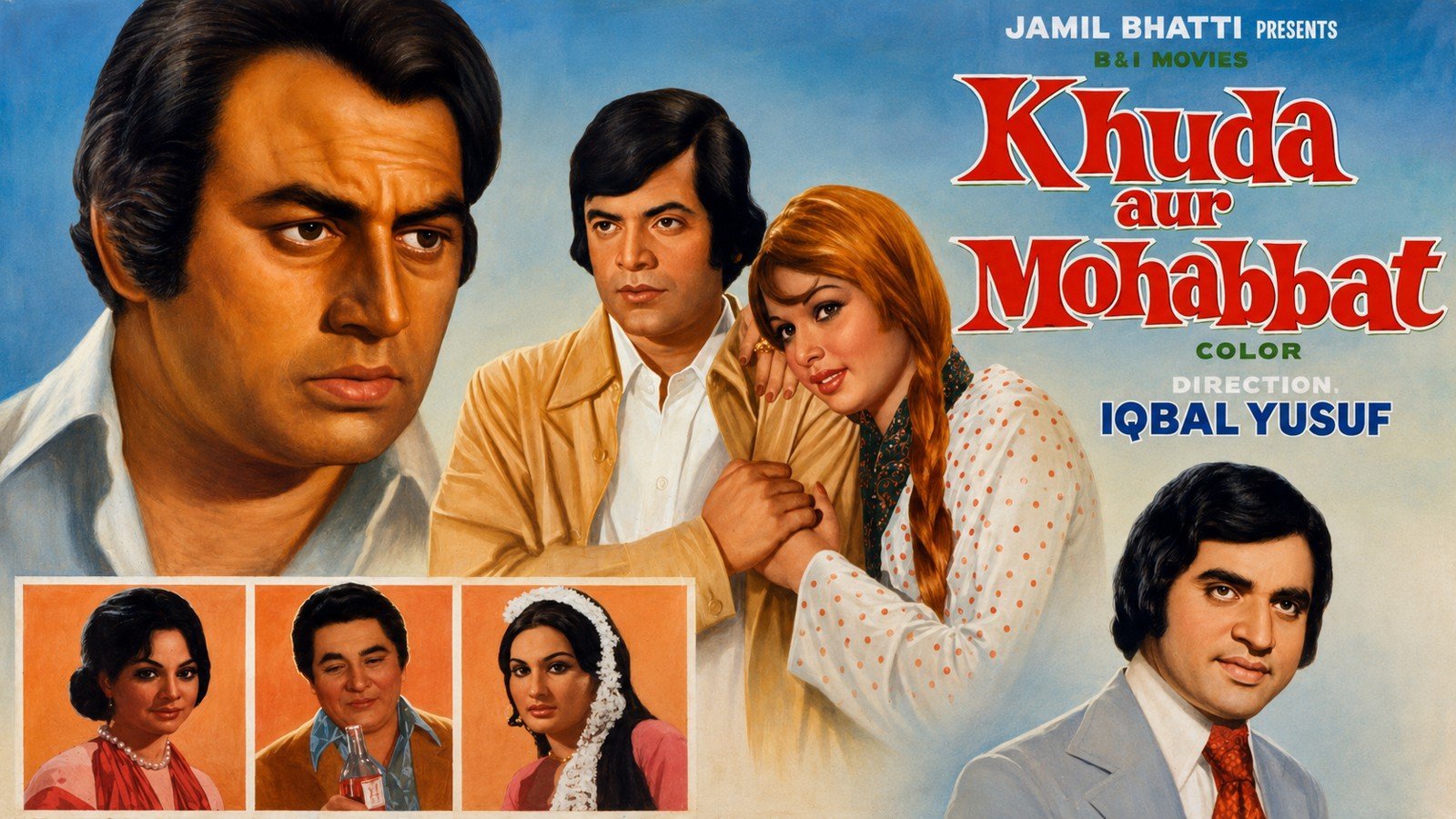
Khuda Aur Mohabbat (1978)
Cast: Mohammad Ali, Babra Sharif, Waheed Murad, Ruhi Bano, Ghulam Mohiuddin, Lehri, Ghazal, Tamanna, Najma Mehboob, Atiya Sharif, Jahangir Mughal, Chakram, Mirza Shahi, Saqi, Inayat Anjum
Director: Iqbal Yousuf
Synopsis: Hugely entertaining hoot of a Zia-era pro-Islam melodrama with Babra Shareef turning in an Oscar-worthy performance.
Reviewed by: Omar Khan
Could it be a sign that the urge to watch this 1978 post-Zia melodrama coincided with the last ten most holy days of the most sacred month on the Islamic calendar? Could it be just a coincidence, or is it a sign, a message to mend the heathen ways and seek the righteous path, having strayed for so long? Khuda aur Mohabbat is a film that could save souls, and steady and guide those who have stumbled and lead them to eternal peace and glory in this life and beyond. This film can bring light where there is darkness and serve as a beacon of hope to the faithful, and also those who have yet to receive the true enlightenment. Khuda aur Mohabbat might be another commercial melodrama aimed at making a quick buck at the Box Office, yet its lofty morals elevate it to higher ground.
The film begins with a shot of what resembles a parliament building or Palace exterior. The shot establishes that the family residing within are incredibly wealthy even if their furnishings and attire tend to belie that fact. Tamanna Begum is terribly excited that his son Babar is about to return from London after his studies. Her brothers,
Lehri and Mohammad Ali, are equally happy, and soon enough, Babar strides into the house looking like a hip Londoner with massive Bell Bottoms and bushy lamb chop sideburns. He is accompanied by two women with flowing blonde wigs and white faces, and it soon transpires that one of them is his new British wife Anita and Rita, her younger sister. Ghulam Mohiuddin (Babar) greets his elder brother with a “Hello, How do you do?” rather than the traditional “Assalam Alaikum”.
At the same time, Tamanna is in shock that her son should have married a non-muslim, instead he has married a white woman and brought her home. Just as the appalled mother is about to lay into her son for having the gall to marry an “angrez,” Mohammad Ali reminds her that Islam forbids treating guests aggressively. Also, the religion is against using force to impose itself on others, and those who use the sword to impose Islam are misguided. He believes love is the way to conquer minds, not the sword. Tamanna backs off, and the two white women are accepted as guests, even though they barely speak a word of Urdu, and there is a severe communication gap between the two sisters and the rest of the household. However, they grasp enough to be in awe of Mohammad Ali’s accepting attitude and shower him with praise, “Oh, you are a great man,” and so on.
Lehri, a frustrated ageing scheming weasel of a man, senses an opportunity to latch onto the attractive but naïve Rita as soon as possible.
The following day Rita decides to head out for some sightseeing and approaches a taxi stand where the lecherous Jehangir Mughal serenades her. Fortunately for her, a waiting taxi driver beats Mughal up, and she decides to tour Lahore with the decent Taxi Driver instead.
The Driver (Waheed Murad) shows Lahore’s famous sights while Rita struggles to communicate, often using her pocket dictionary to find the right words to use in Urdu. When she tells him she is hungry, he takes her to a typical Taxi Drivers Dhaaba, where the horrid
Khuda Aur Mohabbat
Jehangir Mughal again tries to impose himself on Rita and is thrashed by the gallant Waheed Murad. Day turns to night, but Babra realizes she has lost her handbag, which contains her home address, and now the two of them drive around the city trying to find where she lives. As night falls, Waheed Murad suggests that she stay at his place with his mother and that he will drop her home the following morning.
Rita sleeps in the bed near Waheed’s mother, who wakes up horrified to find a white woman in the adjacent bed and takes to beat her. She is rescued by Jameeluddin, whom she calls Jimmy and matters are sorted out amicably. Babra watches the mother teach little children from Quran and is deeply impressed. Later, Rita is reunited with her sister and the family, who give Waheed some money as a reward for looking after Rita so well. Like the fine gent he is, he refuses any extra money, and his decency deeply affects Mohammad Ali, who remarks how rare it is to find someone who doesn’t put money before morals.
Later that night, Rita is mesmerized by some sounds she hears from the prayer room and follows the voice to find Mohammad Ali reciting from the Quran. She asks him a few questions, which he answers saint-like, again making a deep impression on her.
The following evening when Jimmy takes her to the Tip Top Dance club where all the fashionable modern people of the city hang out, Rita feels awkward and asks him to leave the place as the noise and the atmosphere disturbs her. Gradually she finds the Western, unislamic lifestyle less attractive than she once did.
Jimmy is puzzled but pleased to see these changes in her personality and takes her home to learn more about the Quran from his mother. The two women strike a bond, and Rita soon professes to want to marry Jimmy.
Tamanna is mortified at the prospect of bringing home a lowly driver as family, but the sage and saintly Mohammad Ali reminds her of the ways of Islam, and she is subdued once again. Wedding plans are made, but complications arise when a neighbour madly in love with Jameel, starts causing problems. Lehri, desperate to break the union of Jimmy and Rita, hatches an evil plan that threatens mayhem, and a heart attack strikes Mohammad Ali due to all the tension created. The marriage is in a total disarray, Mohammad Ali is about to keel over, and disaster looms—a dreadful situation from which there seems no escape.
Will things be resolved? Will Mohammad Ali live or die? Will Rita and Jamil’s relationship come to a shuddering end? Everything appears in tatters as the film reaches its climax.
The film is the perfect Zia Ul Haq era sermon and a brilliant showcase for the wonders of the Islamic faith. However, what sets it apart from most other movies is that it doesn’t avidly attempt to malign different beliefs like so many films have hitherto done. There is none of the vitriol and hatred that similarly themed movies spew most offensively. Khuda aur Mohabbat certainly talks up Islam by claiming the Quran to be the last word of God, compared to other books that have come before and that there will never be a book to follow. However, it doesn’t attack other faiths like many hatemongering films have tended to.
The film makes a few judgement calls, such as how the Islamic Family system treats parents compared to the way it is in the West.
Still, it never stoops to vilify other faiths, an unfortunate path many scriptwriters and producers have chosen.
The performances generally engage with Babra Sharif, outstanding as Rita with her little pocket dictionary. Not for one second does she seem like a British woman, but there is some charm to her effort’s
Khuda Aur Mohabbat woeful inaccuracy and lack of authenticity. There are one or two enjoyable club dances and a duet with highly amusing English lyrics.
Overall, Khuda aur Mohabbat is a typical pro-Islam film for the masses but executed without the hate that permeates many of the subgenre. It is entertaining, amusing, witty and generally inoffensive, and if it plays to the gallery, it is perfectly understandable considering its target audience.



0 Comments
Leave a Comment