
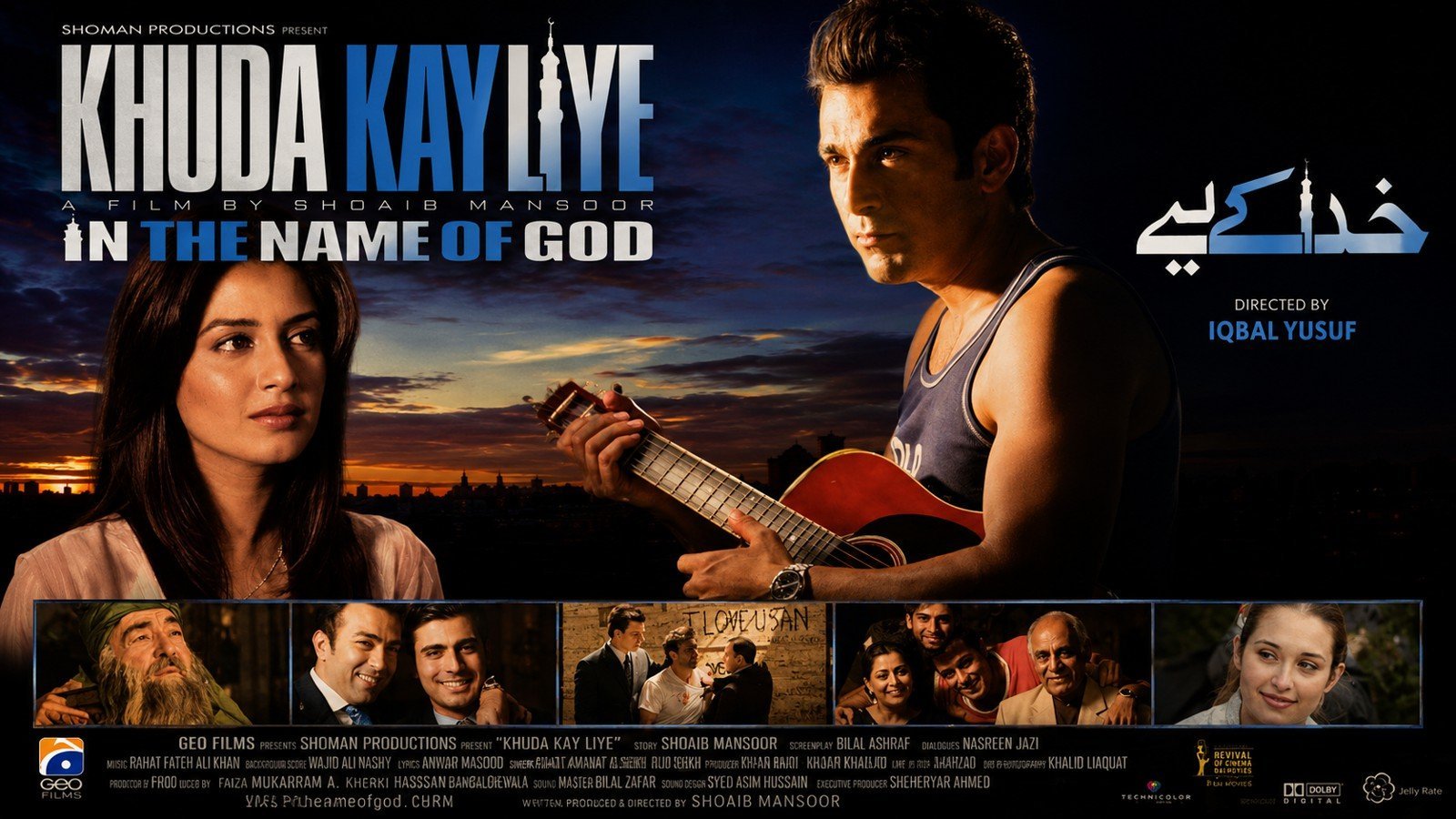
Khuda Ke Liye (2007)
Cast: Shaan, Rasheed Naz, Iman Ali, Fawad Khan, Naseeruddin Shah
Director: Shoaib Mansoor
Music: Various
Synopsis: Hugely ambitious and largely impressive post 9/11 scenario based movie.
Reviewed by: Omar Khan
The Geo Media Group announced Film Director Shoaib Mansoor’s highly ambitious project with a considerable fanfare. With time, it had become one of the most anticipated movies in recent Pakistani history (sounds almost like an accolade!). It arrived riding a wave of publicity seldom witnessed in Pakistan.
After the first few shows of the movie, the rave reviews started to fly thick and fast; even normally sane people spouted gushing superlatives, and the queues grew longer and longer with each passing day.
So, is the film all that it is touted to be? Does Khuda Kay Liye live up to the enormous hype, and does this film signal the muchproclaimed “Revival of Cinema in Pakistan,” and will it win an Oscar? The following review will attempt to address those queries.
Having spent the last day or two hanging out at a cinema in Royal Park that was screening Nasha Jawani Da, I had ample time to be amazed at the current level of commercial cinema in Pakistan and most of the theatres themselves. Sitting in rubble watching Nasha Jawani Da, one wondered why even a poor labourer wouldn’t prefer to spend his time trying to catch some sleep than watch the garbage on screen. Worse still, the trash on the screen projected by a relic built in 1938 and the sound that came through the few still functioning, bust-to-pieces loudspeakers was more crackle than audio. The coffee, chai and cold drinks kiosk lay in ruin, as did everything else in this particular cinema in the heart of Pakistan’s film industry, Royal Park Lahore.
But back to Khuda Kay Liye – The title sequence is simple yet dignified. The background music is soft and pleasing, suggesting even at the very outset that the audience might be in for a surprise and for those who watch films like Nasha Jawani Da regularly might do well to keep the smelling salts handy. From the few opening scenes of the film, it is evident that the aesthetic and orientation of the film are unrecognizable from the world of Nasha Jawani Da.
The acting, for the most part, is commendable, with some performances outstanding and some less than memorable. However, there is genuine quality in the drama, yet the real star is the writer, who has etched believable and likeable characters; there are no tacky songs nor any vulgar comedy – it’s all hugely refreshing.
Among the actors, Rasheed Naz walks away with a towering performance under his belt, and hopefully, the film’s success means we will see a lot more of him. He is brilliant, exuding a perfect blend and balance of charm and menace. His portrayal rings frighteningly true. The parents of Shaan and Fawad Khan are also well-acted and perfectly believable. Shaan himself turns in an honest and sober performance, even if he looks more like the parent of a college student than a student himself. However, his girlfriend is a weak link, and their moments together are perhaps the least effective scenes of the entire movie. The scenes at the Jazz College veer into some weird Teenage
Khuda Ke Liye
Kids from Fame kind of thing with a cheesy number, when all the kids join in with Shaan like some horrible We Are the World spinoff.
Iman Ali carries herself well and turns in a perfectly adequate performance, despite the occasional accent cock up. Whenever she says Dave like Dive, she suddenly morphs into a cockney lass from Dalston, then slips back into her regular blah accent. These accent malfunctions provide some moments of comic relief, but criticizing the film for such negligible issues would be nitpicking. Shoaib Mansoor has taken on an arduous task and has accomplished what he set out to achieve. It is head and shoulders and in anything else above any other commercial film made in Pakistan in the last quarter of a century, if not more. Its message is relevant and vital; even without the message factor, the film succeeds in almost every count. That said, I found the movie over long to about 45 minutes – the second half was laborious at times. Right at the end, with the court case scene and the arrival of Naseerudin Shah, the film appears to step into a traditional Bollywood-style uplifting sermons.
However, these are minor quibbles with a film that will set the standards for all mainstream movies. It is a superb effort by Shoaib Mansoor, a truly towering achievement, and his movie deserves the success, and the accolades showered on it.
Khuda Kay Liye is a ridiculously gigantic step forward for Pakistani commercial cinema. Watching the film with a packed, utterly involved crowd with no empty seats was a little special. Can there be life after death for Pakistani cinema? Or will we be banished to premature hell and be forced to watch Nasha Jawani Da sitting in the rubble that was once a cinema? Khuda Kay Liye and a couple of other films in the pipeline suggest that 2007 could well turn out to be a pivotal year in Pakistani cinema history. Geo, the thrust of this “Revival of Cinema in Pakistan,” deserves credit for daring to attempt what nobody dared and, by doing so, retaining their cutting edge.
One of the best aspects of KKL was that it didn’t ape Bollywood, while Javed Shaikh’s Yeh Dil Aap Ka Hua leant so much towards Bollywood aesthetics. Shoaib Mansoor, to his credit, has not styled the film to mimic the style of Bollywood or anywhere else, and he has just followed his impulses which have turned out to be a considerable strength of the movie. Overall, it was a very wellcrafted, intelligent and impressive film that would have been even better had it been more concise. Oscar Awards may not beckon yet, but despite that, the film is a welldeserved triumph for Shoaib Mansoor.


0 Comments
Leave a Comment