
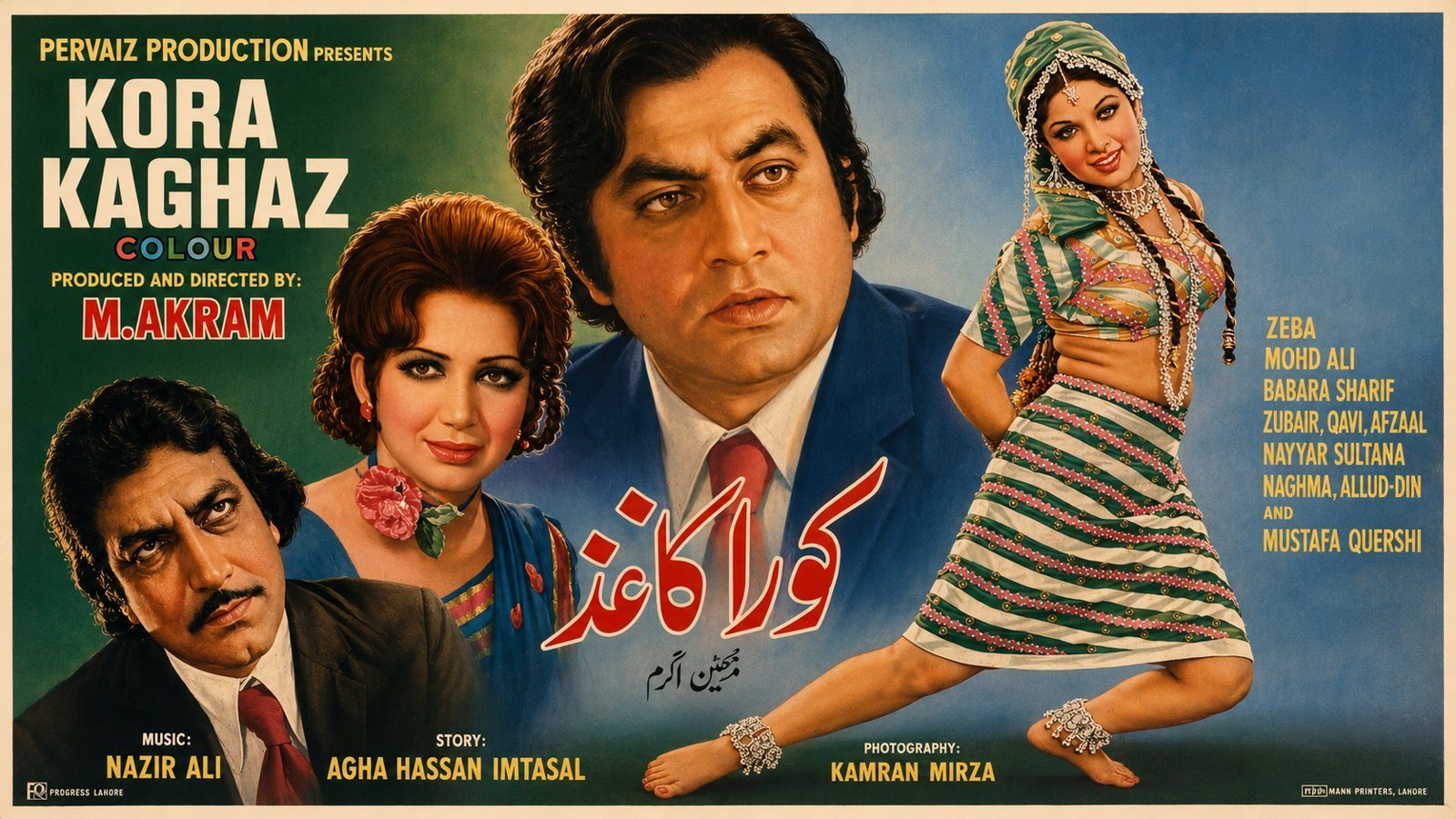
Kora Kaghaz (1978)
Cast: Zeba, Mohammad Ali, Babra Sharif, Zubair, Mustafa Qureshi, Afzaal Ahmad, Shahnawaz, Qavi, Nayyar Sultana, Naghma, Saba, Allauddin, Parveen Bobby, Mizla, Kemal Irani, Nasira, Tani Begum
Director: M. Akram
Synopsis: An impressive array of Lollywood greats litter the cast of this delicious tale of morals, revenge, intrigue, backstabbing, miracles, Some Say I Am Sweety and the kitchen sink as well.
Reviewed by: Omar Khan
Akram had recently scored a considerable dud with Aakhri Goli and set out to redeem his box office standing with Kora Kaghaz, ensuring he signed a bunch of A-list stars to give his film the edge. Nazir Ali was roped in for the music and slightly fading superstars Mohammad Ali in the lead role along with Zeba, Naghma, Mustafa Qureshi, Nayyar Sultana, Babra Sharif, Afzal Ahmed, Allauddin, Taani, Nasira and finally Shahnawaz. Zubair, an aspiring new “hero,” who debuted in Kora Kaghaz in a vital role playing opposite rising star Babra Sharif. Still, while she was to forge a hugely successful career for the years to come, poor Zubair was never to be seen again.
The film had permanently been lodged in the memory bank since my brother and I purchased a cassette tape of Nahid Akhtar’s spicy new songs and were blown away by it. There were such great songs as “You Are a Wrong Man, wrong man, wrong man, wrong man,” “You Are Lady Killer,” and “Come On Boy, let’s Enjoy this is Sachurday Night.” But the one that stood out among the gems delivered entirely in English and has since gone on to become the cult classic of Pakistani film songs of all time was, of course, “Some Say I Am Sweetie” by Nahid Akthar. This song made a mark on us as few others had, and the desire to watch Kora Kaghaz has been simmering ever since.
A YouTube search can get you to the song. Still, as we were to discover, and millions of you would have, the song used in the film is radically different from the spectacular version recorded and released on Vinyl and Cassette in the late ‘70s. The Audio version has no Urdu verses used in the movie and is 100% English. The version you are shown in the film has the English verses removed entirely and replaced with Urdu verses. Though the song is still a catchy little ditty, it has been stripped of the glorious lyrics and rendered a shadow of its best, which fortunately has been preserved on Vinyl and Audio Cassette and is now found on Spotify and iTunes.
But Kora Kaghaz is much more than just the movie containing “Some Say I Am Sweetie.” It is more than a delectable slice of masala featuring classic desi morals corrupted by money and modernity’s evil ways.
Brilliant scenes contrast the lifestyles of two sisters, one plying her trade as the trophy wife of an upwardly mobile, modern husband at the club, while the other traditional and unfortunately mute wife clutches her husband’s toes…the toes which are now her life. Alauddin has been forced to get his daughters married off, and
Naghma, the younger and rather snazzier daughter, though timid and godly, doesn’t take too long to break into a full hair-dance routine at the beckoning of her husband and his sleazy mates at the club. The shrinking, sari-clad ghareloo girl throws off her inhibitions within minutes to become the focus of the club nightlife scene, a role she
Kora Kaghaz rapidly relishes. Her hairstyle undergoes radical changes in that the classic desi bun is replaced with a mod-girl haircut. She tosses her locks vigorously with abandon while executing a series of stunning hair-dance moves.
The “hair dance” is typically a club dance move perfected in Pakistan where the tresses are thrown from side to side, obscuring most of the face while keeping in rhythm with the music and wiggling the hips in tandem. The finest exponent of this art has probably been Aaliya from the ‘70s; many have followed in her footsteps, and Naghma, too, can perform a pretty mean Hair-Toss as she demonstrates. It’s a dance that has evolved from the debauched dancing that drug-sodden hippies frequently indulged in.
Daddy Allauddin realizes what a horrific lump of a partner he has found for his mute daughter. Beset by the guilt, he gifts his home and most of his assets to the mute Nayyar, having been snubbed by the haughty Naghma, behaving more and more like Bindu from Do Raaste. He tells her that he always believed that her virtue would overcome her husband’s moronic frailties and that she could make a man out of her drunken, womanizing, and wayward idiot of a partner.
Meanwhile, the shallow, two-faced Naghma is enjoying her new role as queen of the club and society girl number one, but things soon start to turn sour for her as her husband and his philandering ways begin to catch up with them. The riches soon turn to rags, and his debts begin to mount, much to the horror of his wife and kids.
Meanwhile, the poor mute’s drunken slob of a husband, Mohammad Ali, visits the local kotha for kicks while his wife waits for him dutifully till the wee hours of the morning. But as morning turns to day, the tragic news soon reaches her that her husband and his sleazy lady friend Mizla were killed in a car accident caused by his excessive drinking. Horrified and consumed by sadness, she is left to bring up her two young sons alone, but at least she has her inheritance to provide them with an education and some prospects in life.
Sister Naghma has also sprouted a girl and a boy, growing up in the shadow of their wayward parents. While the parents idle away the hours with their rubbish, the kids have make-believe club dance parties where they end up as slobbering drunks.
Zeba plays Naghma’s grown-up daughter, while Shahnawaz plays the son. Mustafa Qureshi is their slimy friend with a roving eye and a devious, scheming mind. He senses an opportunity in the faltering way of Naghma’s drunken oaf of a husband who has almost frittered away his entire wealth on gambling debts and now stands on the brink of destruction. Instead of helping his uncle, who is in dire need, he adds fuel to the fire by bringing him more and more alcohol and making sure he gambles away the shirt off his back, which he duly does.
Nayyar has given birth to two fine, morally upright sons; Mohammad Ali is now at least as old as his mother and is the head of an amazingly benevolent pharmaceutical company. He considers “Allah as the owner and he as just another employer.” Nayyar has brought up a fine, upright specimen and a highly successful and respected one too.
Things start getting sticky when Mustafa Qureshi turns Zeba and Shahnawaz against their uncle and simultaneously turns the screws on the drunken father to get his paws on Zeba, even though he also has his eyes on Babra as well. Qureshi cooks a nefarious plot to trigger Mohammad Ali’s downfall and take over his massive wealth.
He blackmails Zeba to be part of the scheme, and there are two accomplices – Qavi, the evil one, who works as an imposter driver cum informer while Shahnawaz is also fully involved. The dastardly Qureshi frames angelic Mohammad Ali and has him all but convicted in court.
All of a sudden, Allah takes notice of all the injustices being committed and oversees a miracle that gives the forces of good one last chance to sort out the dreadful mess of a situation. When the most unexpected event occurs, Mohammad Ali awaits a death sentence, and Mustafa Qureshi’s foolproof scheme is suddenly threatened.
There is much melodrama and intrigue as the story winds to its fairly exciting conclusion. Of the actors, Mustafa Qureshi is outstanding, as he almost always is, and he is given solid support by Mohammad Ali, Zeba, Afzal Ahmed, Naghma, Nayyar Sultana, Allauddin and the rest. Zubair fails to shine, but the rest of the cast is seasoned enough to perform their roles with precision.
There are a couple of known songs, but they are dwarfed by the majestic Some Say I Am Sweetie number. It’s a little awkward to see Zeba playing Naghma’s daughter and Mohammad Ali as the wrinkled, portly son of Nayyar Sultana, but that’s the way it goes in Lollywood. After all, Raakhee Gulzar played the mother of actors who had romanced her not so long ago! Women tend to age three times as fast as men in these parts.
There is an intriguing court scene where the judge is implored that Maa ki Mamta is tangible proof and valid evidence in a court of law. There is much thunder and lightning, emotions soar and ebb, and much soul-searching before the film finally winds down to its underwhelming conclusion.
Kora Kaghaz is a typically convoluted and dramatic family masala entertainer which managed to hold some interest. The lack of need to hit the Fast Forward button proves that the film moved along without getting bogged down, as is the norm. However, Kora Kaghaz doesn’t offer anything new, as the theme of Western debauchery and values leading to the doom scenario is something we have seen dozens of times before. Yet it manages to entertain pretty well, and any film that contains Some Say I Am Sweetie has already won half the battle.



0 Comments
Leave a Comment