
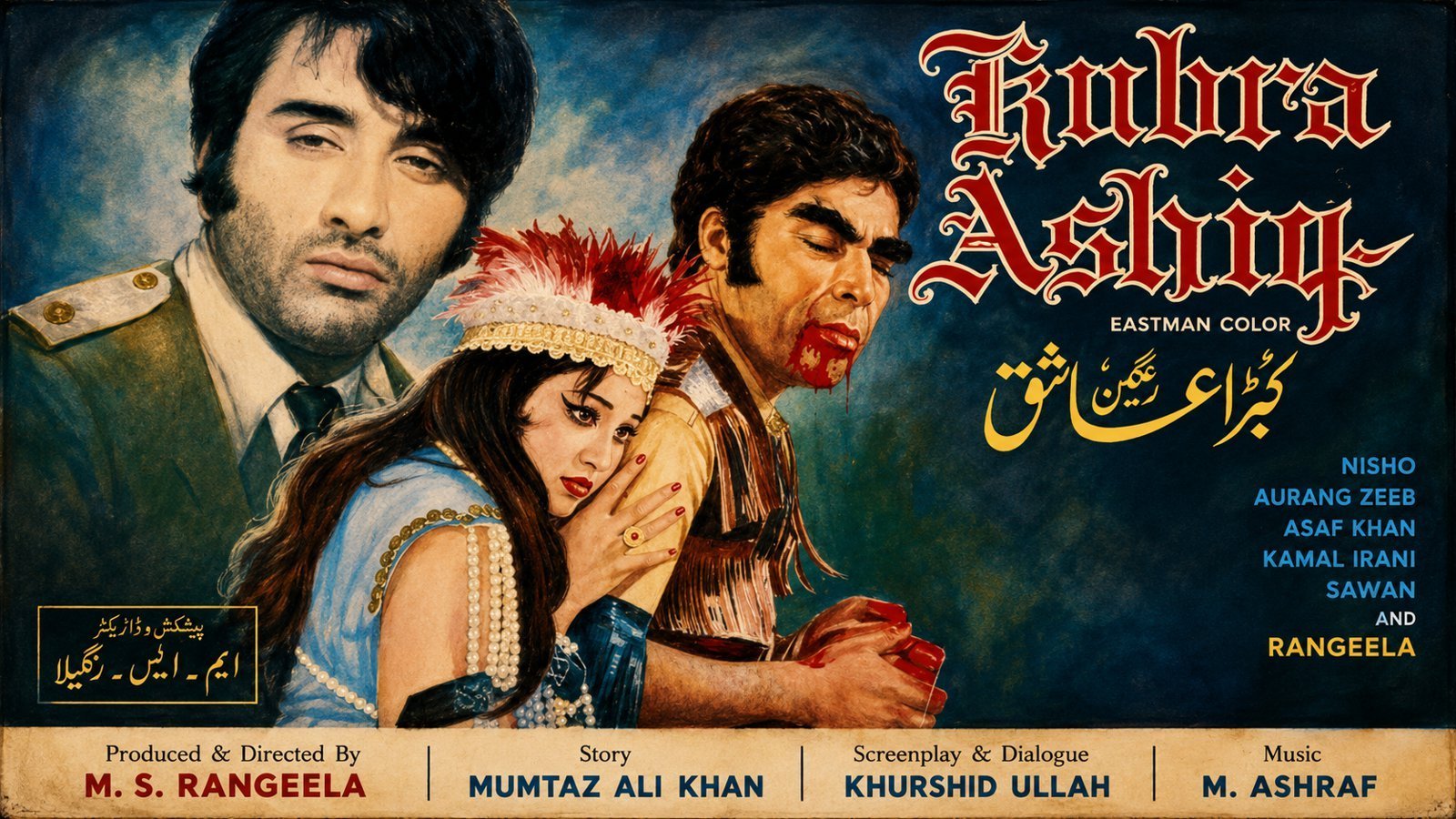
Kubra Aashiq (1973)
Cast: Rangeela, Nisho, Aurangzeb, Nirala
Director: Rangeela
Synopsis: Rangeela’s magnum opus – the Box Office dud that virtually ruined his career.
Reviewed by: Omar Khan
The film was made when Rangeela was at the height of his popularity, had become the top comedian in the country from nowhere, and had directed the smash-hit Deea Aur Toofan. With Kubra Aashiq, he set about making his magnum opus—his defining moment. Alas, the film has become famous for all the wrong reasons.
First and foremost, it was a stinker of a flop that the crowds utterly rejected within the first week of release. The film was derided out of town by audiences and critics alike. It brought a high-flying Rangeela resoundingly down to earth with the rudest of shocks as he had staked his mini fortune on this costume drama epic of absurd proportions.
The film’s abject failure utterly destroyed Rangeela’s career,and it made history as one of the biggest flops ever to emerge from Lollywood. It was vilified so vigorously that we decided to try to get hold of it and view it with a completely open mind, keeping in mind that Rangeela was the man behind the excellent Aurat Raj. Another film primarily rejected by the masses and the establishment upon release—perhaps it could be that Kubra Aashiq could contain undertones of satire or spoofing that were so evident in Aurat Raj? Maybe
Kubra Aashiq deserved a second chance and might be another lost golden nugget reviled and condemned by closed-minded bigots.
The story starts at the end of World War 2, just as the Allies have defeated their foes, and here in the Indian Sub-continent, the people await their much-awaited independence from colonial rule. The colonial rulers are shown to be rejoicing and partying it up to celebrate their victory. To cap off an evening of debauchery, the Gora sahib sends for a group of the finest local belles to satisfy their burgeoning lust. As the news of the abduction of the village belles spreads to the local ranks, they rebel against their oppressors to save their sisters’ honour. A bloody fight ensues, and our hero, Aurangzeb, escapes and drifts into the ocean.
Later, he finds himself washed up in a strange jungle inhabited by Pakistani men trying to look like African tribespeople from a Tarzan movie. Our hero is chased through the forest by these nasty, cannibalistic jungle folk, and just when he is about to be devoured for luncheon, he is saved by Sabu (Rangeela), the local community mutecum-hunchback.
Aurangzeb referred to in typical filmi style as Ajnabi, is treated back to health by the hunchbacked mute Sabu, and they bond together most touchingly. We are shown in a flashback that the evil and jealous Asif Khan had framed Sabu, who was subsequently punished by the village elders with banishment from the royal jungle kingdom. Sabu is sentenced to die, but the pretty princess Nisho throws a tantrum and has him exiled instead to save his life. Quasimodo inspires Rangeela’s Sabu from The Hunchback of Notre Dame, and the film follows similarly.
Unfortunately, Rangeela’s antics of warbling and grunting start grating on the nerves about thirty seconds after entering the film, and they do not relent. The story follows a laborious fable-like tale of how
Kubra Aashiq the mute, once he can express himself, finds that he was better off as a mute after all—and proceeds to hack off his tongue in an ungrateful and extraordinary display of petulance.
The film isn’t the monstrosity it was made out to be; it’s far worse! Kubra Aashiq is an embarrassment from beginning to end—a grand magnum opus gone wrong. Rangeela’s fable based on Quasimodo is one of the most cringe-worthy and lamentably unwatchable films this reviewer has yet to encounter. To endure the dwarf-like mutant Rangeela behaving like a demented moron for two and a half hours is dif- ficult to stomach. The film is a resounding failure in every aspect. Even the sets and costumes upon which Rangeela spent his fortune are appallingly tacky, and the overt attempts at comedy are pathetic at best. The film is mind-numbingly dull, and not even a succession of promising men in bear suits at the film’s beginning materialize into anything of any worth.
Kubra Aashiq is all they said it was, but worse! The film could have its uses, though—as an instrument of torture for errant children or to rid yourself of unwanted company.

0 Comments
Leave a Comment