
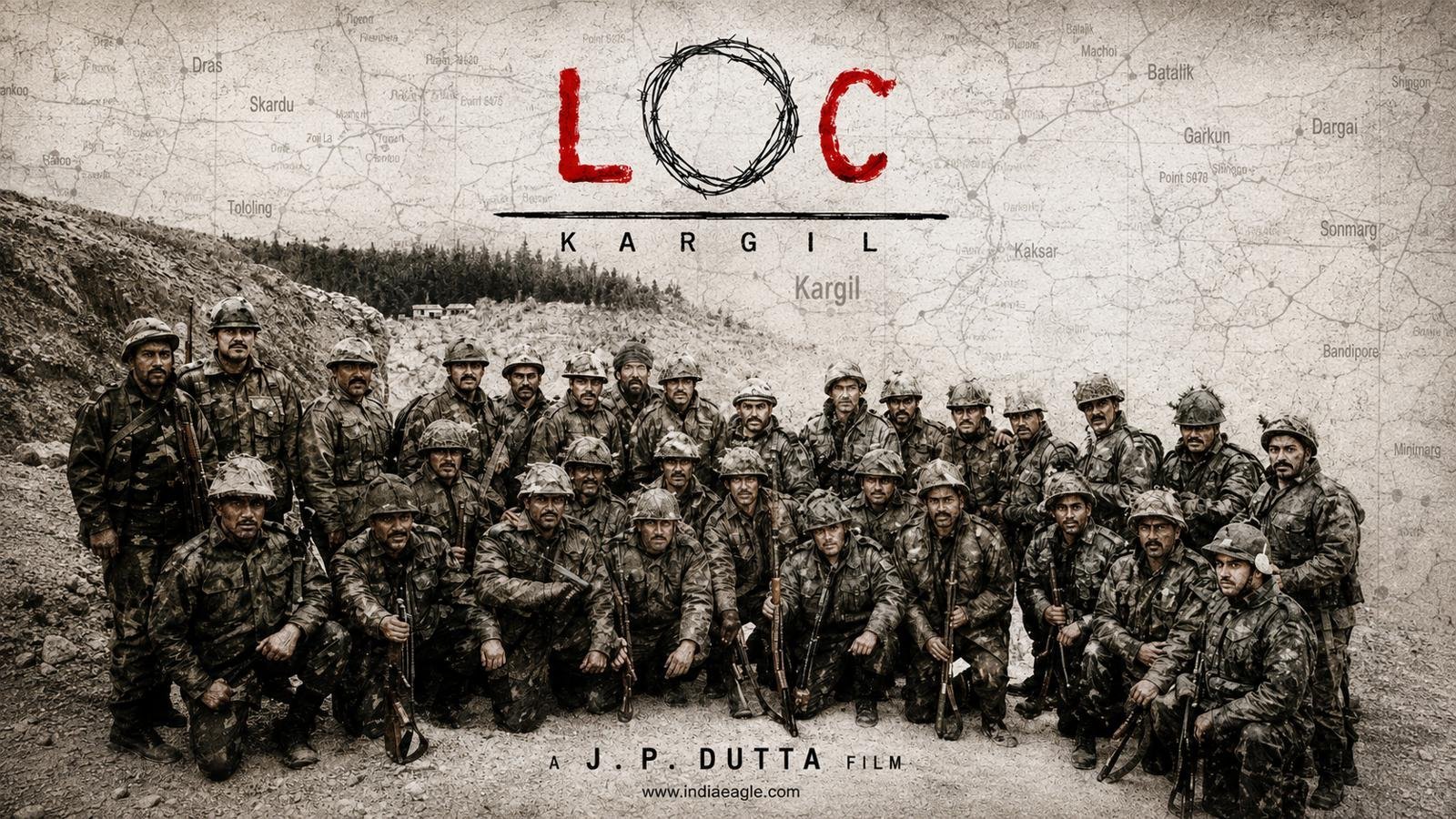
L.O.C. (2004)
Cast: Sanjay Dutt, Ajay Devgun Saif Ali Khan, Abhishek Bachchan, Sunil Shetty, Rani Mukherjee, Esha Deol, Kareena Kapoor, Mahima Chaudhary
Director: J.P. Dutta
Music Director: Annu Malik
Synopsis: More "Cold War" jingoism - hateful attempt to cash in on human tragedy
Reviewed by: Faiz Khan
LOC Kargil probably boasts the biggest star cast ever assembled for a Hindi film, almost Bollywood’s answer to A Bridge Too Far, with actors falling over themselves to be part of J.P. Dutta’s tribute to the jawans who fought and won the battle of Kargil. Unfortunately, that is precisely what the film remains: a tribute to the jawans. So preoccupied is Dutta with telling each individual story that the film loses all perspective, moving from one battalion to another without ever concentrating on anything beyond the fact that these men risked everything for their country.
We all know that war is a dreadful thing. We should also recognise the utter absurdity of two neighbouring countries, essentially the same people divided by history and politics, coming so perilously close to nuclear confrontation. Then again, when governments are incapable of putting their own houses in order, they often look elsewhere to deflect attention from their failures. India is as guilty of this as Pakistan. Does Dutta examine the horror of war, its consequences or even suggest some path towards reconciliation? Absolutely not. His film is jingoistic, rabble-rousing and determined to convince audiences that he has created something which ought to make every Indian swell with pride. I very much doubt that he has.
The film follows the stories of a number of soldiers, all apparently based upon real people rather than fictional creations. Unfortunately, they are presented largely as a collection of gung-ho warriors determined to defeat the “bhediyas” and “kuttas” who have invaded the motherland. Their stories inevitably expand to include the women they have left behind, at which point it is song time. Esha Deol, Rani Mukerji, Kareena Kapoor and assorted other misty-eyed beauties appear to sing a farewell number or shed a tear as their men march off to become heroes.
Every soldier must have his personal story and every star therefore requires his allotted ten-minute segment. One can calculate for oneself how much of the film is spent watching tearful heroines bidding farewell to their jawans. There are stories involving Sanjay Dutt, Saif Ali Khan, Abhishek Bachchan, Ajay Devgn, Suniel Shetty, Manoj Bajpayee, Ashutosh Rana, Nagarjuna, Karan Nath and many more. The list appears almost endless.
The pattern soon becomes painfully obvious. A flashback introduces the soldier and the loved one waiting for him at home. A song follows. Then comes a battle sequence, after which another body bag is sent back. One can predict with reasonable accuracy which soldier will survive and which one is marked for death. If Dutta spends too much time lingering over a romantic flashback, fate is almost certainly not going to smile upon that particular jawan.
After each personal story comes another battle. With every small victory achieved by the various battalions, we return to the anguish of the dead being carried home. What should have built towards a powerful and emotionally overwhelming climax instead totters weakly to its conclusion, with “Ek Saathi Aur Bhi Tha” accompanying the end titles rather abruptly.
I must admit that I was never a great admirer of Border, though I considered it a reasonably accomplished film, perhaps because it concentrated upon one particular battle and a manageable group of characters. In LOC Kargil, Dutta attempts the impossible. Even with a running time approaching four hours, it is simply not possible to tell the entire story of Kargil through this many characters without selecting one individual or one regiment as the emotional focus.
Saving Private Ryan is a tremendous war film because it follows a specific mission—the search for Private Ryan—while still conveying the wider horror, chaos and futility of war more effectively than almost any film before it. Dutta, by contrast, strives for an enormous canvas and ultimately loses control of his own material. In fact, one is forced to ask whether LOC Kargil possesses a plot at all.
The performances are generally good, though each actor is given so little individual screen time that few have the opportunity to create a fully developed character. Saif Ali Khan stands out once again, demonstrating how considerably he has matured as an actor. Abhishek Bachchan brings a welcome energy to his role, while Ajay Devgn remains as dependable as ever.
Akshaye Khanna is burdened with some of the worst and corniest lines in the film, though perhaps even they are not quite as offensive as some of the dialogue given to Saif, Sanjay Dutt and Ajay Devgn. Among the women, Kareena Kapoor receives the largest role, but there is precious little for any of them to do beyond singing a song, shedding tears and, in most cases, receiving the body bags of their dead men. This is most certainly not a woman-centred film.
LOC Kargil is naturally offensive to Pakistani audiences, but it is also insulting to Indian viewers in the way it attempts to manipulate them into believing that this is the definitive account of the conflict. In truth, the film tells no coherent story at all. It merely uses sacrifice, death and patriotic sentiment to persuade the audience that it is a work of consequence.
Anu Malik provides one or two pleasant songs, though none is likely to remain in the memory for very long. “Seemayen Bulaye Tujhe Chalna Hi” and “Main Kahin Bhi Rahoon” are beautifully written by Javed Akhtar and shaped by Malik into genuinely moving compositions.
What is particularly reprehensible is that the film has absolutely nothing constructive to say. It is so one-sided that it might easily have been made during the Cold War, with the wicked Russians replacing the Pakistanis and the Americans presented as spotless heroes. This is particularly disappointing from Dutta, who at least attempted a message of peace in Refugee, however crudely expressed. In LOC Kargil, he appears to have abandoned any such ambition.
Dutta might have gained enormously by addressing the futility of war and the wastefulness of hatred. He could have used the terrible reality of Kargil to suggest that some hope or understanding might emerge from the carnage. Instead, he remains silent on all of these questions, and therein lies his greatest failure. The film is neither convincing fact nor satisfying fiction. It is simply a highly subjective and personal tribute which, after nearly four hours, achieves remarkably little.
Was I the only person yawning long before it ended?
Even more deplorable is the manner in which the film was later marketed as somehow contributing to the beginning of the “peace process” once the cash registers failed to ring as loudly as expected. Hats off to Indian audiences for recognising the film for what it really is: a piece of jingoistic rubbish.
Perhaps Dutta was correct to add the caption “Before We Forget”.
The likelihood is that most of us will forget it very quickly indeed.

0 Comments
Leave a Comment