
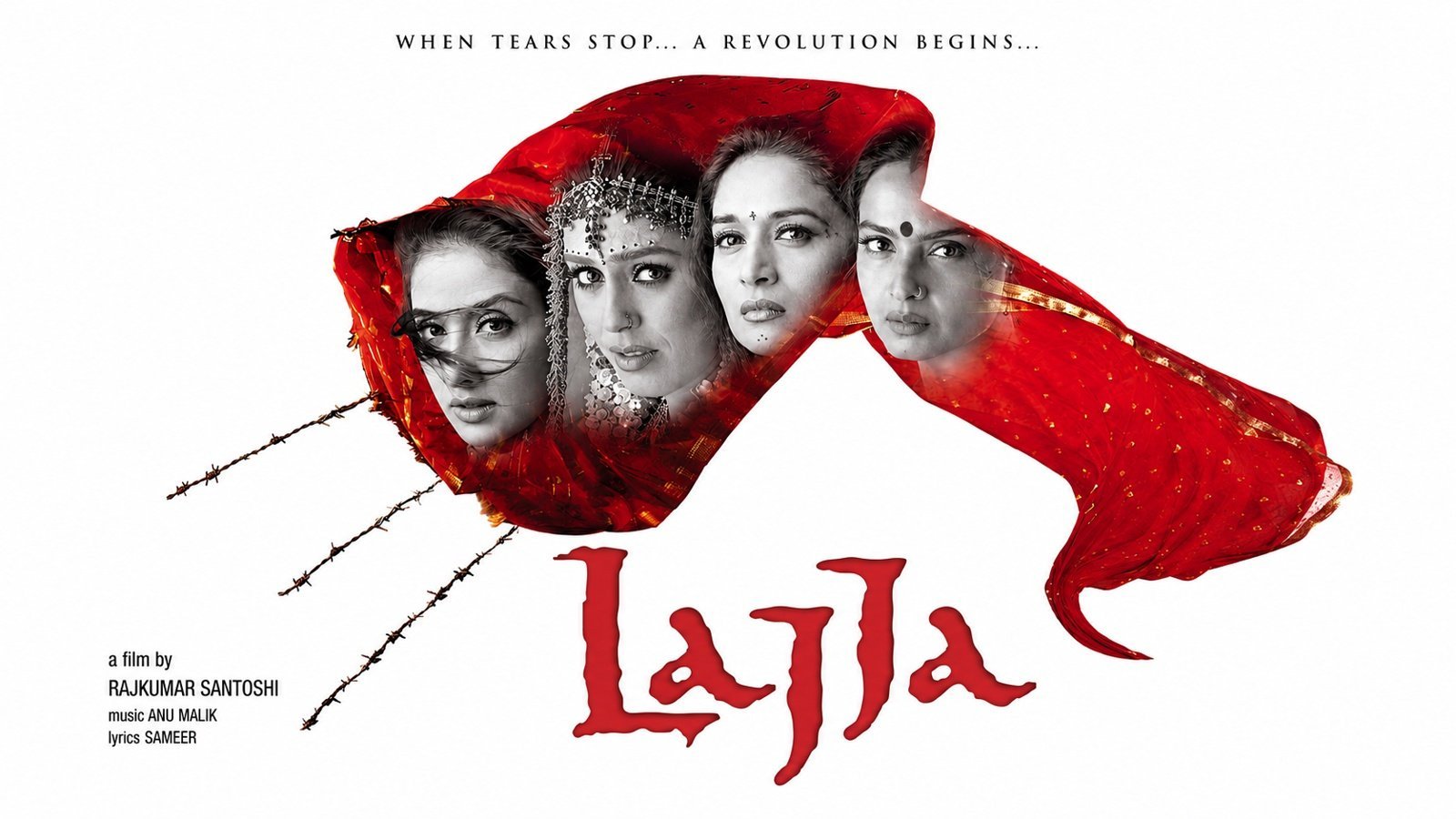
Lajja (2001)
Starring: Manisha, Madhuri Dixit, Mahima, Rekha, Jackie Shroff, Anil Kapoor, Ajay Devgun
Director: Raj Kumar Santoshi
Music Director: Anu Malik
Synopsis: A noble attempt to tackle some serious women's issues falls short of the mark
Reviewed by: Faiz Khan
Santoshi’s film opens with the Manhattan skyline as we are transported into the lives of wealthy NRIs in New York. Our heroine Vaidehi (Manisha Koirala), however, is deeply uncomfortable with the “Western” outlook of her husband Raghu (Jackie Shroff). Taunted, beaten and generally mistreated, Vaidehi is finally despatched back to India by her brutish husband, only for him to suffer an accident which leaves him incapable of fathering a child. Lo and behold, the family doctor then reveals that Vaidehi is already pregnant, prompting hubby and his pater to devise a scheme to bring her back from India so that a vansh may carry their family name forward.
Melting under the force of Raghu’s newly sweetened words, Vaidehi agrees to return, having also been informed by her own family that “a girl’s home is with her pati, not with her parents”. As she is about to board the plane back to New York, the family doctor alerts her to her husband’s nefarious intentions, prompting her to run away. Why she should decide to telephone the doctor from Mumbai airport is anyone’s guess, but then one has to jump-start the plot somehow. Thus begins Vaidehi’s journey, during which she crosses the paths of several women whose stories form the heart of the film.
Her first encounter is with petty thief Raju (Anil Kapoor), who has stolen Rs. 50,000 in order to make his way to Dubai and create a better life for himself. There is genuine sadness in the plight of this man, desperate merely to make some sort of beginning. Their paths cross at the wedding of Maithili (Mahima Chaudhry), which begins to unravel under the curse of dowry. Raju attempts to rescue the situation, but matters go too far and finally provoke an outburst from the bride-to-be, who speaks out against the dowry system and the humiliating treatment of women.
Vaidehi travels onwards and encounters Janaki (Madhuri Dixit), a small-time theatre actress who is also pregnant and due to marry her weak and insecure boyfriend. Poisoned by the insinuations of the villainous Purshottam (Tinnu Anand), who has designs of his own upon Janaki, the boyfriend begins doubting the paternity of her unborn child. He demands that she abort the baby, ostensibly to prove her loyalty and demonstrate that she is committed to him. Janaki rebels and voices her anger through the dialogue of a stage play in which she performs the role of Sita. Why, she asks, must Sita walk through fire when she has committed no wrong? Why is it always the woman whose character must be tested? Predictably, uproar follows and the same hypocritical public which should listen to her instead turns violently against her.
Vaidehi’s journey then brings her into the path of a Naxalite named Bulwa (Ajay Devgn), who saves her during a train massacre. From there she comes across Ramdulari (Rekha), a Dalit midwife whose only apparent crime is that her son has fallen in love with the daughter of a higher-caste family. Once again, it is not the man who bears the punishment but the woman who suffers, and in this instance she pays in the most brutal manner imaginable.
Lajja seeks to give voice to the many injustices inflicted upon women and, for that alone, one must admire Santoshi’s courage. Unfortunately, the opening section involving Vaidehi’s escape from her husband is dreadful. One would have expected the director to devise a more convincing reason for the runaway wife and for the husband’s obsessive pursuit of her. Would it not have been more powerful had she simply left of her own accord, bruising his male ego and provoking his rage? Instead, the screenplay resorts to the crass device of using her as an incubator, although even that perhaps says something significant about the attitude of the subcontinental male.
The climax also lacks the punch it desperately requires. Women charging onto the stage armed with chappals and chasing the villain becomes comic rather than stirring, while Vaidehi’s cries of “Haan, mujhe lajja aati hai” fall far short of the powerful, rousing declaration they were clearly intended to be. Even more damaging is the suggestion that Vaidehi’s ultimate salvation lies with her husband. His sudden repentance and miraculous transformation occur in a matter of moments and are almost impossible to accept. The resolution therefore undermines much of what the film has spent its running time trying to say.
Santoshi also tackles material that will not be easily digested by the masses. Religion is always difficult territory, however fair or relevant the questions may be. All four principal female characters bear names associated with Sita, and while Santoshi’s point is particularly strong in the Madhuri segment, it is unlikely to be comfortably accepted by a broad commercial audience. Nevertheless, one must applaud him for attempting to bring attention to the horrific crimes committed against women, many of which remain unreported or ignored. He addresses dowry, unwed pregnancy, caste prejudice, female infanticide and the deeply embedded double standards of society. To attempt so much within the framework of mainstream commercial cinema is itself something of an achievement. Unfortunately, in trying to reach the widest possible audience, Santoshi also feels compelled to include tiresome comedy and unnecessary commercial ingredients, often drowning the film’s harder truths in a sea of implausibility.
The central role is played by Manisha Koirala, who is adequate without ever being outstanding. The performance does not approach the heights she achieved in Khamoshi, Bombay or even Dil Se. Mahima Chaudhry is effective in her comparatively short role, although the dialogue written for her could have carried greater force. Even so, she manages to deliver a reasonably powerful impression.
The film truly comes alive with the arrival of Madhuri Dixit, introduced magnificently through “Pyar Kiya To Darna Kya”. This is easily one of her finest performances. She lights up the screen with such force that Manisha is pushed almost entirely into the shade. After so many years in the industry, it must be enormously satisfying for Madhuri to receive material of real substance, and she responds with a performance that is natural, effortless and quite superb.
The final chapter brings Rekha to the forefront in another powerful yet beautifully controlled performance. The scene in which she discovers the relationship between her son and the daughter of Danny Denzongpa’s character is particularly haunting. Among the men, Jackie Shroff is saddled with a weak role and fails to make much impression. One also wonders whether Ajay Devgn is needed at all, except perhaps to balance the argument and remind us that not every man in the film is vile. Anil Kapoor, although primarily given a lighter role, is very good as the warm-hearted Raju and brings genuine feeling to the character.
Anu Malik’s music is largely ordinary, though enlivened by three spirited dance numbers featuring Urmila Matondkar, Sonali Bendre and the magical Madhuri Dixit. The cinematography is excellent throughout.
On the whole, Lajja is an uneven film, though one made with admirable intentions. It ultimately misses its mark and, because one expected so much more from Santoshi, the disappointment is considerable. Even so, I would recommend it as a film whose heart is unquestionably in the right place.

0 Comments
Leave a Comment