
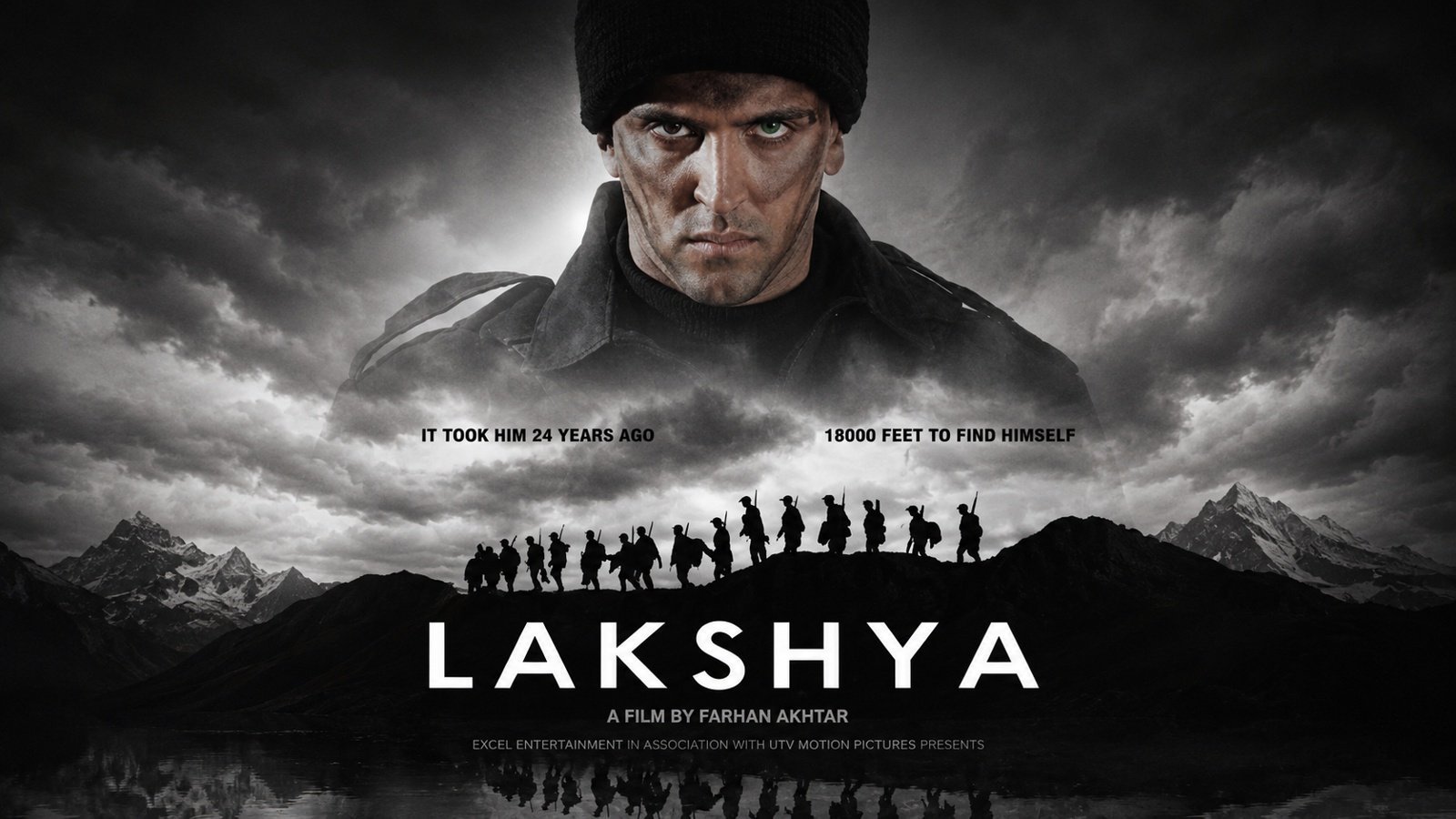
Lakshya (2004)
Cast: Amitabh Bachchan, Hrithik Roshan, Preity Zinta
Director: Farhan Akhtar
Music Director: Shankar-Ehsan-Loy
Synopsis: a bold and commendable attempt at a bit more than just another war flick
Reviewed by: Faiz Khan
Farhan Akhtar struck gold with his maiden effort Dil Chahta Hai, a path-breaking film in terms of both style and content. To measure up to that achievement was always going to be a Herculean task, and Farhan has wisely taken a completely different route with Lakshya, a film set against the backdrop of the Kargil conflict.
The magnificence of the Ladakh mountains beneath cold, grey skies forms the opening image as a car speeds along the winding roads, passing a sign announcing that Kargil lies 200 kilometres ahead. A recruit, Lieutenant Karan Shergill (Hrithik Roshan), arrives at his regiment near the Line of Control, where he is introduced to Colonel Sunil Damle (Amitabh Bachchan). Karan appears troubled and withdrawn, and before long we are transported into a flashback to discover the man he once was: carefree, aimless and sporting long, dishevelled hair, drifting through life without any real concern for what the future might hold.
Also in the picture is Romila Dutta (Preity Zinta), who loves Karan but is far more focused upon what she wants from life. The son of a wealthy businessman, Karan has no goals whatsoever. He sleeps late, lounges around and is constantly plagued by the question of what he intends to do with himself. He is also the product of a somewhat disconnected family, with a supportive mother and an aloof father who is deeply disappointed in his son.
With no firm direction in mind, Karan enrols in the Indian Military Academy, not because he possesses any genuine calling but because the idea seems attractive after one of his friends announces that he intends to join. When that friend drops out, Karan finds himself alone and approaches military training with the same carefree attitude he applies to everything else. The moment the going becomes difficult, he runs away and returns home, only to be informed that he must now join his father’s business because he is clearly incapable of applying himself seriously to anything.
With his future apparently decided for him, Karan goes to meet Romila expecting sympathy and a warm welcome. Instead, she is horrified that he has once again failed to stand by his own decision and tells him that she never wishes to see him again. Her rejection, combined with his father’s conviction that he will remain a layabout for the rest of his life, becomes the turning point. Karan returns to the military academy, this time with genuine determination.
Farhan Akhtar’s film is bold and ambitious, aspiring to be far more than a conventional war movie. At its heart, it is the story of a man searching for direction and meaning in his life, a coming-of-age tale not entirely dissimilar to Dil Chahta Hai, whose characters also moved from youthful irresponsibility towards maturity. Lakshya is therefore not so different in concept, even though it is vastly different in setting and treatment.
The trouble is that Farhan never delves deeply enough into this personal journey. The story of an aimless young man discovering a purpose gradually takes a back seat to the war itself, even though Kargil was presumably intended to remain the backdrop rather than become the central focus. This may be more a weakness in Javed Akhtar’s screenplay than in the direction. Kargil remains a dark episode in Pakistan’s history, and one cannot deny the fact that the conflict ended in an Indian military victory. It is therefore understandable that Farhan Akhtar wished to portray the war from that perspective rather than turn the film into a broader condemnation of warfare.
Yet the battle itself does not truly create Karan’s growth. It merely provides him with an opportunity to demonstrate the resolve he has already acquired. His real achievement lies in the fact that he has found his focus and become a committed soldier before the war begins. If the intention is to present Karan as a man who has finally succeeded in life, then his transformation into a proud and capable army officer should have been sufficient. There is no real need for him personally to conquer the very heights occupied by the Pakistani forces to complete his emotional journey.
Even his original decision to join the army is somewhat unconvincing, particularly if we are expected to believe that the idea is inspired by nothing more than watching an action programme on television.
The film also moves at a languid pace and, apart from one or two songs, there is little to give the proceedings any real buoyancy. The second half becomes much more serious as the Kargil battle assumes centre stage. Although these sequences are brilliantly photographed and impressively staged, they continue for too long and gradually weaken the momentum of the film. More importantly, the horror and futility of war are never really brought home. The conflict is treated largely as a battle for the motherland against an enemy rather than as a tragedy in which lives are destroyed on both sides.
Farhan also sidelines the love story for much of the second half, even though Romila’s rejection is presented as one of the principal forces behind Karan’s transformation. The emotional connection between the two never comes across strongly enough. Similarly, the strained relationship between Karan and his father is insufficiently explored, despite also being used as a major motivating force in Karan’s life. These relationships should have provided the emotional backbone of the film, but neither is developed with the depth it deserves.
Hrithik Roshan’s portrayal of Karan is the film’s most important element. The story revolves almost entirely around him, and he delivers a subtle, deeply affecting performance, finding precisely the right balance between the carefree, somewhat flighty young man of the early scenes and the disciplined soldier who later stands at the border. Hrithik often communicates through his eyes, bringing an intensity to the character that makes one wish the screenplay had allowed him to explore even further. Lakshya should prove to be one of the more memorable films of his career.
Preity Zinta has an important role and brings her customary freshness and intelligence to Romila. She continues to build an interesting body of work, choosing characters for their substance rather than merely the length of the role, and deserves considerable admiration for doing so. Amitabh Bachchan has a comparatively small part and, as always, the audience is left wanting more, though he excels in every scene he is given. Om Puri, sadly, is largely wasted.
The film is handsomely mounted, with exceptional cinematography capturing the stark beauty of the barren Ladakh landscape. The battle scenes are also highly effective, even if they are somewhat prolonged. Shankar-Ehsaan-Loy’s music works better as part of the background score than as a collection of individual songs, and one senses that some of the musical interludes have been inserted primarily to provide a little relief from the seriousness of the narrative. “Agar Main Kahoon” is likely to emerge as the most popular number, although there is genuine poignancy in “Kandhon Se Milte Hain Kandhe”.
Ultimately, Lakshya does not quite succeed because it leaves the viewer strangely cold. This may partly be because the war film has already been overdone, particularly after the recent ordeal of LOC Kargil, and the subject therefore possesses little novelty. The film also arrives at a time when the prevailing mood between India and Pakistan is one of friendship, making a work which celebrates military victory without seriously addressing the futility of war feel slightly out of step.
The film never quite delivers the emotional impact it promises. One leaves the cinema with the feeling that it has not delved deeply enough into either Karan’s transformation or the relationships that shaped him, and ultimately one is not affected as strongly by the story—or its characters—as one should have been.

0 Comments
Leave a Comment