
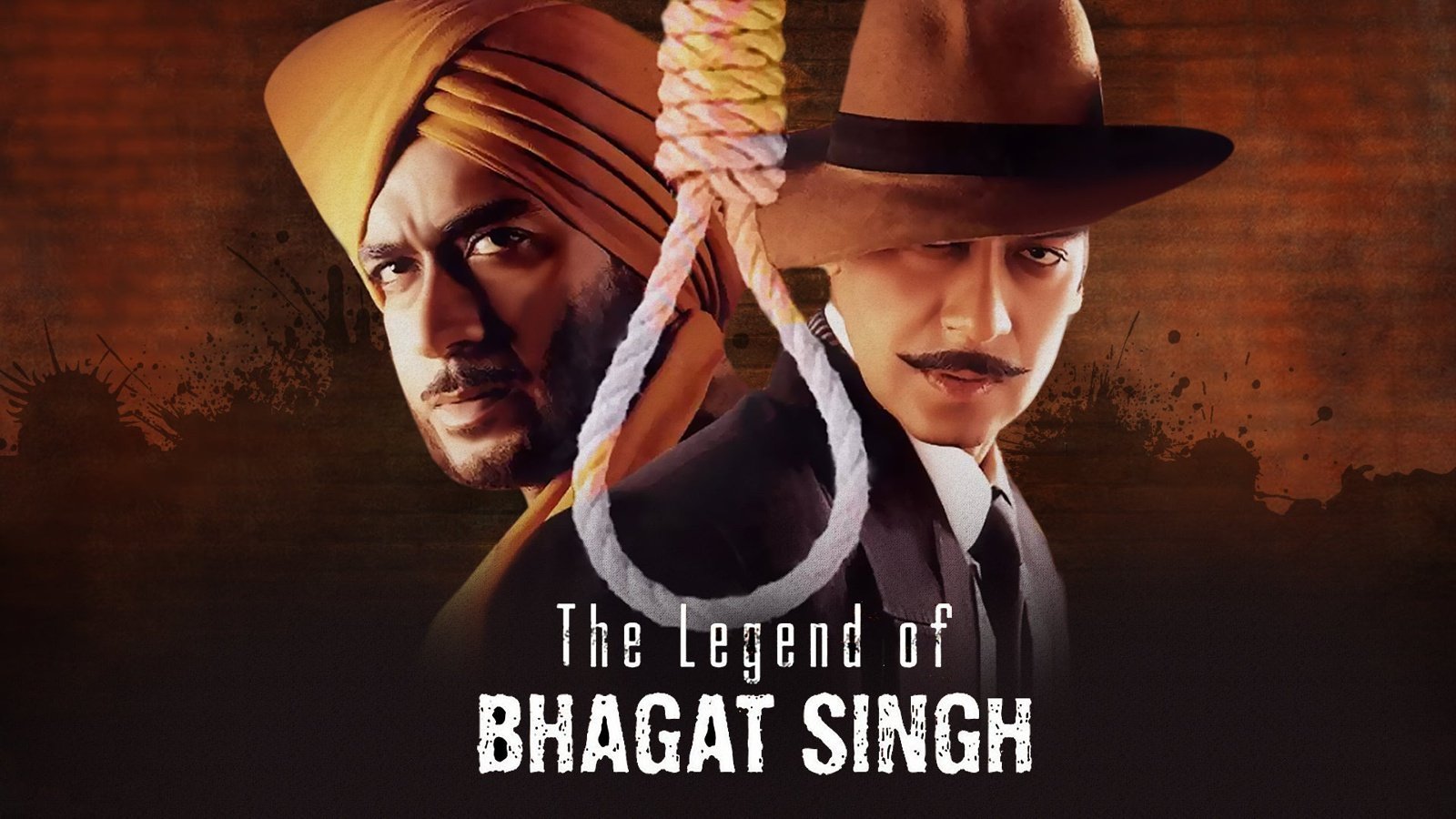
Legend of Bhagat Singh, The (2002)
Cast: Ajay Devgun, Sushant Singh, Amrita Rao, Farida Jalal, Raj Babbar
Director: Raj Kumar Santoshi
Music Director: A.R Rahman
Synopsis: commendable effort with strong direction and exceptional music
Reviewed by: Faiz Khan
All of a sudden, there appears to be a renewed interest in Bhagat Singh, with a spate of films being made on the revolutionary, not least Rajkumar Santoshi’s The Legend of Bhagat Singh and Sunny Deol’s home production starring his brother Bobby Deol in the title role. Both films arrived on the very same day amid much fanfare. Comparisons are inevitable, but each deserves to be judged on its own merits rather than simply in relation to the other.
The Legend of Bhagat Singh opens by flashing much of the story before the audience’s eyes, almost like a trailer for what is to follow, before settling down to begin in the aftermath of Bhagat Singh’s execution. Those opening images prepare us for what proves to be a stirring and deeply moving film, one not without moments of humour and blessed with a series of excellent performances.
Among the opening scenes is a confrontation between an embittered crowd and Mahatma Gandhi, who is questioned as to why he did so little to have the death sentences commuted. The film leaves the impression that Gandhi made little effort to save his fellow countryman. Gandhi had certainly denounced Bhagat Singh following the assassination of Assistant Superintendent Saunders and fundamentally disagreed with his methods of forcing India from British rule.
However, Stanley Wolpert, in his biography of Gandhi, notes that on the very day of the execution Gandhi wrote to the Viceroy, Lord Irwin, making what he describes as a passionate appeal for the death sentences of Bhagat Singh and his two companions to be commuted. Interestingly, Wolpert refers to Bhagat Singh, Rajguru and Sukhdev as "terrorists". Certainly, that is how the British administration regarded them, but is it an appropriate description? It remains an open question.
Given today's world, it is an increasingly dangerous path to tread when judging the rights and wrongs of revolutionary violence. Gandhi would undoubtedly argue that violence can never be justified, but is there room to suggest that the brutal oppression inflicted upon India by the British provided sufficient reason for men such as Bhagat Singh to resort to armed resistance? Can those who resisted imperial rule genuinely be described as terrorists? It is a fascinating question because history itself has so often been written by the victors, allowing the West to criminalise individuals who fought against what was, by any reasonable measure, an exploitative colonial empire that plundered and impoverished the land it governed.
Against the backdrop of the Jallianwala Bagh massacre, in which British troops slaughtered more than four hundred innocent civilians, and amidst the continuing subjugation of the Indian people, Bhagat Singh grows up in a country seething with resentment towards its foreign rulers. Inspired initially by Gandhi's Non-Cooperation Movement, the young Bhagat displays remarkable patriotic fervour even as a twelve-year-old boy. When Gandhi later suspends the movement, believing India was not yet ready, Bhagat Singh is deeply disappointed. His hatred of British rule only intensifies, and he becomes consumed with the desire to see an independent India.
Unwilling merely to stand by as an observer, he eventually joins Chandrasekhar Azad's Hindustan Republican Association, later renamed the Hindustan Socialist Republican Association. During a protest against the Simon Commission, Lala Lajpat Rai is brutally beaten by British police and later dies from his injuries. Gandhi's demand for Dominion Status no longer satisfies many Indians, and calls for complete independence begin to gather momentum. Seeking revenge for Rai's death, Bhagat Singh organises the assassination of Assistant Superintendent Saunders and, together with Rajguru, Sukhdev and Chandrasekhar Azad, escapes from Lahore despite an intensive British manhunt.
Determined to make their voices heard, Bhagat Singh and his comrades later decide to throw bombs into the Central Legislative Assembly, fully intending to surrender afterwards. Their objective is not murder but publicity. The bombs are deliberately designed to create noise rather than casualties. Bhagat Singh is arrested and subsequently linked to the Saunders assassination, spending the next two years in prison awaiting execution. Even behind bars, he continues his struggle, embarking upon a prolonged hunger strike to protest the appalling prison conditions endured by Indian political prisoners. Despite torture and repeated attempts at force-feeding, he refuses to yield. The British authorities eventually concede many of his demands, recognising that he has become an enormously dangerous symbol whose popularity among ordinary Indians continues to grow.
Santoshi deserves considerable credit for attempting to bring such a historical figure to commercial Hindi cinema. Inevitably, he makes certain concessions to the format, including a handful of songs and one rather unnecessary dream sequence, but these also serve to humanise what might otherwise have become an overly sombre and relentless film. There are occasional dramatic liberties—one can hardly imagine Bhagat Singh performing "Pagri Sambhal Jatta" upon a stage—but these function more as symbolic expressions of his revolutionary spirit than as literal history.
Photographed in muted colours and sepia tones, the narrative unfolds with admirable simplicity, although one occasionally wishes Santoshi had allowed certain episodes a little more room to breathe. Given the sheer scope of Bhagat Singh's life, however, time inevitably becomes the enemy. What Santoshi captures magnificently is the essence of the man and the spirit of the times.
Santoshi has always been a curious filmmaker, constantly seeking new subjects rather than repeating himself. Here he succeeds in producing a film refreshingly free from gaudy patriotism or simplistic flag-waving. Melodrama is largely absent, and one quickly realises that a film of this nature gains far more by remaining restrained than by constantly shouting at its audience. Equally welcome is the absence of excessive violence or larger-than-life heroics. Bhagat Singh is presented not as a superhuman action hero but as a flesh-and-blood revolutionary operating within the limitations of his time. Even so, Santoshi never forgets that this remains a commercial film and successfully balances entertainment with historical drama.
Ajay Devgn delivers another understated yet immensely compelling performance in the title role. Following Company, this performance firmly establishes him as one of the industry's finest actors, having travelled a remarkable distance from his early image as little more than an action hero. Sushant Singh as Sukhdev, D. Santosh as Rajguru, Akhilendra Mishra as Chandrasekhar Azad and virtually the entire supporting cast are uniformly excellent. Amrita Rao, despite appearing only briefly as Bhagat Singh's intended bride, leaves a distinct impression and even bears more than a passing resemblance to Nandita Das.
A.R. Rahman's background score is quite mesmerising, while the songs blend seamlessly into the narrative. "Pagri Sambhal Jatta", "Mera Rang De Basanti Chola", "Sarfaroshi Ki Tamanna" and "Jogiya Jogiya" are songs likely to remain in the memory long after the film itself has faded.
I knew remarkably little about Bhagat Singh before seeing this film. By the time the end credits rolled, I found myself eager to learn far more about both the man and the era in which he lived. If inspiring that curiosity was Rajkumar Santoshi's principal objective, then he has succeeded admirably.
A moving, humane and highly recommended film.

0 Comments
Leave a Comment