
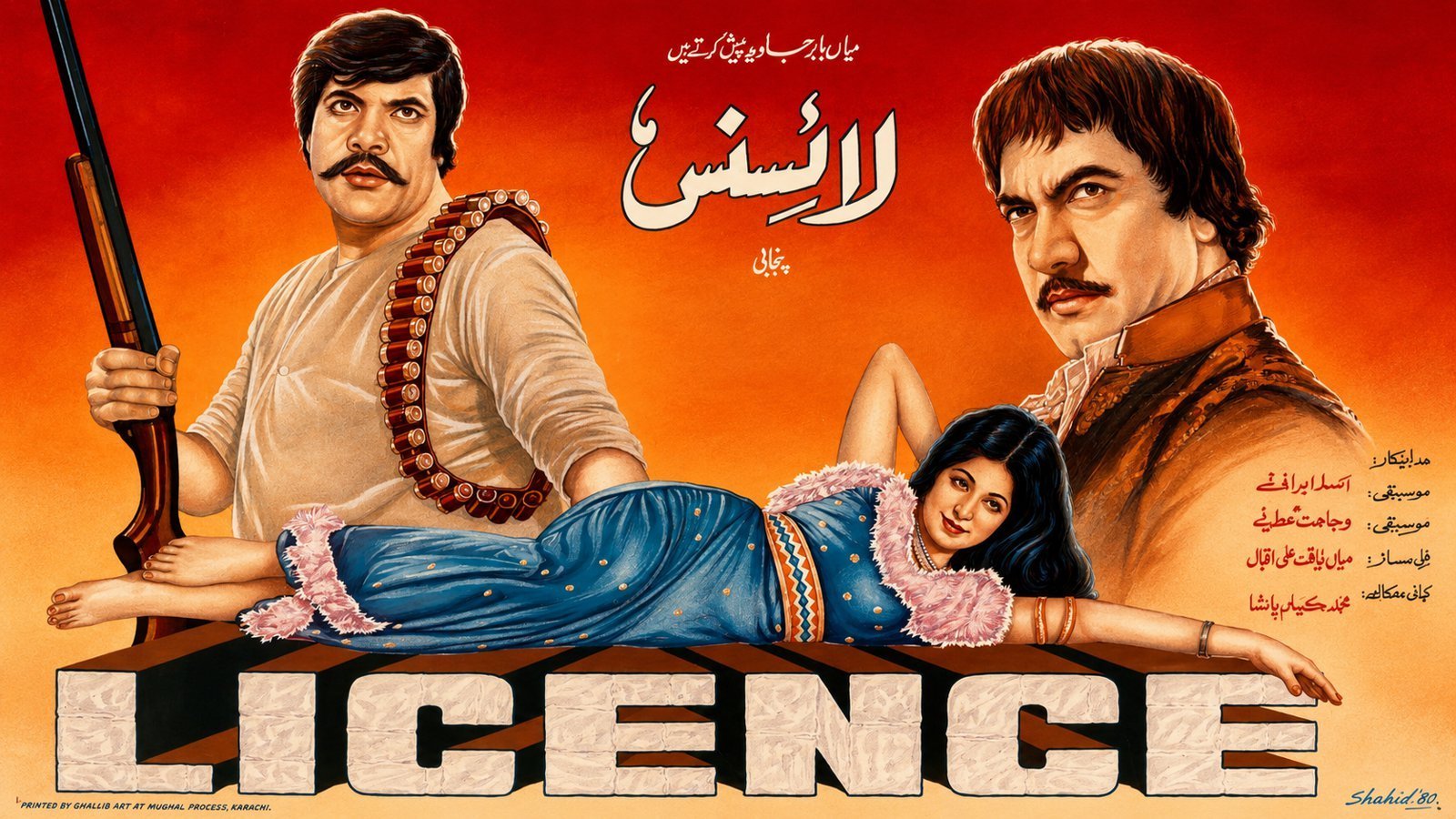
Licence (1976)
Cast: Najma, Sultan Rahi, Mustafa Qureshi, Afzaal & Aziz Mian Qawwal, Nimmi, Aurangzeb, Nanha, Jaggi, Changezi, Afshan, Saqi, Rehan
Director: Aslam Irani
Synopsis: All the ingredients of a typical Punjabi masala rollercoaster with all the necessary elements in place.
Reviewed by: Omar Khan
Licence (note the Lollywood spelling), arrived just a few months before the arrival of General Zia Ul Haq as the Emperor of Pakistan. He brought a strict pseudo-religious code of morality that struck the film community like a bombshell from which it has arguably never truly recovered.
The film has no pretensions other than as a Masala-laden potboiler with all ingredients aimed to click with the masses. The film is built around another larger-than-life performance by Mustafa Qureshi as a crazed “Badmash” bristling with rage and eager to find an adversary to challenge his unrivalled power. Everyone who dares to cross him is ruthlessly dismissed, and he ravages the community at will. On one such rampage, when he has picked up a woman from the local kotha, he is obstructed by a common coachman (horse-cart rider) known locally as a Kochwan, who confronts him, demanding the release of the squealing woman he has grabbed. The confrontation turns vicious, and as Qureshi is dragged away for murdering the woman, he swears revenge and tells the Kochwan (Sultan Rahi) that he will take from him what he loves. You can be sure that their paths will soon cross again.
Najma is the sister of another moronic gangster who meets a nasty end at the hands of Qureshi, who develops a crush on Najma and marks her as a possession he would like to have for himself. Meanwhile, Najma, needy and helpless, finds solace with Achchoo the Kochwan, who brings her home to his place where she can shelter, and their romance can blossom.
The Kochwan has a sister secretly romancing a wealthy industrialist’s son, whose father is disgusted that his son considers a worthless, poverty-stricken waif a potential wife.
Sultan Rahi and Mustafa Qureshi soon come across one another, and Qureshi finds that the girl he has a crush on is now the girlfriend of his mortal enemy, which he views as an exciting challenge. He did, after all, warn the kochwan that he would take the thing he loves most away from him, and now his attention is focused on tearing away Najma from her love and having her for himself.
Soon enough, Qureshi and Rahi are battling it out, ending up in prison. The warden is a thinking man determined to make his prison reform rotten eggs and turn them into productive members of society. He runs a remarkably civil prison with an open discussion between inmates and the warden. He tries to get Rahi and Qureshi to squash their beef, but the two go at each other with hammers and tongs until both are left flat on the floor from sheer exhaustion.
Qureshi is released from jail and sets his sights on exacting revenge and grabbing Najma. Meanwhile, Najma has hit hard times, unable to make ends meet and cornered by sleazy village politicians into utter helplessness. She takes up as a dancer at local club to feed herself and Rahi’s sister and beloved horse, Ghazi.
Everything builds to a crescendo and a showdown designed to leave audiences breathless with excitement, torn with mixed emotions, aroused by fiery passion and a display of stoic morality.
Licence manages to surprise in unexpected ways; Mustafa Qureshi turns in a winning performance and more than does justice to it. Najma also holds her own, especially in the dramatic, emotional scenes, while proving to be a most adept dancer. Sultan Rahi, too, is in solid form and looking fit and lean. Nanna has fun with a turn as a druggie and swindler, while Azim Mian, the renowned Qawwal, tears into his performance with some amazingly spectacular antics. Afzal Ahmed can always be relied on to deliver the goods, while Rehan makes a telling appearance as a Judge whose own morals are given a severe jolt when he visits his local club. Despite the violence on display, Licence carries a discernable anti-violence message between the lines, and generally attempts to address a few issues while dishing out the masala. Licence may appear as another in the long line of violence-laden masala pot-boilers. There is an attempt at weaving in some sort of “meaning”, and the film does manage to hold together reasonably well. It also moves along with a conclusion that isn’t the total predictable yawn that these films all tend to suffer. It is not an outstanding film by any means, but one that can tell a story and even attempt to justify its existence with a moral that elevates it beyond many similar films from Lollywood. Licence manages to surprise, and for once, it’s not for totally negative reasons.



0 Comments
Leave a Comment