
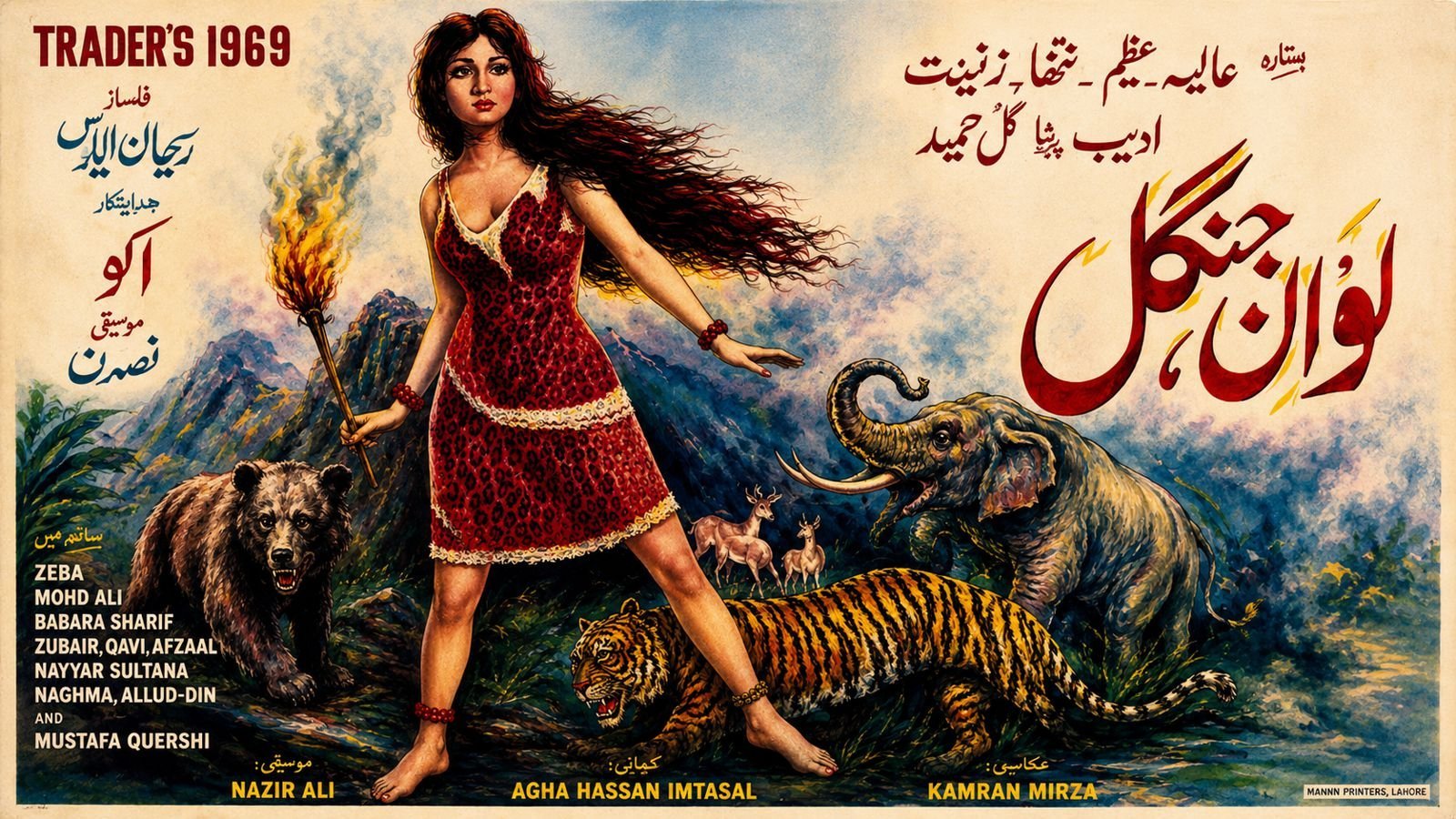
Love In Jungle (1970)
Cast: Aaliya, Azeem, Nanna, Tarana, Adeeb, Gul Hameed as The Jungle Man.
Director: Akkoo
Music: Tassaduq
Synopsis: Lollywood does the Tarzan thing on cruise control, cloaked in a quick-fix history lesson and a rather chillingly familiar refugee exodus, fraught with peril and certain death.
Reviewed by: Omar Khan
Love in Jungle arrived in 1970, hitting many screens nationwide with much fanfare. The adverts featured the physique of a bodybuilder as the local version of Tarzan and the delectable belly dancer moves of rising star Aaliya. The trailer also featured startling footage of fearsome animals from all corners of the planet, including some from beyond.
The movie starts with a map of Burma and the land beside it, which is currently Bangladesh and India, but when shooting the ground on world maps would have been marked East Pakistan at the time of its production and release.
Political tensions peaked between Pakistan and neighbouring India, considering the two had been unified until just a generation ago. In the film, there are scenes with huge air force planes dropping kilo upon kilo of bombs upon the area, causing massive death and destruction with scenes of mayhem and carnage as wretched civilians scramble for safety. Amidst this hell, there is a departure to flee the wartorn area and reach any place that will shelter them and hundreds set off on foot down a dangerous road while still being ravaged from above by bomb-spewing death planes.
There is more carnage, and at least half the refugees succumb. Among those who find their way into the area’s thick forest are a couple of friends joined by a young lad named Maula Bux, who intrigues one of the friends (played by East Pakistani actor Azeem). There is a bit of tongue-in-cheek banter along the way as the audience can easily recognize that Maula Bux is indeed the beautiful Aaliya in disguise.
Azeem has a sidekick in the form of Nanna, who is more than a little confused about his identity. Whenever he confronts a fearful situation, as though encouraged by the effeminate Maula Bux, Nanna loses all sense of his masculinity. There is a remarkable transformation, and he now believes himself to be a woman and thus behaves as he feels he should and refers to himself as a “she, her” rather than a “he, him”. Indeed, the more Maula Bux turns into Aaliya, the more Nanna transforms into a rather shapely young woman. Nanna finds a cure when meeting a female he rescues, but she spurns his advances when he informs her he could become a gorgeous diva.
Lollywood perfected the art of using a green screen way before anyone else. Love in Jungle includes plenty of stock footage from National Geographic films. The borrowed footage is then diligently woven into the action. There are scenes of a cheetah chasing some bird or whatnot. They walk a few steps further, and Nanna goes, “Oh, look at that!” pointing in a specific direction, and they all look startled, and we get more stock film footage of some animals chasing another or just flying around or baring its fangs or whatnot. Then we go a few steps further, and Aaliya screams….“ooh, look at that,” which happens for about two-thirds of the movie. The rest of the show is crammed with some songs and dances and some villainous, nasty tribal sorts who are portrayed as ugly, deceitful and evil. They live in straw huts and have obligatory nasty mask faces and Indian-style teepee thingies as furniture; they are godless heathens. They also shout a lot and act like Serena Williams or Ilie Nastase, letting off steam!
Love In Jungle
Occasionally, they cause problems, like capturing our friends or running away with Aaliya. But perhaps their worst habit is that they are prone to laughing very loudly to make sure you are very clear that they are nasty people. Let’s say they revel in being offensive, ugly and very loud. They also like to make themselves appear dark-skinned for reasons best known to them. The result is duly men-acing, though.
People could look at this film today and find a lot that is politically incorrect. Still, it was a different world back then. Pakistani attitudes towards “tribals”, “Africans”, or non-Europeans usually were as racist and stereotypically offensive as any, and they sadly haven’t changed a lot since then. Political correctness may have reached laughable extremes in some cases in the West. Still, here in Southern Asia, it has not only not arrived, but its arrival also seems to get further and further away with time.
Luckily for our group of friends, each time there is some major trouble, Tarzan appears out of the blue and saves the day. However, things go a little weird one day as Tarzan himself feels he needs to have a woman of his own and carries Aalia away. At this point, the audience may start to count how many times various men abduct her – savages, tribal folk or animals – during the film.
Tarzan is quite rough with her, but then she decides to do what any sane woman would do at that stage. She intoxicates him with a song and dance number that has him feeling some type of way, and they get on like a house on fire, even if his expression remains the same throughout the movie. No, he has two expressions; a moronic smile and a sad face, the type you get in an enclosed place, and somebody emits some wind of a most ferocious constitution.
Time and again, Tarzan saves the day, and he and Aaliya bond closely, but her heart remains with the sickly Azeem, no doubt for his money, as he is not the type of guy a bad bitch would want to step out with.
The film is a crashing bore and a total rip-off, and even a few dances by Aaliya and an appearance by Tarana cannot save this ship from sinking rapidly into high tedium. The only animal of any interest was a man in a hairy gorilla suit; literally, everything else was stock footage from wildlife films.
Nanna tries hard, but the gay-oriented banter is juvenile and offensive, especially considering the holier-than-thou attitude of most around these lands. Political offensiveness aside, the film fails abysmally to entertain. It’s a tragic disaster and a complete failure.
The producers and the directors try to dupe an audience by pretending to be a film shot in “the jungle,” and it simply doesn’t work, not by a long shot. Sadly, with many expectations, this movie is a total waste of time unless you are some crazed psychotic Tarzan movie freak or fanatic Aliya fan. Or perhaps one of those movie geeks who brags to eye-rolling friends, “Yeah, man, I watched this Tarzan movie from Pakistan last night.” In which case, long may you thrive.



0 Comments
Leave a Comment