
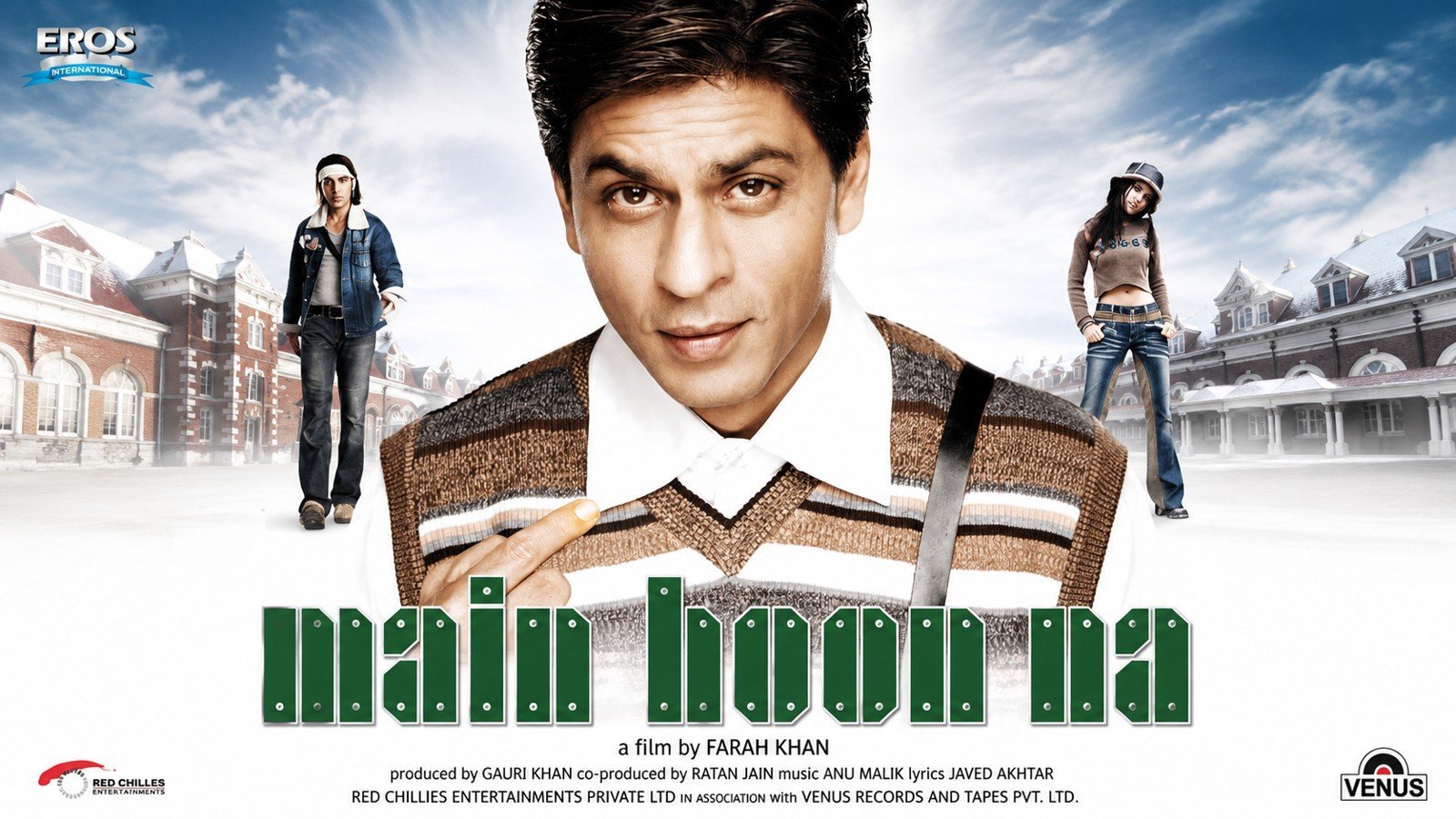
Main Hoon Na (2004)
Cast: Shahrukh Khan, Sushmita Sen, Amrita Rao, Zayed Khan
Director: Farah Khan
Music Director: Anu Malik
Synopsis: Frothy, totally entertaining 70's style "wholesome family entertainer"
Reviewed by: Faiz Khan
Farah Khan’s maiden effort is a sparkling and unabashed attempt at pure entertainment, without any aspiration beyond giving the audience a thoroughly enjoyable time. It is a rollercoaster ride, gloriously over the top and essentially a hotchpotch of films from the past—old wine in a new bottle, perhaps, but surprisingly well executed.
The film opens on the swanky set of a television programme where General Bakshi (Kabir Bedi) is discussing Mission Milaap, an initiative designed to encourage a thaw in relations with Pakistan. It soon becomes apparent that not everyone is in favour of improved relations, least of all a terrorist named Raghavan, who is determined to sabotage the peace process and storms the television studio. Bursting onto the scene in true Mission: Impossible style, Major Ram Prasad Sharma (Shah Rukh Khan) manages to thwart the terrorists, but in the ensuing shoot-out his father, Major Shekhar Sharma (Naseeruddin Shah), is shot by Raghavan while trying to protect General Bakshi.
We then enter flashback territory as Major Sharma, lying on his deathbed, reveals a story to his son which carries more than a passing resemblance to Masoom. The difference is that Major Sharma’s wife was not the forgiving sort and had walked out of his life with their young son when Ram, the child from his relationship with another woman, was brought into the family after his mother’s death. Major Sharma’s dying wish is that Ram should reunite the family. Pure popcorn, but then that is precisely what the film intends to be.
Returning to the present, we are informed that General Bakshi’s daughter Sanjana (Amrita Rao) requires protection from Raghavan and his men. Major Ram is assigned to guard her and, upon discovering that his long-lost younger brother Laxman is also studying at the same institution in Darjeeling, readily accepts the mission. Enter St Paul’s School, set amidst the ravishing beauty of Darjeeling.
We are now transported directly into Kuch Kuch Hota Hai territory, complete with college campus, candyfloss surroundings and an atmosphere that is perhaps a little too syrupy for its own good. Much of the humour is also strongly reminiscent of KKHH, with characters such as the Hindi teacher (Bindu), the principal and the assorted students all seeming vaguely familiar. Consequently, very little comes as a surprise.
Ram arrives at St Paul’s posing as a student and, much to Sanjana’s irritation, attaches himself to her while quietly searching for his brother. Before long he discovers that Lucky, the long-haired college dunce, is in fact Laxman. Sanjana secretly adores Lucky, though he treats her only as a close friend, and Ram naturally sets about trying to bring the two together.
Into this picture walks the new chemistry teacher, Chandni (Sushmita Sen), and Ram is immediately smitten, becoming amusingly tongue-tied whenever she appears. With Raghavan still lurking in the shadows, however, the film soon returns to action while simultaneously resolving Ram’s emotional dilemmas concerning Laxman and his estranged mother.
There is absolutely no novelty in the story and the film borrows heavily from a variety of earlier successes. Its basic premise echoes Masoom, after which it wanders into Kuch Kuch Hota Hai territory, borrows elements from Kabhi Khushi Kabhie Gham and finally concludes with a healthy dose of action. Yet Farah Khan never pretends that she has set out to make anything more than an entertaining commercial film and, on those terms, she succeeds admirably in giving the audience value for money.
Where Farah scores as a director is in bringing together all these familiar ingredients and turning them into a rather tasty trifle—light, frothy and never remotely taxing or offensive to the senses. She also injects a considerable amount of humour and nostalgia into the proceedings. R.D. Burman’s music from Hum Kisise Kum Naheen repeatedly finds its way into the soundtrack and, in many respects, Main Hoon Na feels almost like a tribute to Nasir Hussain’s classic. Ram’s inability to stop himself from bursting into an R.D. Burman song whenever Chandni appears is handled hilariously, while Farah continues the spoofing with references to Dhanno from Sholay and numerous affectionate nods to films of the past. She has a firm command over the material and keeps the narrative moving at a brisk pace throughout.
It is also immensely refreshing to see Pakistan presented in a positive light, reflecting the improving mood between the two countries and providing a welcome change from the endless procession of Paki-bashing films that have been inflicted upon audiences in recent years.
This is Shah Rukh Khan’s film from beginning to end. Not only has he produced it, but he appears in almost every frame and carries the film with considerable ease. The role does not require any great emotional depth, but he delivers exactly what is needed, with energy, confidence and an abundance of charm.
Suniel Shetty plays Raghavan with the required fierceness without becoming unbearably loud. The role is essentially a caricature and even his entrance as the chemistry professor feels like another affectionate nod to Amjad Khan’s villain in Hum Kisise Kum Naheen. It is all thoroughly unbelievable, but then who really cares?
Sushmita Sen is pure magic. Her function in the story is largely to provide the hero with an object of affection and, though her role is hardly integral to the plot, it has been conceived with surprising clarity. Farah Khan knows exactly what she wants Chandni to represent and Sushmita transforms herself into that ideal with effortless grace. She looks magnificent and carries herself with the poise of a true star. There is only one genuinely tender scene between Shah Rukh and Sushmita, as they sit on the steps discussing whether Ram should reveal his identity to Laxman, but brief though it is, it displays the very real chemistry—pun not intended—between the two actors.
Zayed Khan fits the part well and shows considerable improvement since his debut. He has presence and performs with a fair amount of confidence. Amrita Rao also reveals tremendous potential. There is something about her freshness and spontaneity that occasionally brings Madhuri Dixit to mind, and one looks forward to seeing how she develops.
The music suits the film perfectly. It may not be exceptional in its own right, but the songs have become extremely popular and work well within the lively spirit of the narrative.
On the whole, Main Hoon Na is essentially a 1970s-style potboiler mounted with tremendous style and transformed into sparkling entertainment. This is cinema as it was often meant to be. Realism can take a hike; we are here simply to enjoy ourselves.
And enjoyable it most certainly is.

0 Comments
Leave a Comment