
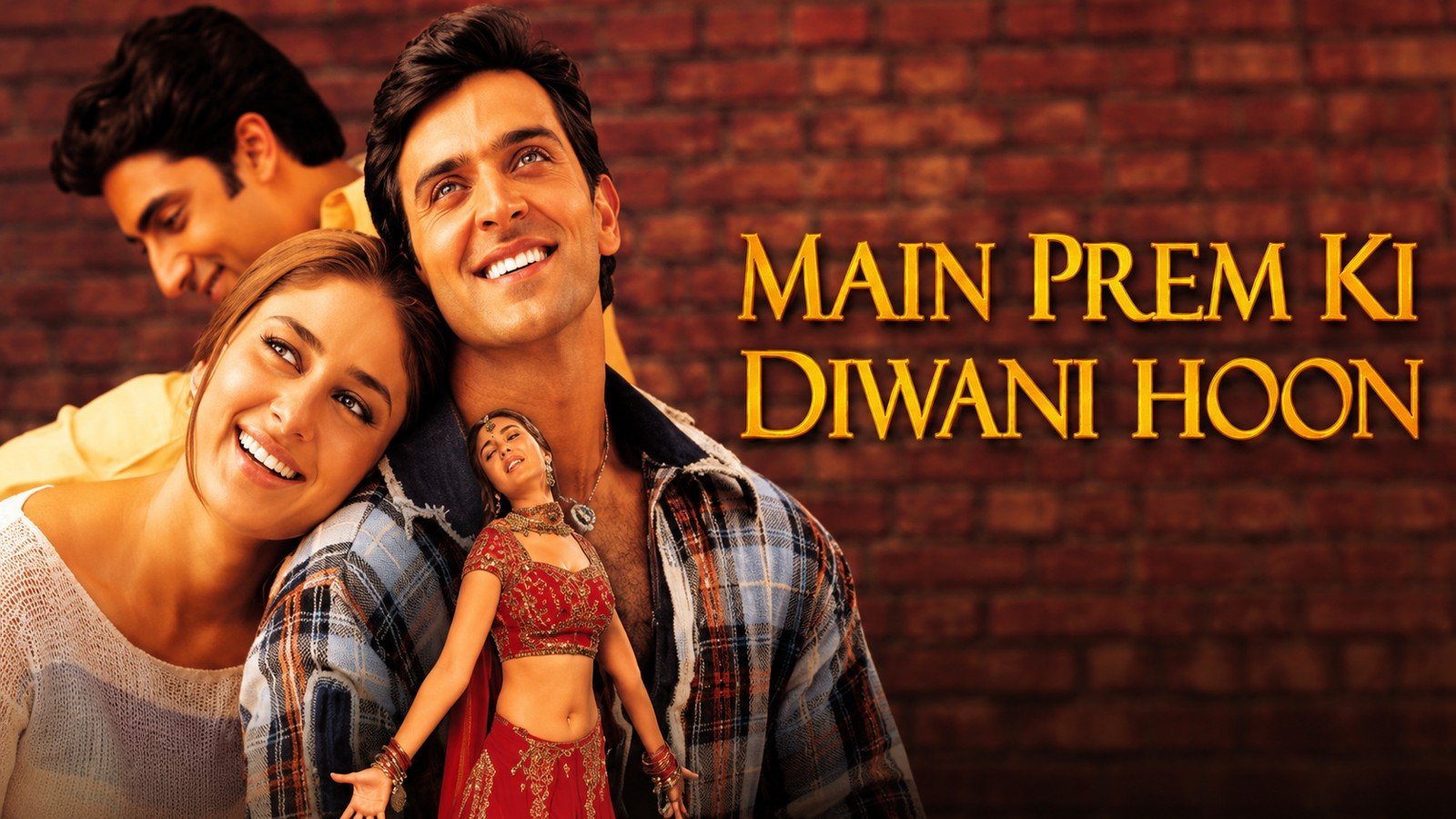
Main Prem Ki Diwani Hoon (2003)
Cast: Hrithik Roshan, Kareena Kapoor, Abhishek Bachchan
Director: Sooraj Barjatya
Music Director: Anu Malik
Synopsis: An updated version of Basu Chatterjee's humorous classic Chitchor
Reviewed by: Faiz Khan
Old wine in a new bottle…isn't that the most overused adage to describe so many of the films churned out by Bollywood? Either that, or the customary "inspiration" which our directors derive from Hollywood. Main Prem Ki Diwani Hoon falls firmly into the first category, attempting to revisit the golden age of Rajshri Films while revamping the formula for a supposedly more modern audience.
Sanjana (Kareena Kapoor) is the daughter of Pankaj Kapoor and Himani Shivpuri, anxious parents desperate to see their younger daughter settled after elder sister Rupa (Tanaaz Currim) has married and moved to America. Sanjana, however, is very much a girl of today—spirited, defiant and determined to make her own choices in life. Modern technology soon enters the picture in the form of an e-mail from sister Rupa informing her father that Prem Kumar, a millionaire based in the United States, is looking for a bride and will shortly be arriving in Sundernagar. The modern age also brings with it one of the most hideous inventions ever inflicted upon the screen—a computer-generated parrot whose sole purpose appears to be speaking in Hindi film titles.
Mother immediately goes into an avaricious frenzy. Here is the perfect catch for her precious daughter, and she leaves no stone unturned in making sure that Sanjana creates the right impression. Sanjana, naturally, is thoroughly unimpressed but reluctantly submits to her mother's increasingly moronic instructions.
Four days later, in walks Prem (Hrithik Roshan), bursting onto the screen in such a manic frenzy that one wonders whether he has arrived directly from a speed laboratory. Loud, hyperactive and relentlessly exuberant, Prem falls for Sanjana almost instantaneously—as indeed he was always going to. What follows is the inevitable love-hate relationship which everyone in the audience knows can only end one way. The problem is that the director stretches this wafer-thin romance across the better part of two hours, forcing us to endure one of the most crass screen romances in recent memory.
What happened to simple courtship? Going out for dinner, watching a film together, getting to know one another? Even the much-ridiculed "You Are My Soniya" sequence from Kabhi Khushi Kabhie Gham appears positively restrained compared with the absurd "Love Boat" competition which forms the climax of the first half, culminating in Prem deciding to mutilate his arm with a tattoo to prove his love. Hardly the sort of message one should be sending impressionable youngsters in this day and age.
Meanwhile, another e-mail arrives from America informing Papa that the real Prem Kumar has been delayed and will now be arriving with his mother to meet Sanjana. All hell promptly breaks loose. Sanjana has already surrendered her heart to Prem Number One—but who exactly is he?
Mother decides to snoop through Prem's belongings and discovers that he is indeed called Prem, but merely happens to be an employee of the real millionaire. Deciding that the truth might jeopardise her daughter's golden opportunity, she conceals the mix-up while poor old father reluctantly goes along with the deception. Prem Number One departs for Delhi, requesting Sanjana to look after his boss, who is not merely his employer but also, as he repeatedly reminds everyone, his "friend, philosopher and guide."
Sanjana dutifully obliges, only to discover that Prem Number Two (Abhishek Bachchan) also begins falling for her, with Mother doing everything possible to encourage the match. Poor Sanjana, however, has already given her heart elsewhere. Having been pushed towards Prem Number One by circumstances and then actively encouraged by her mother, how is she now expected simply to switch her affections to Prem Number Two?
Anyone brought up on Hindi cinema will have little difficulty recognising the classic that Barjatya is attempting to revisit. This is essentially Chitchor dressed up in designer clothes. Basu Chatterjee's delightful little film was a charming comedy where simplicity, believable characters and sparkling dialogue blended effortlessly to create an evergreen classic. Main Prem Ki Diwani Hoon is almost the exact opposite—a demonstration of what can happen when one tampers unnecessarily with perfection.
This is not a reinterpretation in the mould of Bhansali's Devdas, where a familiar story was approached from a fresh perspective. Whether one admired Bhansali's film or not, it undeniably possessed its own identity. MPKDH has no such distinction. Hum Aapke Hain Koun..! was itself an experiment which broke many of Bollywood's accepted conventions while remaining astonishingly simple at heart. Its large family, lavish settings and endless ceremonies were balanced by wonderfully understated performances from Salman Khan and Madhuri Dixit.
Barjatya attempts to modernise precisely the same formula here, merely exchanging sarees and ghagra-cholis for skirts, scuba diving, bungee jumping and white-water rafting. There is the odd reference to sex and even a brief kiss, but does any of this make the film genuinely modern? Hardly. It is merely decorative icing placed upon the same cake Barjatya has been baking ever since Maine Pyar Kiya. We have the sprawling mansions, the enormous sets, the familiar college competitions, the stage performances and yet another excuse to showcase the heroine through an elaborate set-piece. Where HAHK had Antakshari, MPKDH gives us the interminable Valentine's Day "Love Boat" competition—dull almost beyond endurance.
Very little actually happens until the inevitable misunderstanding changes the direction of the story. Barjatya then briefly pauses to examine the emotional consequences before resolving everything with remarkable haste.
The tragedy is that Barjatya remains incapable of breaking away from the simplicity which made his earlier films so endearing. Indeed, no one would have been better suited to remake Chitchor had he retained its modesty and warmth rather than inflating it into a garish, overlong spectacle centred around mistaken identity. Subtlety disappears entirely. Instead, we are subjected to an irritating talking parrot, unnecessary cartoon animation involving the family dog and a procession of juvenile gimmicks which add absolutely nothing to the story. Perhaps Barjatya imagines such devices will delight the front-bench audience, but they merely become distractions.
The film ultimately suffers because it is simply too loud. Hrithik Roshan's character ought to have been irresistibly charming; instead he becomes exhausting. Everything operates at full volume. Boom, boom, boom—the pace is so relentlessly hyperactive that there is never a moment to breathe. Barjatya possesses a perfectly workable premise but labours it endlessly until the interval, by which time Prem Number Two finally appears and the film at last acquires some genuine dramatic interest. One only wishes the triangle between the three leads had been introduced much earlier rather than after two hours of songs and overblown situations. In fact, I returned home thinking of Na Tum Jaano Na Hum. For all its shortcomings, that film possessed considerably greater warmth, depth and charm than this one.
Hrithik Roshan throws himself into the role with admirable commitment and plays Prem exactly as written. The problem is not the performance but the character itself, who is simply too boisterous to remain endearing. Hrithik continues to impress by the sincerity he brings to every role, though I do wish someone would occasionally allow his hair to fall out of place. Kareena Kapoor is similarly immaculate throughout, every strand of hair perfectly arranged, every application of lipstick gleaming beneath the lights. She has the best role in the film but spends much of it relying on familiar expressions and exaggerated mannerisms which by now have become rather repetitive. It is only towards the climax, when she shares quieter scenes with Hrithik, that she reveals flashes of genuine dramatic ability.
Abhishek Bachchan actually emerges rather better than expected. Playing Prem Number Two as an introverted, decent and understated young man suits him well and this is one of his more effective performances. Pankaj Kapoor, meanwhile, comes closest to portraying an authentic human being amidst all the surrounding hysteria, while Himani Shivpuri's mother is little more than an exaggerated caricature of every over-anxious parent desperate to marry off her daughter.
Much has been made of Anu Malik's music, but while the songs undoubtedly grow on you with repeated listening, this is hardly one of his stronger scores. There is no equivalent here of Maine Koi Jaadu Nahin Kiya or Rabba Mere Rabba to lift the soundtrack to memorable heights. It is pleasant enough and undeniably popular, but ultimately a rather pedestrian effort.
I sincerely hope the film succeeds for the sake of Hrithik Roshan and Abhishek Bachchan. Both deserve a genuine break. Unfortunately, this overblown and exhausting exercise is not quite the one either of them deserved.

0 Comments
Leave a Comment