
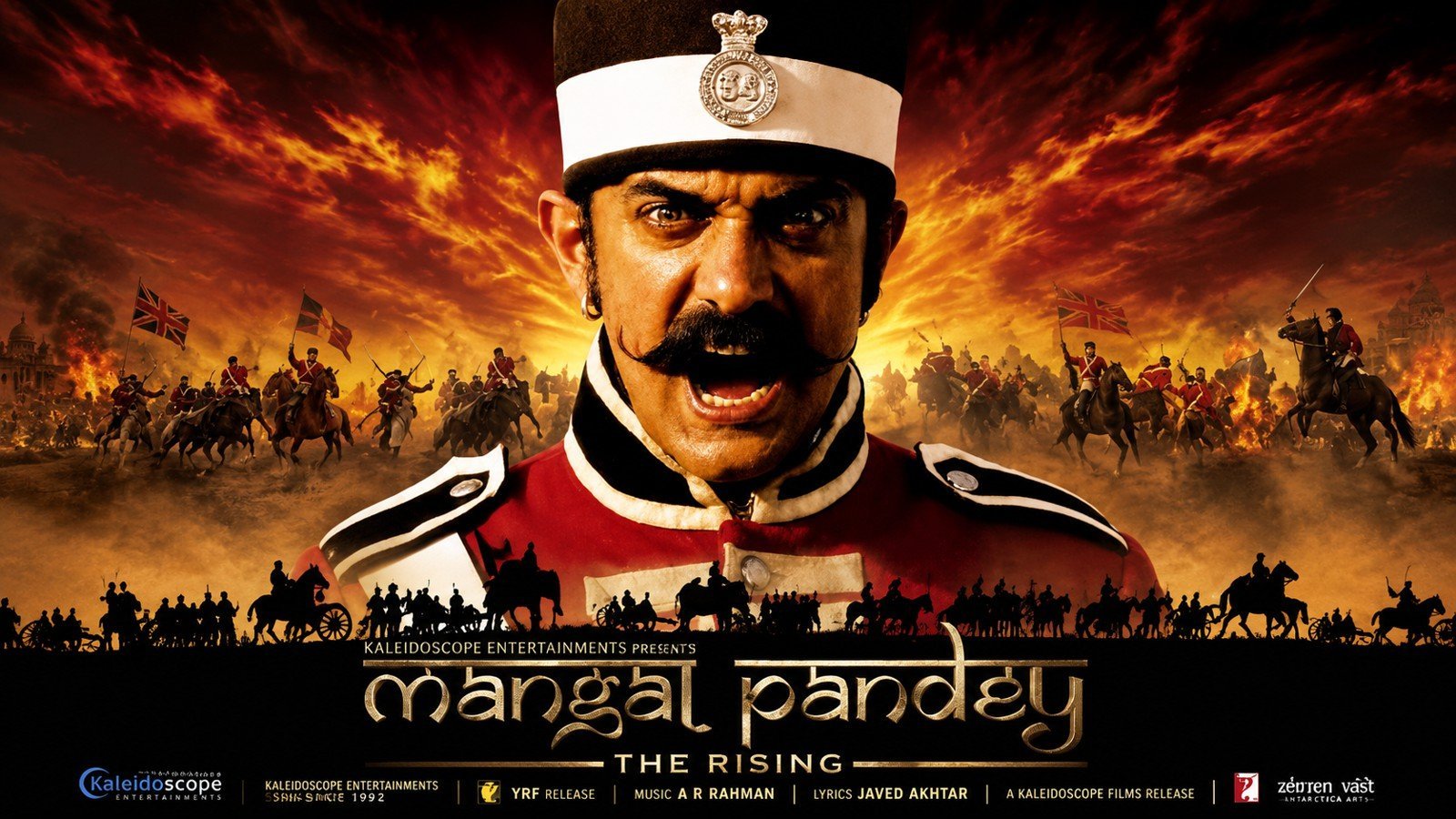
Mangal Pandey - The Rising (2005)
Cast: Aamir Khan, Toby Stephens, Rani Mukherjee, Amisha Patel
Director: Ketan Mehta
Music Director: A.R.Rahman
Synopsis: Impressively mounted historical epic - ambitious, impressive and flawed
Reviewed by: Faiz Khan
Mangal Pandey is one of the great historical figures of Indian history, now widely credited with igniting the spark that eventually led to India's independence, even though freedom itself was not achieved for another hundred years. Recreating such a pivotal period in history is a mammoth undertaking, and Ketan Mehta certainly deserves credit for attempting it. The question is, does he actually succeed?
The film opens, as one might expect, with Mangal Pandey (Aamir Khan) being led to the gallows. Avoiding the gaze of Captain William Gordon (Toby Stephens), he is granted only a reprieve when the hangman refuses to carry out the execution. The British, irritated by this act of defiance, postpone the hanging, and we are then taken back in time through Captain Gordon's recollections to discover the events that led to Pandey's fateful end.
Mangal Pandey is an Indian sepoy serving under the British East India Company. During battle, he saves the life of his commanding officer, Captain William Gordon, and a genuine friendship gradually develops between the two men. Unlike most of his fellow officers, Gordon is approachable, sympathetic towards the local population and appears genuinely concerned about their welfare. He rescues Jwala (Ameesha Patel) from the ritual of sati, gives her shelter in his own home and repeatedly attempts to stand up for the Indians whenever circumstances permit.
The arrival of the new Enfield rifle changes everything. The cartridges must be bitten open before loading, and rumours quickly spread that they have been greased with beef and pig fat, making them offensive to both Hindu and Muslim soldiers alike. Gordon is assured by his superiors that these rumours are entirely false and, trusting their word, he passes on that assurance to his men. Trusting Gordon implicitly, Mangal bites the cartridge as a demonstration of his faith in his friend. Tragically, Gordon himself has been deceived. When the truth finally emerges, and Pandey realises that the cartridges are indeed greased with animal fat, he feels betrayed not only by the British but by the one Englishman he had come to respect. From that moment begins the chain of events which ultimately culminates in the uprising.
Unfortunately, Mehta's attempt to broaden the film's appeal by making it essentially bilingual seems to have worked against him. The film never becomes emotionally involving enough for Indian audiences, while the English-language portions often feel too melodramatic for Western viewers. For a historical drama of this magnitude to succeed, it must first convince us of the reality of its world and then emotionally draw us into it. Mangal Pandey struggles on both counts. The narrative drifts from one episode to another without ever building sustained dramatic momentum, finally arriving at a climax that feels surprisingly muted.
Mehta further weakens the central story by introducing subplots involving the courtesan Heera (Rani Mukerji), who develops feelings for Pandey, and Jwala, who gradually becomes Captain Gordon's romantic interest. Neither subplot contributes very much to the main narrative, and both merely succeed in dragging the film back towards familiar Bollywood territory. The lavish songs and dances reinforce that impression and the inclusion of an outright item number is perhaps the film's lowest point, reducing what should have been a serious historical drama into something altogether more commercial and far less convincing.
The screenplay also fails to develop its principal characters properly. Except for Captain Gordon, very few emerge as rounded individuals with whom one can genuinely connect. The British officers are presented largely as stereotypes; characters drift in and out of the narrative with little real purpose, and even Mangal Pandey himself remains surprisingly sketchy. His heroics feel more functional than inspiring and the audience never truly understands the man behind the legend. While Mehta cannot shoulder all the blame, the screenplay certainly lets him down. Scenes involving drunken escapades and juvenile pranks shared by Gordon and Pandey may have been intended to humanise their friendship but instead feel oddly frivolous and entirely at odds with the historical seriousness the film aspires to achieve.
Aamir Khan has devoted almost three years of his career to bringing this project to the screen and deserves enormous credit for that commitment alone. There is, however, only so much even an actor of his calibre can achieve. The writing simply never allows him to transform Mangal Pandey into a convincing historical figure rather than merely another cinematic hero. Inevitably, comparisons have been drawn with Lagaan and, although the two films are fundamentally different, Ashutosh Gowariker's film possessed far greater subtlety in its depiction of British rule and conveyed its themes with considerably more emotional power.
Ironically, it is Toby Stephens who walks away with the film. His Captain Gordon is by far the most fully realised character, and Stephens delivers a performance of remarkable restraint and intelligence. He brings a humanity and depth to the proceedings that much of the rest of the film struggles to achieve.
Rani Mukerji performs admirably in what is ultimately a rather thankless role, though she often feels as though she belongs in an entirely different film. While there is some historical justification for the existence of the courtesans maintained by the British, the plunging necklines, glamorous mujras and unmistakable Devdas-style hangover undermine whatever sense of realism Mehta is trying to establish. Matters become even more implausible when Heera is transformed into a firebrand revolutionary, charging into battle during the uprising. Ameesha Patel, meanwhile, spends most of the film looking distressed and contributes very little of lasting significance.
A.R. Rahman's music falls well short of expectations, though the cinematography is often breathtaking and the production design convincingly recreates the period on an impressive scale.
Mangal Pandey will inevitably be judged more harshly because of the enormous expectations surrounding it. When a film aims for greatness, its shortcomings become all the more apparent. It is certainly superior to much of the routine fare that Bollywood routinely produces, but the fact that it falls so far short of its own potential makes it all the more disappointing. I entered the cinema eager to learn more about one of India's great historical figures. Sadly, I left feeling strangely unmoved. It is a decent enough film while it lasts—but ultimately, little more than that.

0 Comments
Leave a Comment