
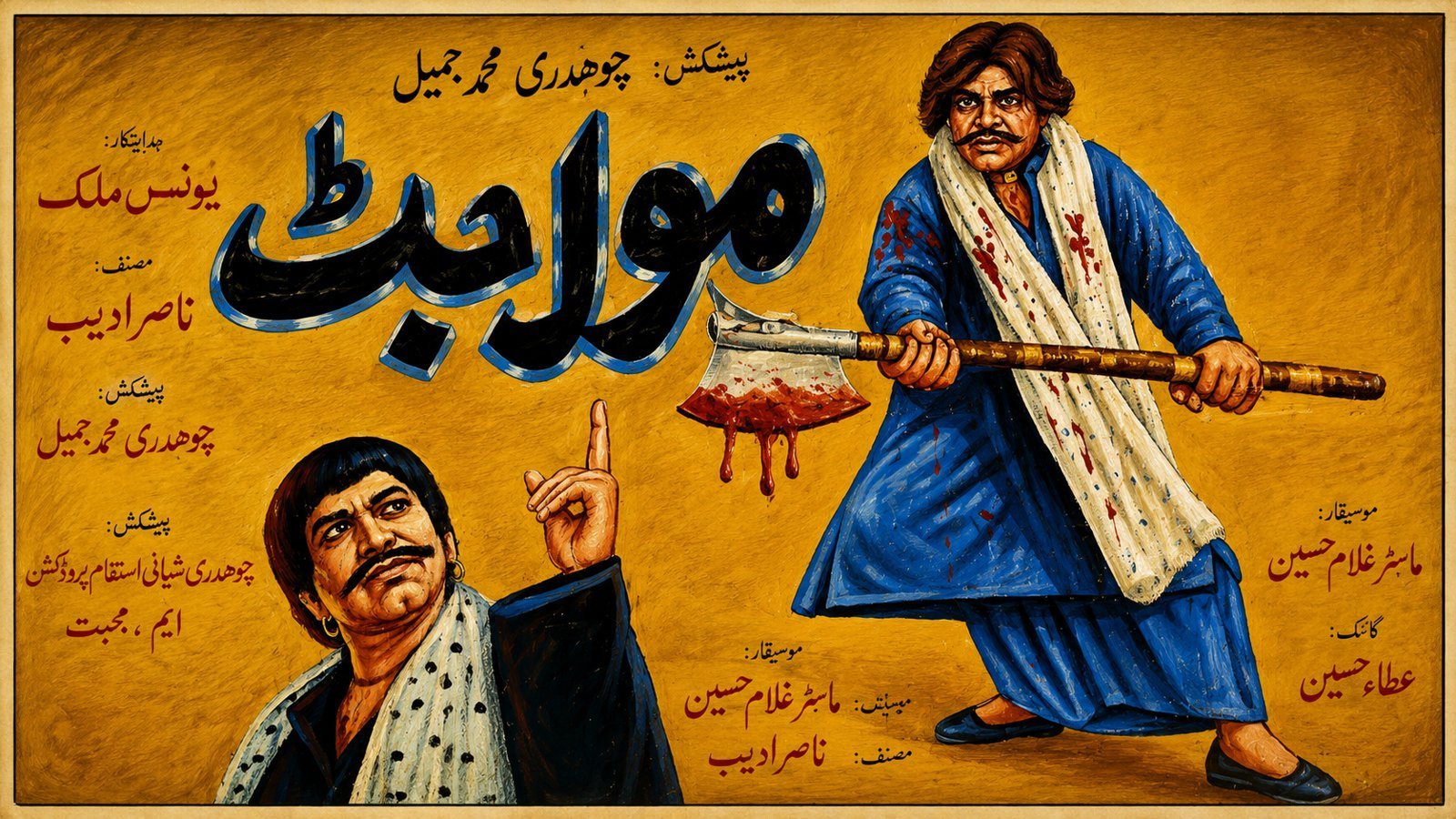
Maula Jatt (1979)
Cast: Sultan Rahi, Mustafa Qureshi, Aasia, Chakori, Kaifee, Seema, Aalia, Anita
Director: Yunus Malik
Synopsis: A uniquely Punjabi experience that is now a legend and A myth as much as it is a film……thrills, spills, raunch, paunch……THE Lollywood classic.
Reviewed by: Omar Khan
On its face, it is just another revenge-laden action masala pot-boiler, yet it has become so much more than just another Punjabi movie. A trendsetter like none other before, it is more talked about and more controversial than perhaps any other film produced in Pakistani cinema history, and a film that has evolved into the first homemade Superhero and “brand name” that ever spluttered out of this motley Pakistani film industry.
“How” is a conversation that continues wherever Pakistani films are discussed. What makes it so unique among its peers? The answer may not be clear, and dozens of theories may exist. The fact remains that no movie has ever impacted Pakistani popular culture and folklore as this one.
It’s a fascinating blend of the usual twisted Lollywood formula but done with tremendous, rustic panache and style. As with all Punjabi films, the characters are much larger than life—part of the “charm” of the film. The plot has nothing new to offer and begins with the mandatory attempted rape scene, which is aborted due to the timely intervention of Maula Jatt, Lollywood’s version of Superman.
The usual posturing between Maula, the would-be rapist, follows with each reminding the other of “who they were talking to.” There is a brief interlude where the mother, always morally upright and pious, delivers a rollicking to the rapist, who is well-connected (his brother is the much-feared mass murderer Noorie Nut, currently residing in jail). The rapist has to go back home having not accomplished his task, which is a source of great shame for his family and their “honour”. At the same time, the would-be rapist returns home to a roasting from his sister for besmirching the family honour, and not accomplishing the rape he had set out to. The livid sister shoots her brother dead to preserve the family’s “honour”.
The woman who was nearly raped and has now been rescued by Maula feels that it’s not enough for her—She bursts into an energising, hip-swivelling number which ends spectacularly with blood spurting from her feet, as she proceeds to do spins on some craggy rocks. Her feet soon turn to a pulp, and then she spouts blood from her mouth, just time enough to deliver a death speech, letting us know that she felt ashamed for having been the target of attempted rape and that she thought her “honour” had been compromised forever, and thus death was the only way out. You can see a pattern emerging here, and it is evident that this subjective notion of “Honour” is the foremost guiding factor for these people…it is the be-all and end-all of life, this thing called “ghairat” or “honour”.
The rest of the movie is a string of set pieces where our two protagonists, Maula Jatt and Noorie Nut, exchange thunderous one-liners at each other. These include several high-pitched, resonating, soul-stirring war cries unique to Punjabi culture known as the “barrak” The movie is littered with these confrontation scenes where meaty, juicy, crowd-pleasing couplets are ex-changed—the scriptwriters coming up with their juiciest one-liners to mesmerise the audience. The “barrak” or “verbal brawl” has been described as the Maula Jatt style Punjabi movie hall-mark. According to noted Lollywood expert Mushtaq Gazdar (from his book Pakistani Cinema), “barrak” is a high-pitched, full-throated, threatening yell, warming up, a prelude to a brawl, verbal or physical, difficult to explain through any single word in English or Urdu.
The man who initiated this form of expression in local cinema was Mazhar Shah, the prototype villain of this genre— excerpt from Gazdar’s excellent book. Chakori has turned in a spectacular performance, probably the best of her career as the sister of Noorie Nut. (Daro Nathni—a role she reprised years later in Wehshi Aurat). She is at least as demented and psychotic as her brother; the fabulous Noorie is played astonishingly well by Mustafa Qureshi.
The film’s confrontation scenes, the screen presence of the stars, Qureshi and Sultan Rahi, and the racy pacing help prevent the movie from turning into the usual drudgery. Chakori adds tremendous spark, veteran Aalia shines briefly, and Aasia shows why she ruled before being succeeded by Anjuman.
The soundtrack is also one of the best in Lollywood history, with the innovative use of drones for the villain’s theme. It’s a very effective aspect of the film. Credit also to Kaifi and especially Seema, who turns in a blinder as Daani. The music, too, contains some crowd-pleasing numbers by men for a change.
Despite the horrid production values, the film has some crude style and moves at a sizzling pace. The fights are ridiculous but amusing, for they are utterly over the top. Perhaps Qureshi’s menace as Noorie Nut provides the film with its natural beef. The chemistry between himself and Rahi is intense and electric enough for sparks to fly during the juicy confrontations, with the audience lapping it up.
Their partnership was to continue in countless movies, but the novelty didn’t last. The other major factor in the film’s success is the script, loaded to the brim with stunning couplets and one-liners that leave the crowd gasping in disbelief and awe. Not only is the film armed with an explosive script, but it is singularly successful in tapping into a Punjabi psyche in a way few other films have been able.
There’s revenge, killing, violence, rape, reverse honour killing (where the woman kills the man for a change!), and the usual crazy stuff. Still, Maula Jatt remains a classic despite being fodder for the warped—but perhaps a scathing social and political satire between the lines? The film was a raging success nationwide but nothing short of a sensation in Punjab. It ran to packed houses for two and a half years until it was forced from screens by a paranoid government, alarmed by its success in the film’s anti-establishment undertones.
General Zia’s military government tried to get the film stopped weeks after its release. Still, Sarwar Bhatti managed to get a stay order, allowing the film to remain in cinemas for two years. The film did roaring business for two years and was set to continue its record-busting run, but the Regime jumped on their chance on the lapse of the stay order, and the film was removed from screens and banned further exhibition. The film was also responsible for the government hurrying in a new code for filmmakers, which prohibited them from portraying the establishment in too harsh a light. Maula Jatt’s two-and-a-halfyear run remains the record for any Punjabi film, and the movie could have challenged Aina for the longest-running Lollywood film ever had the government not forced it off screens.
People in the know claim that one of the primary reasons for the film’s extraordinary success was that the producers illegally incorporated scenes of the movie that the censors had given the chop. The censors had removed scenes of unprecedented carnage in the movie, but these bits were put back into the film when it played in cinemas. One scene had Maula Jatt axing off a leg and an arm and then catching the severed limb as it flew through the air in his bare hands! Another had Maula’s axe ripping open a man’s guts to have the intestines fly out spectacularly.
The campaign to ban Maula Jatt gained even more emphasis when the government got wind of the flagrant abuse of the censor’s order.
Sarwar Bhatti was furious at the government’s action, quite rightly so. However, he had amassed his fortune over in the two and a half years that the film broke all sorts of Box Office records.
On a recent trip to Royal Park (October 2001), we found a spectacularly painted poster of Maula Jatt being prepared for Sarwar Bhatti (the producer/owner) of Maula Jatt and that the film is due for a re-release with all those infamous gory bits reincorporated—a mouth-watering proposition. Our chance to watch the film in its completely uncensored version finally arrived on the 19th of March, 2002, when Mr. Sarwar Bhatti kindly offered to let us borrow a print from him to watch at a local cinema. We enjoyed Mr. Bhatti’s company for dinner and half of the movie. I was apprehensive about meeting such a legendary character from the industry, not knowing what to expect. However, he arrived on time in a battered white car and seemed perfectly modest and soft-spoken, with fiery, expressive eyes and a boyish smile.
Mr. Bhatti was a very proud man, and rightfully so, as when the history of Lollywood is considered, there will always be a chapter reserved for his humongous classic. His Maula Jatt is so much more than just a film—I was astonished as I watched the movie with swarms of local cinema hands and friends who had excitedly gathered for our midnight showing of this legendary classic. There was an outcry when Mr. Bhatti suggested it was late and that we should watch the censored bits. Everyone present was keen on watching the film from beginning to end, even though it would end well past am. And so, we started, and soon I realised this film’s profound influence and how it was so much more than just another hit film.
I do not exaggerate when I write that 90% of the 30-odd people watching the film knew every line of the movie by heart and were reciting the dialogues along with the movie. This film is a one-of-akind phenomenon that has influenced local popular culture more than any other in the history of Lollywood. Watching the film itself was an exhilarating experience on the big screen, with the additional asset of having Mr. Bhatti providing us with a live running commentary, which was very enlightening.
He also pointed out his Hitchcock-like appearance in the film, which we would never have seen if he hadn’t told us. Finally, the breathtaking gore scenes were as juicy as I had imagined in the most warped of my lurid nightmares. There is a fabulous gandaasa fight scene right after the interval where Maula Jatt slashes and hacks a bunch of Noorie’s men to a bloody pulp. His razor-sharp gandasa is shown hacking off various arms and legs, and the special effects are most impressive as the limbs go hurtling through the air, spouting blood as they fly.
In one of the defining moments of screen splatter (remember, this is 1979), Maula Jatt catches one of the hacked limbs as it hurtles through the air and chucks it away mercilessly! The other infamous scene is during the last fight when horse-riding goons attack Maula, but he manages to fix his gandaasa blade in the nick of time and gut the goons like fishes. This time he plunges his gandaasa into the gut of his enemies and proceeds to twist the instrument before ripping out the intestines of the unfortunate victims. The audience is treated to the fabulous sight of Maula’s gandaasa with bits of human intestines dangling from the blade—enough to satisfy the most hardened gore hound. No wonder these scenes were chopped off by the censors here in Lollywood and the British censors, where the UK video release also misses the succulent moments of great gore.
Our profound thanks to Mr. Sarwar Bhatti for allowing us to appreciate his masterwork in its complete uncut form on the big screen—as it was in its initial weeks of release before the censors brought out their shears.
Crediting Maula Jatt solely for creating a legend is not precisely accurate. The Maula Jatt saga was introduced in Hasan Askari’s 1975 genre-busting violent epic Wehshi Jatt. This film must be “credited” with beginning the violence-laden Jatt cycle featuring Sultan Rahi—a process that, despite Rahi’s untimely death (murder), continues more potent than ever in 2002, over a quarter-century since Wehshi Jatt. In fact, at the time of writing, a remake of Wehshi Jatt is about to explode onto cinemas starring the Rahi of the new age, Shaan.
The Jatt series’ main characters are introduced to us in Wehshi Jatt, including Rahi as Maula, Aasia as Mukho, Seema as Daani, Afzal Ahmed as Roshan, and Ilyas Kashmiri as Malka. These characters have reprised their roles for the subsequent follow-up movies, including Maula Jatt and Jatt in London and Roshan Jatt. Speaking to Sarwar Bhatti recently, I asked him how he came upon the idea of Maula Jatt, to which he was honest enough to state that, in actuality, Wehshi Jatt had been the inspiration. Bhatti wanted to take the story a few steps further and introduce a stunning new adversary in Mustafa Qureshi’s Noorie Nut. The Kaifi character of Mooda is a reprisal of the role played so endearingly by Iqbal Hassan in Wehshi Jatt. At the same time, Chakori’s famous Daro Natni is a continuation of Ghazala’s Shammo character from the same movie. Bhatti Sahib asked me if I had seen Wehshi Jatt (which I hadn’t then) and informed me that he endeavored to recreate the myth introduced in Wehshi Jatt but produced it on a lavish scale. To present his version in glorious colour, a novelty for Punjabi films back in 1979—shot as they mostly were in grainy black and white.
The rest is history, and this movie has become the template for 90% of Punjabi films are produced even if nearly 40 years have passed. Under production forever and still unreleased is a “revamped”, updated, modern version of the legendary movie. It remains to be seen if it lives up to the original’s legendary status or will go down as an attempt at milking what has become Pakistan’s first and only “Brand Name” film remains to be seen. Time will tell; meanwhile, the original Maula Jatt stands peerless among Pakistani Punjabi movies and has transcended to become Mythical. Lightening has never struck in quite the same manner as it did in 1979, despite thousands of attempted clones unleashed on audiences over the years.


0 Comments
Leave a Comment