
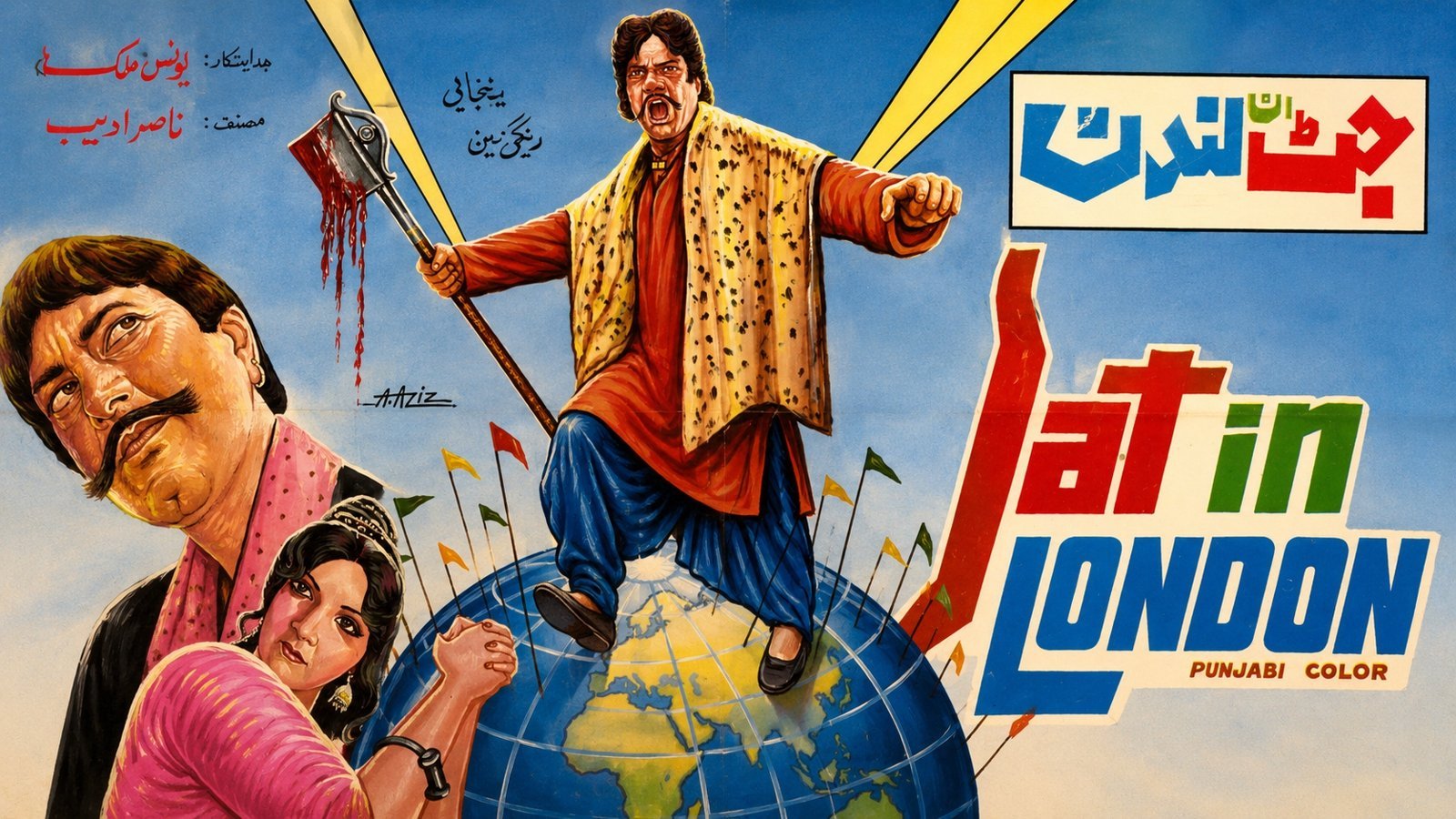
Maula Jatt In London (1981)
Cast: Sultan Rahi, Mustafa Qureshi, Aasia, Chakori, Afzal Ahmed, Seema
Director: Yunus Malik
Synopsis: Dastardly Jatt and Nut shenanigans continue, but now London is the scene!
Reviewed by: Omar Khan
Maula Jatt in London is just one of the numerous sequels of the historic Maula Jatt— a testament to the original’s hysterical popularity in a land where sequels are generally unknown. Jatt in London carries weight as the “Official” sequel to Maula Jatt, as it shares the same cast as the original and the director. The plot continues from where the first Maula Jatt ended: Daro Nutni (Chakori) has managed to settle the terrible feud between Maula Jatt and Noorie Nut by marrying Mooda, Maula’s soul brother. However, now Maula faces trial for his reign of terror, during which his legendary Excalibur-like Gandaasa butchered thousands.
With the trial heading towards an inconclusive end, the judge and jury go into a huddle as it becomes clear that they will not have enough evidence to bury Maula. Even their crucial witness, Noorie Nut, who was Maula’s mightiest adversary, speaks in favour of the Jatt, claiming that he now realizes that the only thing that can topple the Maula is a Maula! The judges decide the best they can do to save the nation from chaos and obliteration at the hands of a renewed Jatt regime is to exile Maula Jatt to a distant country. The plans run into problems when no government in the international community is willing to accept as dangerous a guest a Maula Jatt; even North Korea and Cuba refuse, as does the Western block. The exasperated local
Government defies orders by shoving Maula Jatt on a jet (the Jatt-Jet!) bound for London as, according to the judges, London is such a country that knows how to deal with hardened criminals and thus the apparent place to deport him.
Upon arrival, Maula is apprehended by Her Majesty’s curiously sun-tanned police, fluent in Punjabi. An armed escort takes him to the courts, where he must face the ruthless British law. Maula is reprieved when a mysterious, wealthy Seth offers his bail, leaving the Jatt free to walk the streets of London, but not before the British Government confiscates his deadly gandaasa blade. The weapon is placed strangely in some distant corner on a stool in Madame Tussaud’s sports section (near Cassius Clay)!! Drastic anti-gandaasa measures the law took to save London from enduring the terrible calamity of a mighty Jatt da Kharaak!
Then in a highly charged and typically dramatic scene with countless impact shots, upside down, sideways, every which way, we are shown that Maula recognizes his benefactor, the wealthy Seth, as none other than his long-dead companion Roshan Jatt. But it turns out that Seth (Afzal Ahmed) is not Roshan, but his dad. After a tearful reunion, Maula stuns the Seth by enquiring about Dara Nut, Noori’s brother who lives in London. Seth is horrified that Maula wants to associate with the Nut clan, especially as Dara Nut is a well-known gangster and murderer in London. Seth warns him about Dara and demands that he steer clear of the goon, not that Maula fears anyone on earth but his mother. Meanwhile, Mukhoo (Aasia), Maula’s mung (fiancé), is shocked to view the British newspaper clippings featuring front page pictures of Maula Jatt surrounded by a bevvy of British beauties. Mukhoo and the imperiously blimpish and loud Daani (Maula Jatt’s famous Mother, acted brilliantly by Seema), hop on the next plane to London to join Maula.
The two lovebirds now enjoy London’s incredible sights, notably some semi-derelict streets near picturesque Hounslow and Southall,
Maula Jatt In London amidst startled and somewhat bemused locals and horrified tourists. They visit a disco where Mukhoo slaps the customers, forcing a change in the music so she can teach the goras something about Bhangra.
Dara Nut shatters the bliss by confronting Maula, enraged at his thrashing (killing) of seven of his henchmen. Just as the dreadful Dara is about to lay into the Jatt, Maula tells him that the old enmity is over and that Dara should return home to see for himself.
Dara is utterly mortified to find his brother, Noorie, once the proudest murderer and “evil doer” in the land, now a one-legged cripple singing the praises of their sworn enemy Maula Jatt. Later, when Dara finds his sister, who had once been the most feared psychotic killer in the land, transformed into a meek and servile housewife, cooking roti for the sworn enemy Mooda, he snaps. He berates both Noorie and Daro, pulling his gun out and delivering the justice of a “ghairatmand” brother on a sister who had dared to tarnish the image of the Nut clan. In a scene of superb comic farce, Daro and Mooda each take turns jumping in the way of the bullets meant for each other – touching, albeit sublimely ridiculous. Dara returns to London to wipe out Maula Jatt forever, but Noorie has plans.
The film manages to re-create and continue much of the same outrageously over-the-top style of the excellent original. Most of the action revolves around the mighty confrontation scenes. The performances are typically frenzied, with Seema as Maula Jatt’s mother turning in a genuinely stupendous, almost acrobatic performance. The film’s climax, in which she hurtles through the streets of London like the Incredible Hulk, searching out the mighty Gandaasa and launching her mighty Maula Jatt call (a la Tarzan’s call), is a joy to behold.
Sultan Rahi cackles with relish and plays Maula Jatt as only he can. Mustafa Qureshi sparkles in the double role of the one-legged Noorie and the heinous criminal Dara Nut, while Aasia has several dance sequences and looks jaded for the most part. She had been the cause of some severe delays during the production. Yunus Malik and the producers were set to register a case against the actress for not ful- filling her obligations. She had gone into hiding after an embarrassing escapade at the Studios. Aasia’s self-imposed exile caused the film to be delayed by months and may have cost the producers a lot of money, as other Maula Jatt clones flooded the market before this film could be released. Nazli does her thing playing Dara’s evil moll.
Overall, the film is, in essence, a loving ode to the original, and commendable efforts are taken to recreate the charm and magic of the original—including the brief but startling gore effects, keeping in mind that Maula Jatt was Lollywood’s first-ever outright gore film.
The movie celebrates the original’s glory, and the scriptwriters must be congratulated for their success in integrating the Jatt films into one semi-cohesive, chronological order. We even learn about Maula Jatt’s origins and his father, Chaudhary Rehmat. The fights are suitably spectacular, but the dances sadly lack the vulgarity and crudeness of the pre-Zia era.
What is impressive, though, is how hideous the filmmakers have managed to make London look, having shot most of their footage in some drab back street of Peckham, with boarded-up windows and blighted, low-income housing as the backdrop.
The climax scene, however, remains memorable not only for Seema’s demented antics but also for the fact that the editor has spliced the film so that Dara is very much in Islamabad in front of the presidency while Maula, the person he is battling, is in Southall.
All the incompetence adds to the charm of the film. To its credit, this sequel manages to incorporate much of the overall flavour of the original without perhaps being able to match the electric intensity that made Maula Jatt such an unforgettable experience.

0 Comments
Leave a Comment