
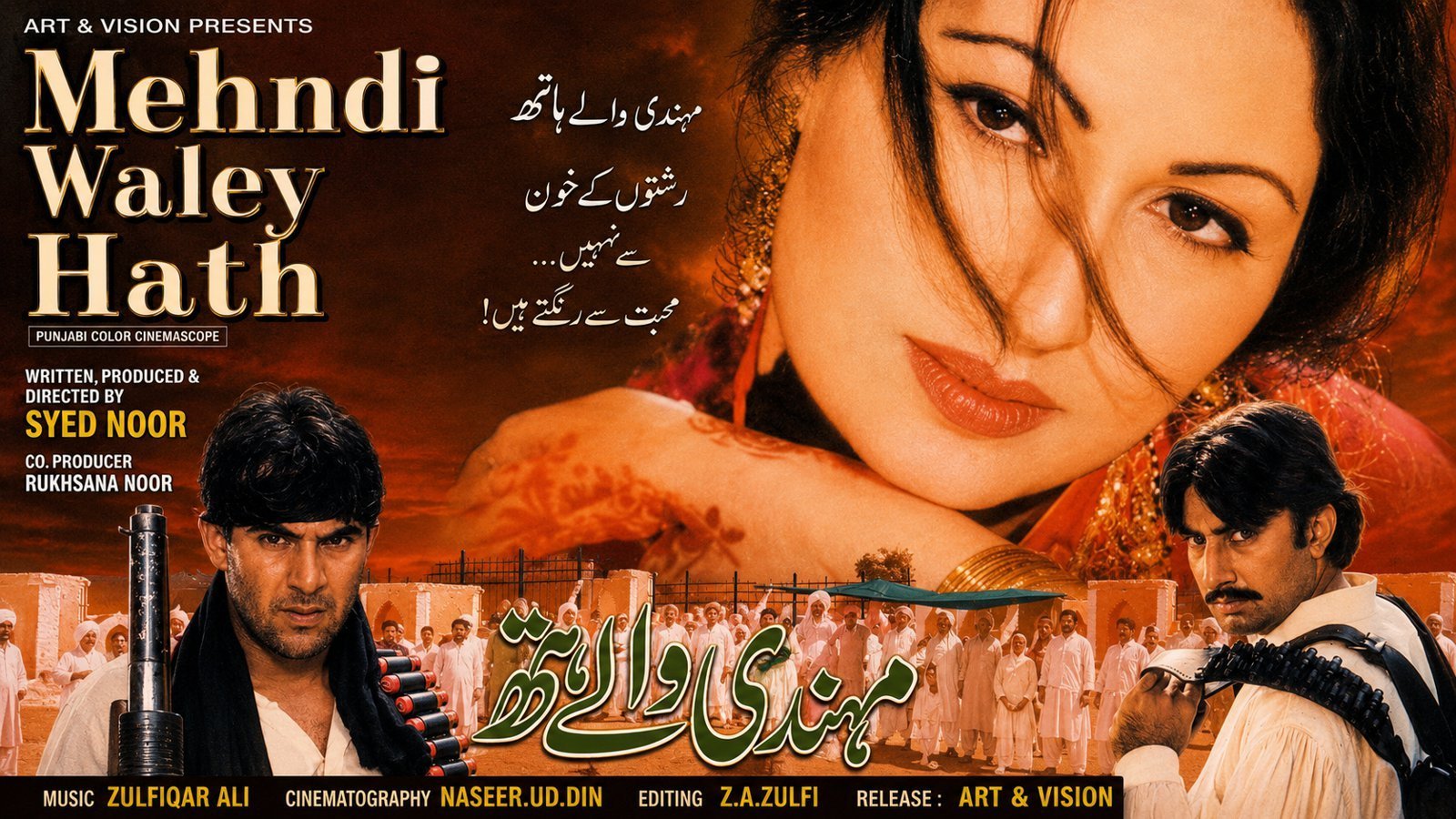
Mehndi Waley Hath (2000)
Cast: Saima, Moammar Rana, Babar Ali, Bahar, Shafqat Cheema, Nirma, Naghma
Director: Syed Noor
Synopsis: A noble attempt at shedding light on a barbaric tradition against women.
Reviewed by: Omar Khan
Mehndi Waley Hath was Syed Noor’s unofficial follow-up to Choorian, and subsequently, expectations among the public and within the industry were sky-high. Last summer, when the preview trailers were screened, they caused mini hysteria in some centres in the Punjab, where audiences demanded them to be replayed repeatedly. There had been reports Noor had been wrapped up in the shooting of his particular pet project. All other productions he was involved in received a cold shoulder while Noor worked painstakingly on Mehndi Waley Hath.
Saima was the major attraction in the film, and she looked great in the promotional clips. It did phenomenal business in the initial week or two, before settling for a steady run when the film opened.
The film enjoyed a six-month silver jubilee run in several centres of Punjab, playing in regular shows (3 shows per day), which was commendable even if it hardly matched the record-busting success of Choorian.
The film begins with a voice-over explaining the “cause” of the filmmakers in attempting to expose a “crual custom” (as the poster said) that exists in the rural areas of Punjab. The action is based around the rural haveli of Vadda Saeen—the family elder and his wife. They live in their sprawling estate with the extended family that is usually warring with one another. There are also legions of enslaved people (ghulams) who devote themselves to the Vadda Saeen and show their love for their Saeen by kissing and nuzzling his feet! Women are married off illegally to the Quran, so the landowning family doesn’t have to part with any of its wealth.
The house contains two warring “bahu’s”, the benign, kindhearted widow, Naghma, and the Wicked-Super-witch-from-Hell, Bahar. Naghma has a demented son, Babar Ali, who shoots people for fun and a daughter, Saima, an overgrown 35-year-old teenager with an unhealthy pigeon fetish. Problems arise when it is discovered that the family will stand to lose a large segment of their land once Saima is wedded. The family elders cajoled and abetted by eyebrow queen Bahar, decide to adopt a plan where Saima is to get married, not to a handsome young prince but to the Holy Book.
There are to be no festivities, no joy, and little chance of children. She must also wear white and live in a deserted mausoleum with her husband! Naturally, Saima, expecting marriage to a handsome young pigeon, is depressed when she is banished to a life on the periphery. Matters start coming to a head when Rana returns from “frontline duty” to find that the girl of his dreams has been forced to wed a Quran and live in exile. He consults a nearby imam who tells him that such marriages are unrecognized by Islam and are simply illegal schemes by which families attempt to retain their wealth. So, armed with this information, the hitherto timid Rana decides to take on the almighty family of Vadda Saeen, led by the dangerously psychotic Babar Ali.
Mehndi Waley Hath First, the movie must be commended for at least attempting to tackle a relevant issue in a language most likely to be understood by the masses. The film is also to be congratulated for avoiding the sleazy element associated with Punjabi movies. Syed Noor plays to the masses but successfully avoids the smutty stuff, going for the wholesome style of “Choorian” instead. The film has some decent tunes to help it along, but the pace starts slowing more and more as we approach the inevitable climax.
Saima looks fetching and should be featured in next year’s Film Award ceremonies for acting in this film—yet she looks considerably older than her co-star Moammar Rana. Bahar eats up the screen and dominates as only she can, while Nirma, as Babar Ali’s trinket, doesn’t make much impression despite being given a sizzling number to perform. Nirma’s future doesn’t appear to be too bright. Babar Ali takes most of the acting accolades, delivering a menacing performance as the evil brother Mattoo. He ought to forget about taking on romantic leads, considering how average (to put it mildly) he looks, and would be far better advised to stick to this sort of negative role, which he performed with such distinction here. Mehndi Waley Hath is not an outright embarrassment and is elevated by the “message” that it attempts to deliver. A feather in director/producer/screenwriter Syed Noor’s cap—a rare commodity these days.


0 Comments
Leave a Comment