
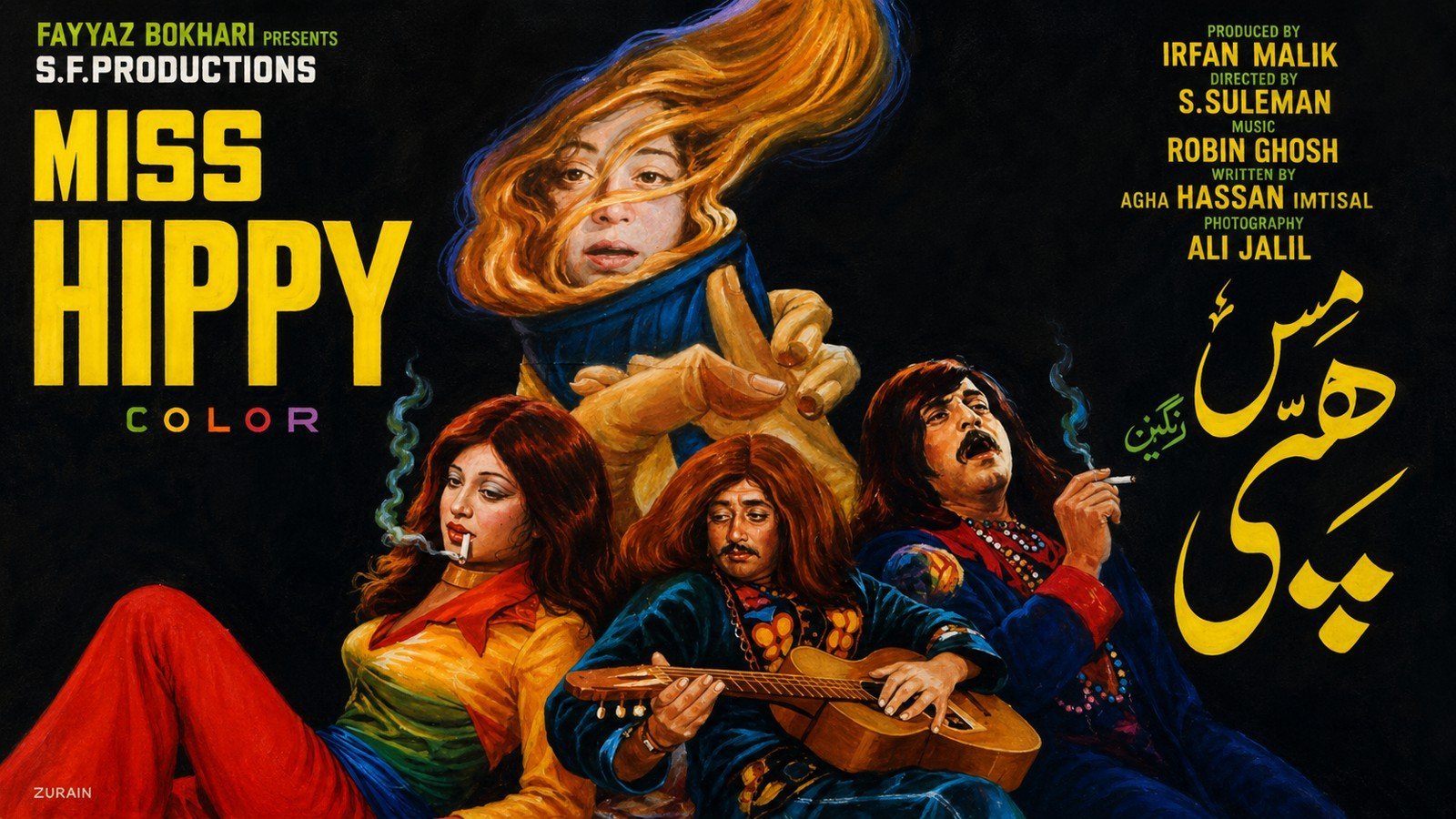
Miss Hippy (1974)
Cast: Shabnam, Nadeem, Sabiha, Santosh, Munawar Zareef, Nazli Director: S. Suleman
Synopsis: A family adopts a Westernised, modern “lifestyle” with catastrophic results.
Reviewed by: Omar Khan
Another forceful Lollywood socio-drama, Miss Hippy, is about the disasters that befall a family that adopts a Westernised, modern “lifestyle”. In this case, we have the wealthy couple, Santosh and Sabiha. They live comfortably with their daughter Bubbly, and their adopted son Nadeem, in a reasonably grand house cared for by several servants. Santosh is keen on keeping up with fashion and the latest trends, but his fundamental problem is that, almost unknown to him, he has turned into a hardened alcoholic.
One night, when Bubbly yearns for parental love and throws a tantrum, her callous father gets her groggy with spoonful of cognac to get her to sleep. Sabiha is shocked at her husband’s behaviour, but she is too meek to stand up to his domineering manner. Santosh is far more interested in making sure he doesn’t miss five minutes of his debauched friend’s dance party than attending to the emotional needs of his daughter.
We gradually watch Bubbly grow up wearing dresses and learning to dazzle guests with her disco-dancing skills. However, due to her habitual guzzling of hard liquor for the last eight years, she has become a hardened alcoholic with a habit at least as bad as her father’s— despite being merely 12 years old! She steals into Daddy’s larder, makes off with the occasional bottle to guzzle and passes out.
One day, Daddy finds out and reacts in his typically deranged style by lashing out at everyone but himself—the person who first started her on the evil spirit. He terrorises his daughter until, in sheer desperation, she decides to escape from home and nearly gets run over by someone who picks her up and turns her on to the sordid world of hashish.
While her mother goes batty and can’t fall asleep, waiting for her daughter’s return, the daughter has turned into Miss Hippy, preaching free love and living in a perpetual haze of hashish and other terrible drugs. Not only does she devote her life to this debauched drug haze, but she also turns into one of the main cogs of an international drug-running syndicate run by her fellow hippies. She uses her stunning beauty and charms to significant effect, dodging customs checks all over the land to spread the evil menace of narcotics. In their spare time, the hippies preach to their lord, a white-bearded Rajneesh-like spiritual leader, who always propounds the theories of free love and sex amidst clouds and clouds of hashish.
Two undercover cops infiltrate Bubbly’s murky world; one, Nadeem, is a long-lost childhood companion of Bubbly. With his sidekick, Munawar Zareef, they pose as hippies and soon gain acceptance into Shabnam’s (Bubbly’s) clan. Once within the clan, they can get invaluable first-hand information about the smuggling operations. Still, Shabnam discovers that Nadeem is an undercover cop trying to bust their gang and has him captured. However, slowly but surely, Nadeem plants the seeds of doubt in Shabnam’s drugged-up mind that her spiritual leader is merely a drug peddler and nothing more. Soon, she is convinced when the fake Imam’s wig and beard are yanked off—the police strike, but Shabnam is allowed to reform due to her compliance in rounding up the criminals.
Nadeem takes her home, which happens to be the same home she escaped from as a child (and has no recollection of due to her excessive drug and alcohol abuse), and here she comes across her ghastly
Miss Hippy father. Now he turns all moralistic on her and throws her out for being a vile drug-running criminal. Even though her presence bought miraculous relief to Sabiha, who had gone insane pining for her daughter’s return—she was able to fall asleep in Shabnam’s company.
Intense melodrama ensues as Shabnam is chucked out of the house. Eventually, all is revealed after all sorts of twists and mayhem. The film is another expertly concocted tonic for the masses. It shows how superior their way of life is, as compared to the debauched, hedonistic ways of the West, and how those of us who choose to adopt a Western lifestyle can only end up in the worst untold misery.
In the soul-stirring climax speech delivered by Shabnam, she questions the government for not doing anything to stop the infiltration and unrestricted travel of evil Hippies in the country. She demands a ban on the entry of such people, who call each other “comrades” rather than brother and sister.
The story’s morals are clear—evil Westernised ways mean that “modern” parents are too busy partying at clubs and with other “fashionable” friends, when they should attend to their children at home. Instead, these evil hedonistic parents hand over their children to servants who pretend to be devoted but are cunningly mercenary in their motives. The movie shows that a father getting late for his dance party prefers to douse his daughter’s demands with a spoonful of brandy rather than be tardy for the all-important party.
Miss Hippy’s message is hardly an uncommon theme in Lollywood cinema, and has been done to death in countless movies ever since the cameras started rolling in this country. This genre has provided vast entertainment and amusement along the way. Miss Hippy is similarly fascinating but loses steam after the first half, when Shabnam is reformed from the drug-running super criminal cum hardened alcoholic she is early on. However, she turns in a polished, professional performance as ever and virtually carries the film on her shoulders. Nadeem does not have much scope, while Munawar Zareef shines as his sidekick, as he appears in drag in several scenes (something he is very comfortable with), and is hysterical in each of these scenes, as is his appearance. He mentions a line in the film about how the rich and famous always suffer from liver complaints first and foremost, the irony being that he was to go to a miserable premature death due to this ailment. Sabiha does her weeping, pining mother bit with conviction, and Santosh is impressive as the monster father who turns repentant, having destroyed his daughter’s life with his own hands.
Some weaknesses of the film are its unimpressive songs and lack of oomph. Also, the film gets bogged down in the latter stages when the melodrama takes over entirely, and the hippy bits are done away with altogether. Like most films of the land—the movie is more than predictable, and the audience is always at least five steps ahead of the narrative, and in serious danger of nodding off as the film nears its conclusion. That said, it’s a reasonably engaging social melodrama with a potent message about the terrors that the Hippy comrades represent to world peace!
The hippy retreat set is intriguing, though, as is the wonderful title music. Lollywood can always be counted on to provide some of the world’s most stunning wigs. On this count, Miss Hippy certainly delivers.



0 Comments
Leave a Comment