
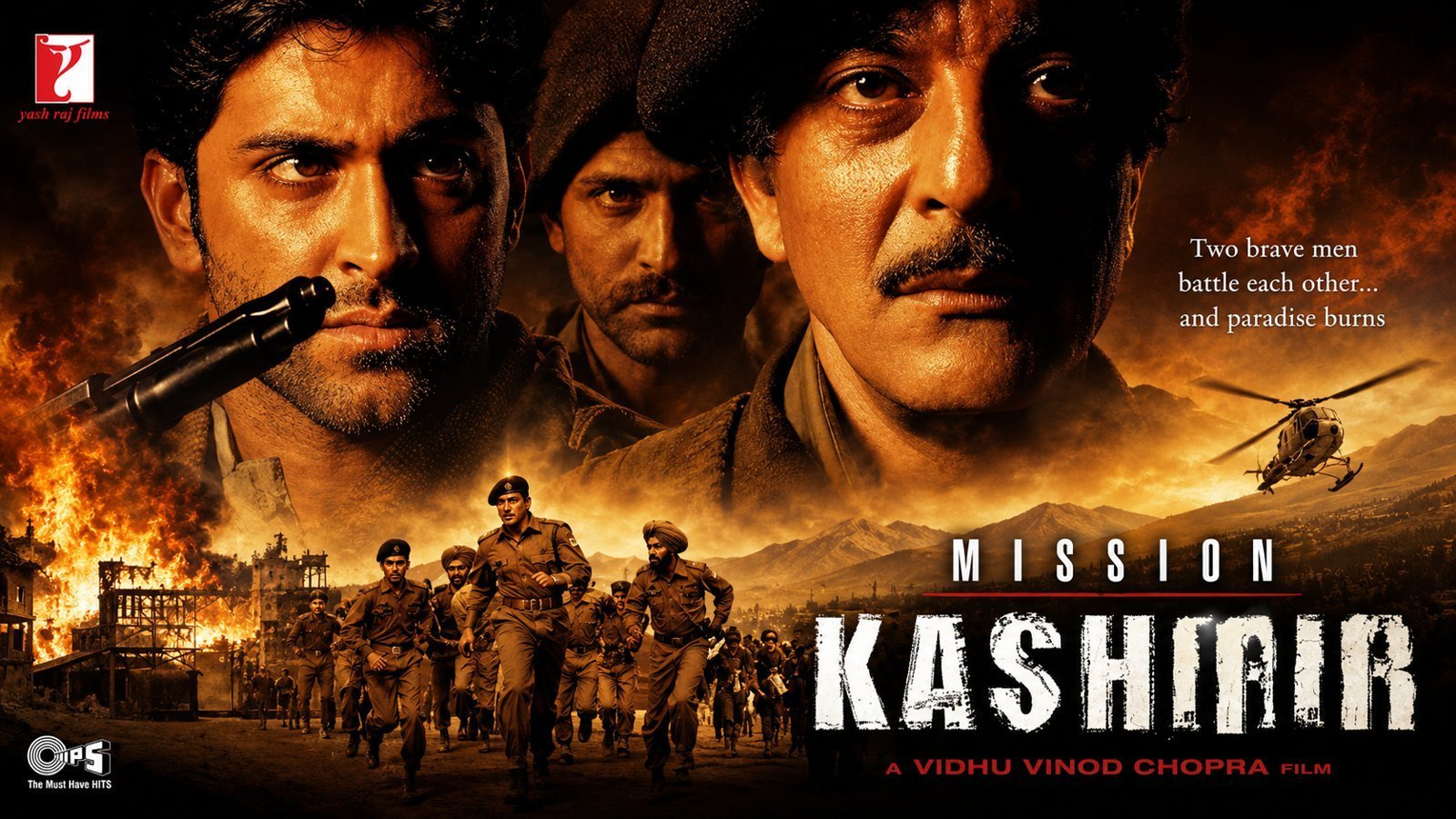
Mission Kashmir (2000)
Starring: Sanjay Dutt, Hrithik Roshan, Jackie Shroff, Preity Zinta, Sonali Kulkarni
Director: Vidhu Vinod Chopra
Music Director: Ehsaan Shankar, Loy
Synopsis: excellent performances, a gripping plot and tight direction
Reviewed by: Faiz Khan
A shikara glides across a still lake, the beauty of Kashmir resplendent in the background, a hazy mist clutching the mountains. It is quiet, calm, serene. The stillness is shattered by an explosion. The shikara erupts into flames to the haunting strains of Dhuan Dhuan, a visual metaphor for a burning Kashmir—once one of the most beautiful places on earth, now ravaged by repression and terrorism, consumed by fear and divided by politics in the name of religion.
Inayat Khan (Sanjay Dutt) is a BSF officer living in Kashmir with his wife Nirmala (Sonali Kulkarni) and their young son. Such is the climate of fear that doctors refuse to treat policemen or their families, terrified of militant reprisals. After an accident, Inayat's son is denied treatment and dies as a result.
Soon afterwards, Inayat receives information about the whereabouts of a group of militants and leads an operation to eliminate them. Bursting into the house where the militants have taken refuge, his men slaughter an innocent family in the crossfire, leaving eleven-year-old Altaf as the sole survivor. Traumatised, Altaf is haunted by the eyes behind the balaclava that murdered his family.
Consumed by guilt, Inayat brings the orphaned child home, where he and Nirmala become his foster parents. Altaf fills the void left by the loss of their own son, while they attempt to atone, in some small measure, for the tragedy that Inayat has caused.
Gradually, Altaf begins to settle into his new life, unaware that the man he now calls father is the very man responsible for the deaths of his real parents. Love begins to heal these broken souls—but only briefly. When Altaf eventually discovers the truth, he attempts to shoot his foster father, fails, and runs away.
Ten years later, Altaf (Hrithik Roshan) has become part of a jihadi organisation led by Hilal (Jackie Shroff). His sole purpose in life is to avenge his parents by killing Inayat Khan. Hilal, however, has carefully nurtured the boy for his own sinister agenda. Having paid two million dollars to execute the mysterious "Mission Kashmir", he dispatches Altaf back to the valley to begin its implementation.
Returning to Kashmir, Altaf reunites with his childhood sweetheart Sufi (Preity Zinta), though he exploits her for his own ends before blowing up a television station. The first stage of the mission is complete. His next objective is Inayat Khan—and the fulfilment of his revenge.
But what exactly is Mission Kashmir? Is this simply another routine revenge drama dressed up against a volatile political backdrop?
On the surface, perhaps. Yet beneath that lies a film attempting to portray the devastation of Kashmir through the framework of a mainstream Bollywood thriller. Vidhu Vinod Chopra has crafted an intelligent, responsible and often deeply moving film, balancing large-scale action with genuine emotion remarkably well.
The first hour is exceptionally powerful—disturbing, painful and emotionally draining. Chopra's images of children surrounded by the bodies of their murdered families, the fear that dictates everyday existence, and the destruction of innocence as seen through Altaf's eyes are genuinely heartbreaking. These lives feel painfully real.
Chopra directs the scenes between the young Altaf, Sanjay Dutt and Sonali Kulkarni with extraordinary sensitivity. Rather than resorting to melodramatic outbursts, he expresses the child's trauma through the haunting drawings Altaf produces, allowing them to convey emotions that words never could. Likewise, Altaf's gradual rehabilitation and the grief of his adoptive parents are handled with admirable restraint. Chopra strikes a raw emotional nerve throughout these early scenes.
Hrithik Roshan's arrival provides a shift in tone as the film moves towards larger-scale action and the inevitable commercial songs. Fortunately, Chopra never loses control of the narrative, and the central story remains compelling throughout. The songs, while pleasant enough, interrupt rather than enhance the flow of the film. Technically, however, Mission Kashmir is on a par with many Hollywood productions, culminating in a spectacularly mounted climax.
This is undoubtedly Sanjay Dutt's triumph. He delivers one of the finest performances of his career as Inayat Khan, perfectly capturing the transformation from the sensitive but driven officer we first encounter to the older, weather-beaten Inspector General who finds himself the object of hatred from the boy he once raised as his own son. It is a superbly judged performance.
Sonali Kulkarni provides excellent support in a comparatively small but important role. Hrithik Roshan also gives another fine performance, though some may criticise its similarities to his role in Fiza. Even so, he conveys Altaf's torment, his suppressed childhood trauma and his manipulation at Hilal's hands with conviction. Without revealing too much, one particular scene of mourning is genuinely devastating.
Preity Zinta sparkles as always, bringing warmth and natural effervescence to Sufi. Jackie Shroff is mesmerising as Hilal. Speaking almost in whispers, he projects menace through the quiet authority of his voice and, above all, through his eyes. His performance is understated yet deeply unsettling, like a slow poison that gradually infects everyone around him.
Shankar-Ehsaan-Loy's music is distinctive and memorable. Bumbro had already become enormously popular, while Dhuan Dhuan lingers in the memory long after the closing credits have rolled.
Ultimately, Chopra seems less interested in offering solutions than posing difficult questions. Does violence inevitably breed more violence? Does every atrocity committed by militants provoke an even harsher response from the authorities? And does every innocent family caught in that cycle create another Altaf? Where does such a cycle ever end?
Chopra wisely offers no easy answers. Rather than assigning simplistic blame, he merely explores some of the forces that continue to tear Kashmir apart. Is the conflict fundamentally religious? Political? Or is there a far greater conspiracy beneath the surface? Significantly, Chopra dedicates the film to Kashmiriyat—the centuries-old tradition of religious tolerance, coexistence and harmony.
I doubt Mission Kashmir will change Kashmir. But it is an honest, thoughtful and deeply sincere effort that deserves to be seen. With outstanding performances, a gripping story and assured direction, this is Vidhu Vinod Chopra's finest film since Parinda. Quite simply, Mission Kashmir stands head and shoulders above almost every other Bollywood film to tackle this subject.

0 Comments
Leave a Comment