
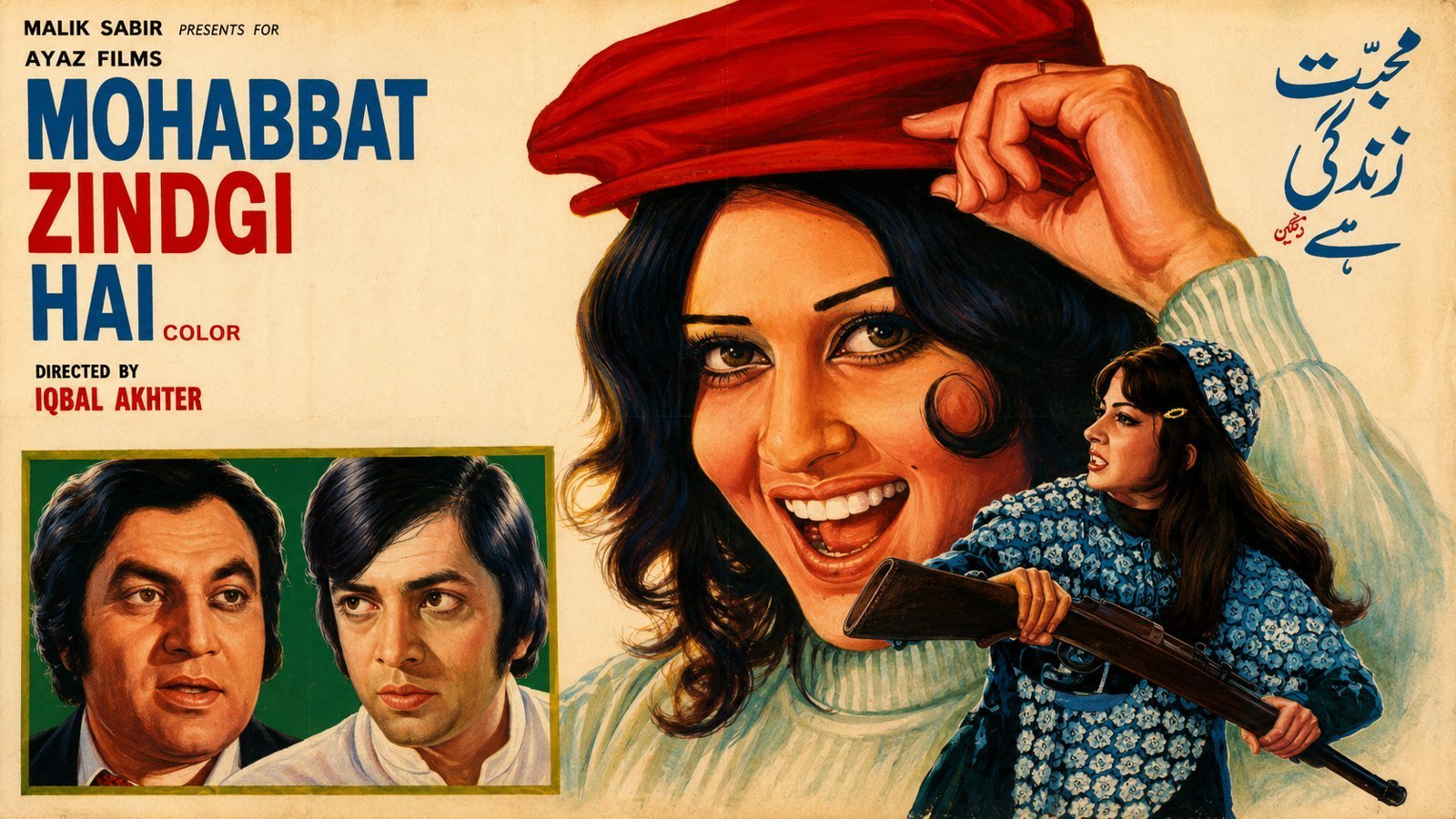
Mohabbat Zindagi Hai (1975)
Cast: Mohammad Ali, Zeba, Waheed Murad, Mumtaz, Nayyar Sultana, Lehri
Director: Iqbal Akhtar
Synopsis: Westernised values threaten to wreak havoc in this thrilling epic fable.
Reviewed by: Omar Khan
The film was one of several that lit up the screens during the summer of 75, raking in rupees and notching up an impressive platinum jubilee along the way. The mid-’70s were the golden age of Lollywood production, even if the bubble was just about to burst with the arrival of the dreaded VCR and even more dreadful Zia Ul Haq dictatorship lurking just around the corner.
This film was an all-around family entertainer with a social message as old as the hills. The plot revolves around the tried and tested formula of Eastern virtues pitted against Western civilisation’s debauchery and depraved nature. After the usual traumas, all ends well; everyone realises the folly of modernism and decides to adopt traditional, conservative, righteous and archaic ways.
The movie’s underlying theme is the same as hundreds of its ilk: “to enjoy” is the most terrible evil, which results in death if you are a man and gang rape, followed by death if you are a woman.
In this breezy entertainer, we have Zeba as Nadira, a madcap tomboy with a penchant for thrashing the local hoods to pulp. Mohammad Ali tames her tomboyish ways when he marries her after some highly corny but amusing comedy frolics in the movie’s first twenty minutes involving the two of them and Khalid Salim Mota, Qavi and Lehri.
When the newlyweds move to the city to be with Mohammad Ali’s family, the plot unfolds, revealing a home torn apart by discord and unhappiness. At the head of the family is a kitty party-holding, blond wig-wearing, cigarette-smoking, and disco-dancing Aunty (Tamanna). She encourages her daughter, the errant Farzana (Mumtaz), to follow in her footsteps. When stepson Mohammad Ali objects to Mumtaz hanging out at the club daily, he is put in his place, reminded that he is no more than a stepson and has no rights in the household.
And so, we see Mumtaz frittering her life away at the club amidst terrible people who like to “enjveye” life rather than sit moping around at home. The film warns that a single woman is prone to ill judgment and must have a man in her life as a guiding force, and if it ever happens that a woman is in the position to call the shots and make the decisions, all will soon go woefully wrong.
The club dancing Mumtaz’s fiancé arrives after a gap of five years, having completed his studies in England (at 40). He is mortified to find that the prissy, Ms Goody Two Shoes, he had left a few years ago, has transformed into a voluptuous, go-go dancing beauty—the life of the local club.
Waheed Murad plays an England-returned geek, the epitome of Eastern virtue despite his stint abroad. Mumtaz is disappointed that the Prince Charming she had been hoping for has turned out to be the most gormless and insipid dolt possible.
Waheed decides he can’t possibly get married to the party babe Mumtaz but is convinced by Mohammad Ali to give it one final try. Waheed announces his membership to the club with a sizzling song that delights Mumtaz, who is thrilled that her fiancé is not the drip that came back from London but a trendy, hip-dancing, westernised dude who loves to hang out at the club swigging neat whisky.
Murad’s ingenious plan is to infiltrate the club as a regular, win over Mumtaz’s attention, and somehow force her to see the shallowness of the western ways of the wretched club. To cut a long story
Mohabbat Zindagi Hai short, Waheed Murad manages to get Mumtaz to reform back to the prim and proper goody two shoes of yesteryear. Still, in doing so, he becomes tragically addicted to the club’s life and refuses to give it up.
Will Waheed now fritter away his own life in the evil trappings of that hell hole of debauchery known as the club, or will someone be able to get him to realise the error of his ways? Mohammad Ali delivers a few typically stirring speeches, and even Zeba tries her luck but to no avail—Waheed will not budge from the club.
Despite the somewhat predictable storyline, the film manages to entertain and move along at a rollicking pace. Zeba has a spunky role to which she does full justice, and Mohammad Ali is his excellent self. Waheed Murad does a reasonable job of moping around and looking witless, and his hairstyle is at least as annoying as his insipidness. Mumtaz provides a little spark with her saucy dance Dil Sambhala Na Jaye and the smash-hit number Nahid Akhter’s Tut Turoo Turoo Tara Tara. At the same time, the two Ahmed Rushdie songs filmed on Waheed Murad were also enormous hits in their time—Dil Ko Jalana Ham ne Chhor diya and Mashriqi Rang ko Chhor Ke. The film manages to hold attention, though it is formulaic.
Mohabbat Zindagi Hai is a racy family entertainer with an outstanding music score and super performances by Zeba, Mohd Ali and Mumtaz. It’s a good old-fashioned farce and manages to work primarily with solid performances by the main leads other than Waheed Murad, who looks like he is afflicted by sleeping sickness. It’s challenging to decide which is worse, Murad’s patented hairstyle or his mind-boggling dance steps. It’s not difficult to see why Mohabbat Zindagi Hai was such a whopping success when released in 1975. The matinee show we watched was packed with women, some comfortable enough to have their toes perched on the seats before them. Having a burqa- clad Aunty's set of delightfully painted toes in the adjacent seat is an enduring, if odious, memory.



0 Comments
Leave a Comment