
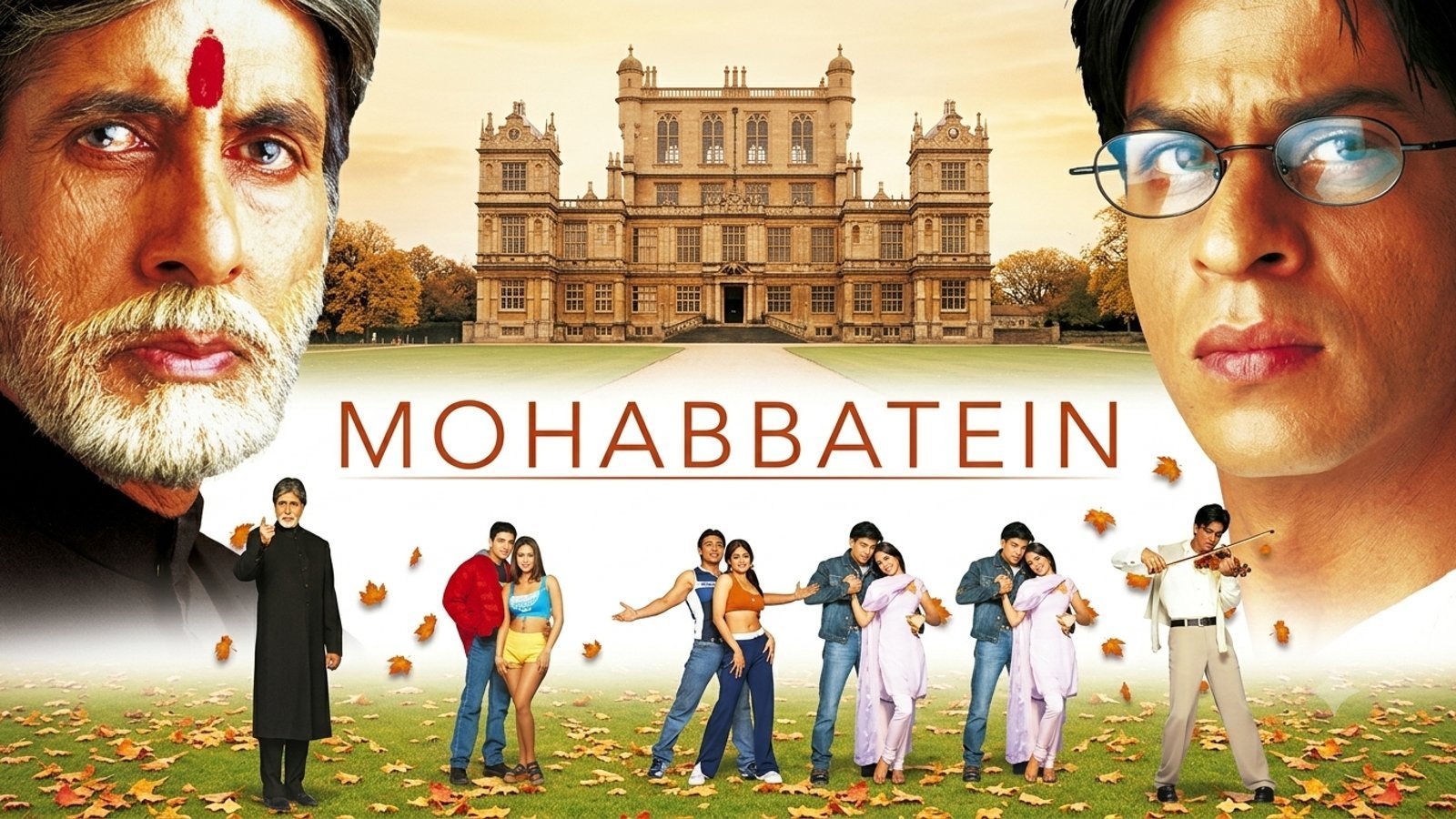
Mohabbatein (2000)
Starring: Amitabh Bachchan, Shahrukh Khan, Uday Chopra, Jugal Hansraj, Jimmy Shergill, Shamita Shetty, Kim Sharma, Preeti Jhangiani
Director: Aditya Chopra
Music Director: Jatin Lalit
Synopsis: Follow-up to Dilwale Dulhania is highly ambitious but ultimately a flawed successor
Reviewed by: Faiz Khan
A train slowly pulls into a station, almost identical to the platform that carried Raj and Simran away to their happily-ever-after in Dilwale Dulhania Le Jayenge, Aditya Chopra's previous effort. Could this be Dilwale Part Two? Even now, DDLJ remains a magical film, brought to life by wonderful performances and one of the finest structured scripts Bollywood has produced. Mohabbatein therefore has an enormous legacy to live up to.
The story revolves around three students at Gurukul—Sameer (Jugal Hansraj), Karan (Jimmy Shergill) and Vicky (Uday Chopra). Gurukul is ruled with an iron hand by its principal, Narayan Shankar (Amitabh Bachchan). From his opening address to the students, it becomes obvious that this resembles a military academy far more than a college. Any breach of Gurukul's traditions results in almost immediate expulsion.
Narayan Shankar is cold, aloof and emotionally distant. He dislikes change. For twenty-five years he has run the institution according to his own rigid principles and remains fiercely proud of them.
The film then follows the romantic journeys of the three boys. Vicky loses his heart to Ishika (Shamita Shetty) from the neighbouring college. Karan catches sight of a mysterious girl dressed in red across a railway platform and instantly falls in love. Sameer still carries a torch for Sanjana, a girl he has not seen for six years and to whom he has never found the courage to confess his feelings.
Naturally, these romances are forced to blossom under the shadow of Narayan Shankar's uncompromising rules, particularly the absolute prohibition on leaving the Gurukul grounds. Rumour has it that years earlier he expelled a student for daring to fall in love with his daughter—a tragedy that eventually led to her suicide. Even then, the man remained unmoved. No prizes for guessing who that unfortunate student might have been.
Sameer reunites with Sanjana in the marketplace, although she now has a boyfriend and he still cannot bring himself to express his feelings. Karan discovers that the mysterious girl in red, Kiran, is a young widow who continues to wait faithfully for her husband because her father-in-law refuses to abandon hope that he may still return alive. Friendship slowly develops into love.
As for Vicky and Ishika, they seem to have wandered in directly from the sets of Dil To Pagal Hai. Apart from the usual flirtation and banter, there is very little substance to their romance.
The catalyst behind this sudden outbreak of romance is the arrival of the new music teacher, Raj Aryan (Shah Rukh Khan). He encourages the boys to follow their hearts, preaching the virtues of music and love with infectious enthusiasm. Inspired by him, the three students burst through Gurukul's gates and into the inevitable song and dance sequences—fortunately for them while the principal happens to be elsewhere.
Raj gradually earns Narayan Shankar's trust and even succeeds in softening some of his rigid rules. Matters come to a head, however, when Raj organises a birthday celebration and invites the girls from the neighbouring college, accompanied by their principal (Helen). Narayan Shankar is outraged and demands Raj's resignation.
Only then does Raj reveal the truth. He is the very student whom Narayan Shankar expelled years ago for loving his daughter. While this revelation shocks Narayan Shankar, it is hardly likely to surprise the audience. Raj's contract prevents his dismissal, and he vows to remain at Gurukul until he has filled it with enough love to defeat Narayan Shankar's philosophy of discipline without emotion.
Thus begins the real conflict. Will love triumph, or will tradition prevail?
Aditya Chopra has woven together four love stories into a narrative that ultimately promises more than it delivers. Loosely inspired by Dead Poets Society, it lacks both the emotional depth and the genuine student-teacher relationships that made Peter Weir's masterpiece so compelling. Instead, Chopra spends much of his time juggling the romances at the expense of what should have been the heart of the film—the ideological battle between Raj Aryan and Narayan Shankar.
The greatest weakness of Mohabbatein is that the three youthful romances simply aren't very interesting. There is very little conflict in two of them, and they amount to little more than candyfloss. Only Karan and Kiran's story contains any real emotional substance. So much time is devoted to these romances that the film sacrifices genuine drama for an inevitable, rather clichéd build-up towards the climax.
Even more disappointing is the underdeveloped relationship between Raj and his students. We are repeatedly told that he transforms their lives, but we are rarely shown how. Apart from a few classroom scenes and musical interludes, there is little evidence of any meaningful bond between teacher and pupil. Did he genuinely inspire them? Did he fundamentally change them? The film never really answers these questions.
Instead, Raj wanders through Gurukul accompanied by the spirit of his deceased lover Megha (Aishwarya Rai), spreading love and hope with the occasional shower of yellow flowers.
The film truly comes alive whenever Raj Aryan and Narayan Shankar share the screen. Their confrontation is the film's greatest strength, and one wishes Aditya Chopra had centred the entire story around them. This is not simply because Amitabh Bachchan and Shah Rukh Khan are two exceptional actors. Their scenes possess genuine dramatic weight, something largely absent from the three youthful romances.
One longs for more moments like Raj quietly recalling "Ek ladki thi deewani si..." before Aankhein Khuli, but sadly they are few and far between. The romances themselves contain very little freshness or passion. Even Raj's own relationship with Megha never quite moves the audience, and her suicide becomes one of the weakest emotional moments in the film.
Amitabh Bachchan towers over the entire production. It is a joy to watch him in a role worthy of his immense talent. Here, at last, is a character that suits both his age and his gravitas. Never once does he resort to excess. His Narayan Shankar is restrained, believable and quietly formidable.
Shah Rukh Khan also gives a fine performance and more than holds his own opposite Bachchan during their confrontations. Elsewhere, however, he occasionally feels like an older version of Raj from Dilwale Dulhania Le Jayenge, complete with familiar expressions and mannerisms. The problem lies less with Khan than with Chopra's screenplay, which never develops Raj Aryan as fully as it should.
Among the newcomers, Uday Chopra gives an easy-going performance that suits his carefree character well. Jimmy Shergill emerges with the strongest role of the three younger heroes and handles it with considerable charm. Jugal Hansraj is natural and unaffected throughout.
Of the girls, Shamita Shetty brings energy and confidence to what is essentially a glamour role. Kim Sharma remains largely insipid, while Preeti Jhangiani, despite arguably having the best-written role, leaves surprisingly little impression. Of the younger cast, only Jugal Hansraj consistently projects genuine warmth and vulnerability. Aishwarya Rai drifts in and out of the narrative as Raj's ethereal muse, more symbolic than substantial.
Jatin-Lalit's music proves to be one of the film's disappointments. There are one or two pleasant melodies, but for a Yash Raj production the soundtrack falls well short of expectations.
Aditya Chopra directs with confidence but appears overwhelmed by the sheer size of his own creation. There are simply too many characters and too many storylines competing for attention, with the result that very few receive the depth they deserve. Nevertheless, he remains an assured storyteller, and despite its considerable running time, the film never becomes dull.
For me, the film's most delightful moment comes when Helen suddenly breaks into dance during the birthday party. It is pure cinema—bridging generations, celebrating Bollywood's past while embracing its present.
Perhaps it is unfair to judge Mohabbatein so harshly. It remains miles ahead of much of the forgettable rubbish released every week, and I would certainly recommend it to anyone wanting to watch a worthwhile Hindi film. But Aditya Chopra invited comparison by following Dilwale Dulhania Le Jayenge, and by calling this film Mohabbatein. One expects overwhelming romance, passion and emotional intensity.
Instead, the film offers those qualities only on the surface.
Having said all that, I still enjoyed Mohabbatein. But at three hours and thirty-six minutes, I doubt I shall be rushing back for a second viewing.

0 Comments
Leave a Comment