
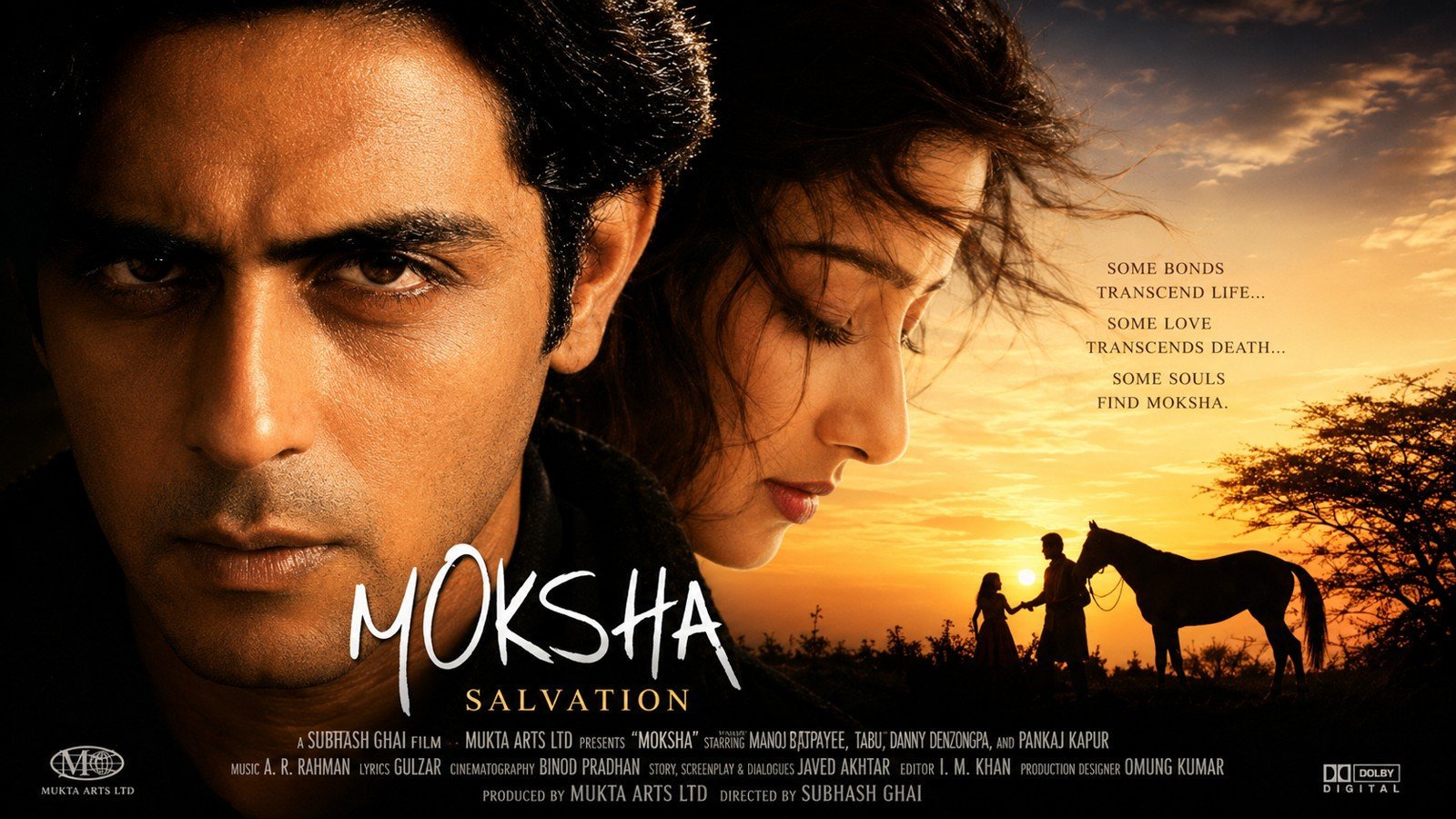
Moksha (2001)
Starring: Arjun Rampal, Manisha Koirala
Director: Ashok Mehta
Music Director: Rajesh Roshan
Synopsis: A fresh and intelligent film, cleverly plotted and beautifully shot.
Reviewed by: Faiz Khan
Ashok Mehta's maiden directorial effort, Moksha (Salvation), finally making its way to theatres, is something of a surprise in itself. The film has languished in limbo for almost three years and perhaps struggled to find distributors until Arjun Rampal made a name for himself with Pyaar Ishq Aur Mohabbat. Having said that, I may be jumping the gun somewhat, as Moksha has yet to receive a full commercial release and what I saw was a festival print, which may well differ from the version eventually released.
Three years is a long time for any film to remain on the shelf. More often than not, such productions emerge looking dated, uneven and disjointed. Thankfully, Moksha suffers from none of those problems. Instead, it turns out to be a refreshingly intelligent film, cleverly structured and beautifully photographed.
The film opens in the present, photographed in stark black and white, with a restless and tormented Vikram (Arjun Rampal) seemingly drifting aimlessly from place to place. Mehta constantly alternates between past and present, gradually revealing Vikram's story.
The son of a wealthy horse trainer, Vikram becomes a lawyer but soon grows deeply disillusioned with the legal system. Convinced that justice is available only to those who can afford it, he conceives the idea of establishing what he calls Nyay Darshan—"The Court of Last Resort"—a legal institution dedicated to helping those too poor to pursue justice through conventional means.
In India, very few lawyers are willing to work pro bono. There is no comprehensive legal aid system capable of protecting the poor. If you cannot afford proper legal representation, the chances of obtaining justice become painfully remote. Vikram's dream is therefore both wonderfully idealistic and hopelessly impractical. Such an institution would require enormous financial backing, yet the very people wealthy enough to finance it do not need it themselves. The inevitable question becomes: "What's in it for me?"
Vikram meets Ritika (Manisha Koirala), who embraces his dream and vows to support him forever. The two even jokingly agree that should either betray the other or abandon their shared vision, the punishment should be death. What begins as playful banter gradually assumes far greater significance as the story unfolds.
Ritika's friend harbours an inexplicable hatred for Vikram and even threatens him. Meanwhile, after repeatedly failing to secure financial support for Nyay Darshan, Vikram arrives at a desperate conclusion. If no one will fund justice, he will rob a bank to finance it himself.
Ritika refuses to participate and, troubled by terrifying premonitions of his violent death, pleads with him to abandon the plan. Vikram, however, has become consumed by his obsession. His vision has overtaken his judgement.
The following morning he arrives at the bank, only to discover that an anonymous woman has already telephoned the manager warning of a possible robbery. Realising someone has betrayed his confidence, Vikram goes to confront Ritika.
In truth, I have already revealed more than I probably should. The plot is considerably richer and more layered than this simplified synopsis suggests.
Ashok Mehta ultimately transforms what begins as a social drama into a fascinating tale of love, obsession and psychological disintegration. There is never any overt madness, yet it constantly lurks beneath the surface. Vikram's idealism gradually mutates into obsession. His vision of justice becomes so consuming that he can no longer recognise his own moral contradictions. He condemns brutality in others while becoming increasingly blind to his own.
Likewise, there is an undercurrent of emotional perversity that is never fully articulated, only subtly suggested. Many scenes linger in the mind because they seem to demand interpretation beyond their immediate meaning. To my mind, any film that provokes genuine thought rather than simply spoon-feeding its audience has already achieved something worthwhile.
This is an impressive directorial debut. Mehta has fashioned Moksha almost like a European art-house film from the 1960s. Arjun Rampal could easily have stepped out of a Jean-Paul Belmondo film—black-and-white chic permeates every frame. I am certainly not suggesting comparisons with Godard, for Moksha never approaches that level of greatness, but its structure and visual language clearly aspire towards European cinema, and Mehta carries this off with considerable confidence.
Occasionally, however, the cinematographer within Mehta overwhelms the storyteller. Certain passages become self-indulgent, lingering longer than necessary simply because they look beautiful. Likewise, one or two songs could easily have been removed altogether. They contribute very little and merely slow the film's already languid pace.
This was intended to be Arjun Rampal's debut film, and it reveals an actor of considerable promise. He is undeniably handsome and possesses remarkable screen presence, yet Mehta wisely avoids reducing him to little more than a model. His performance is restrained, natural and quietly assured. Add to that his wonderfully deep speaking voice, and one cannot help wondering what might prevent him from becoming a major star.
Sadly, I suspect this very film will struggle commercially. It is simply too stylish, too reflective and too leisurely paced to appeal to mainstream audiences. I sincerely hope I am proved wrong.
Manisha Koirala is also impressive as Ritika, although her playful introduction and early scenes are somewhat irritating and could have been handled with greater subtlety. Fortunately, as the narrative develops, so too does her performance, becoming increasingly mature and emotionally convincing.
Rajesh Roshan's music is disappointingly ordinary and leaves very little lasting impression. Ironically, it is Ashok Mehta's camera rather than the soundtrack that provides the film with its emotional rhythm and elevates it above the ordinary.
I would certainly recommend Moksha. It is not a great film, nor does it always achieve everything it sets out to do. But after so much formulaic cinema, it is genuinely refreshing to encounter a Hindi film that dares to be different—and, for the most part, succeeds.

0 Comments
Leave a Comment