
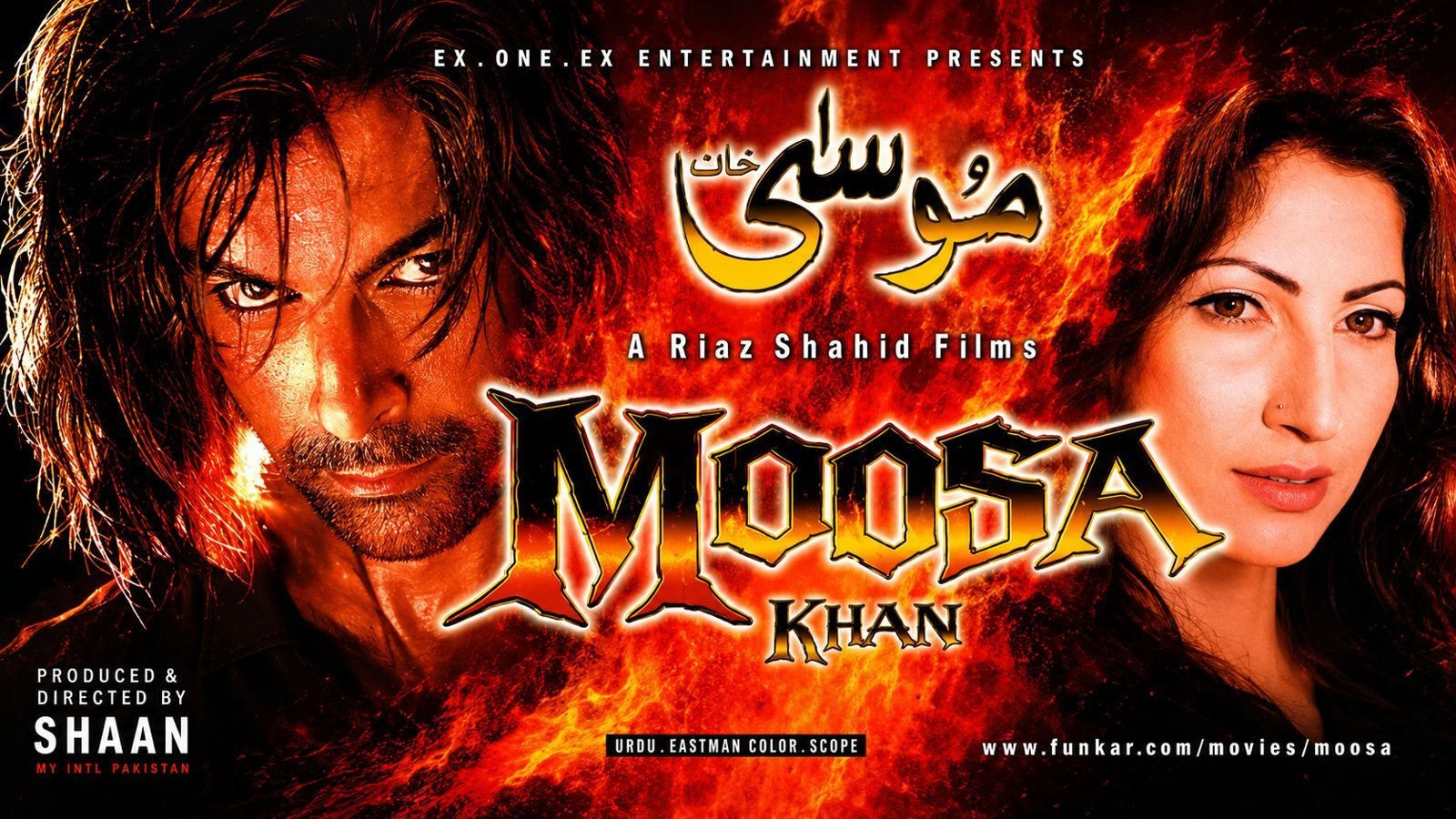
Moosa Aka Moosa Khan (2001)
Cast: Shaan, Saima, Abid Ali, Shafqat Cheema, Rembo, Noor
Director: Shaan
Synopsis: Despicable for its messages of hatred and intolerance and woefully inept.
Reviewed by: Omar Khan
After months of hype, Shaan’s highly awaited labour of love, Moosa Khan, finally arrived as the biggest of the season’s Eid releases. Shaan had reportedly spared no expense in constructing his third effort as director—the quest for excellence being a top priority. Not only was the critical expectation sky high, but so were the hopes of massive financial gains.
From the moment the film opens, one is assaulted by a surge of serene, triumphant music that is instantly identifiable as the theme from Last of the Mohicans (we later get treated to repeated doses of music lifted from Mohicans, Gladiator, as well as snatches of Prodigy!). The first impression is “rip-off,” and alarm bells start ringing as the music strides on shamelessly until the end of the credits, which curiously never seem to list the cast. Maybe it’s just a foregone conclusion that every Lollywood production, Urdu or Punjabi, is bound to star Shaan, Saima, Shafqat Cheema, and Rembo.
As of April 2002, Moosa Khan’s censor certificate has been withdrawn, and the film has been effectively banned from further exhibition. The reason for the ban was the scenes depicting minority religions in poor light—the only question is, what took the censors so long to realise that this film is full of such venom, and why did it take them three months to react? The film has already made a lot of money, and now that it has been banned, it will undoubtedly increase the film’s interest tenfold.
Anyway, back to the film’s plot—the setting is in some time warp, suggesting a pseudo-colonial subcontinent where Muslims, Hindus, and Christians seemingly inhabit the land of Kashmirpur and its environs under the dominance of obese Punjabi men, wearing an assortment of blonde wigs (Colonials). Beautiful white doves of peace flutter in the foreground in idyllic slow motion, while an all-male choir of angels burst into a heavenly tune as the audience is introduced to the local Mosque and its saintly Maulvi, played by Abid Ali.
The Maulvi completes his prayer in a regal slow-mo, and emerges from the distance as pigeons and doves flutter about in a mad frenzy. It’s all rather blissful, and both Leni Riefenstahl and Josef Goebbels would be proud.
After this thundering success, Shaan, who had spent years at college yards from where 9/11 occurred, announced that he would launch” Osama,” the Motion Picture, in honour of his hero. Of course, he isn’t the only one who champions Bin Laden. In a rapturously embraced speech by all, Pakistani leaders have referred to Osama Bin Laden as “Shaheed” while making General Assembly speeches a mile or two from the site of the massacre.
Many applauded, but a few were left reeling in horror. In the same address, there was justifying the morality of Death Wish, while the satirical Monty Python’s Life of Brian was targeted as an example of Islamophobia. Shaan roared his approval on social media, as did most
Moosa Aka Moosa Khan of the nation. Months later, a lavishly produced Turkish Television Soap Opera was added to the scheme of “fixing the nation’s morality” with proper role models.
Shaan’s Osama film never made it to completion. The project may have come undone in an age that saw the emergence of ISIS. The entire region is in flux with support for ISIS and their brand of faith sold to kids in New York, Paris, and Bradford with videos similar to the imagery seen in Moosa Khan. Only far slicker and with a backdrop of lilting religious songs of glory and martyrdom. Maybe there is still hope for the movie, and in current circumstances, a film called Osama could well be a financial blockbuster and multiple-award winner. Who knows? Back to Moosa Khan, though.
After the blissful joyous peace, love, and tranquility with doves flying around in slow motion, our focus turns across the way, where there is a temple, not a mosque.
A temple where instead of doves of peace, there is a menacinglooking python at large, along with a group of snarling, drooling old men draped in orange robes with funky hairstyles cringing at the sound of the Azaan from the nearby Maulvi.
So enraged are they by this sound and the pompous Maulvi responsible for it, that they hatch an evil scheme in collaboration with the local godless firangi gora’s (white men—who worship only money), to bring about the end to the sound once and for all. The director runs all the clichés into the ground with the Maulvi’s long, drawn-out, glorious martyrdom in a scene of unintended hilarity. As the infidels try to gun down the lecturing Maulvi, their guns suddenly malfunction by divine intervention. The same when the evil kafirs prepare to fire heavy artillery at the Mosque. The Maulvi appears magically, leaping in the way of the projectiles and heroically thwarting any attempt at desecrating the Mosque. Moments later, the background choir of angels turns from Peace mode to jihad mode. The Maulvi mumbles a few pious utterances and launches his tasbee (holy beads) into the air to see it transform mid-air into a mighty Sword of Islam. He dramatically catches the falling blade and proceeds to hack to death the entire posse of goons who had dared to try to attack the Mosque. As Maulvi Abid Ali finally caves in his blimpish child Osama, sorry, Moosa waddles slowly to the death scene, his eyes burning with the fire of vengeance.
Moosa grows up in a cave somewhere (Tora Bora?), having turned his back on his religion, owing to his disillusionment when his father was murdered. He has instead taken to living alone in some distant caves with his horse Sheru as a companion, and likes to dress up like one of the members of that laughable ‘70s glam rock band Kiss. Moosa (Shaan) has become a cold-hearted mercenary, but all that will change with Saima’s arrival.
She shows up, dressed to kill with her father, to a place that is a den of vice. He had reasons for bringing his daughter to this place, but when the salivating goons start making moves on her, he turns indignant and starts spouting lectures, for which he is swiftly shot. Shamoon (Cheema), sporting his usual bizarre get-up with a flowing ponytail and reptilian accessories, becomes obsessed with Saima’s voluptuousness, snaring her in his lair. However, in keeping with the film’s utterly warped manner, Saima chooses to stab herself to death rather than compromise her” izzat” (honour) as any ordinary “honourable” woman would (should?) do. Shamoon has her stitched up in the nick of time, yet she remains merely a captive pet for her tormentor, waiting for the first opportunity to flee.
Moosa Aka Moosa Khan
Saima is rescued from Shamoon’s clutches one night and whisked away to freedom, but when she begins to take a fancy to her rescuer, it transpires that all he intends to do is use her as part of a transaction. Saima is dumbfounded when Moosa turns her over to another set of captors and begs him not to, but he continues to walk away, stonefaced, and impassive.
As Moosa is about to mount Sheru and ride off into the distance, Saima comes up with a brainwave; she takes to covering her head (in dramatic slow-motion) and starts reciting the words (with added echo effect) of the Quran in a last-ditch effort to get through to the uncaring Moosa. When Saima reaches a crescendo with the retort of “Kya tum Moosa nahin ho” (Are you not Moosa?), her words finally seem to hit the spot, and suddenly Moosa assumes the role that his father, the saintly Maulvi, had always dreamed of.
Moosa bludgeons his way through the fully armed opposition and makes away with Saima to the forest’s safety, where he is joined by his childhood chum Georgie (Rembo). Love blossoms, and Saima and Moosa marry and build their dream home away from the world’s troubles. Still, Shamoon’s henchmen are constantly searching every inch of the forest to recover Saima and destroy Moosa. It is a matter of time before they discover the mountainside home. Meanwhile, Saima produces a child and forces her husband to bury his weapons and pray for solace. Shamoon’s horrible henchmen show up one fateful day, while the ghastly tot and father are away hunting. There follows the usual bloodbath and mayhem as sprog, and Dad return to begin jihad against those responsible for Saima’s death.
In one of the movie’s many brilliant scenes, Moosa is performing his prayers when a goon with a massive machine gun arrives, firing shot after shot at Moosa. The giant bullets float in a Matrix-like slow motion towards our hero, and each time, by divine intervention, they somehow fail to hit their target. In a moment of sublime ridiculousness, Moosa catches the last bullet in mid-air and tosses it aside disdainfully before striding out (angels in full battle cry by now) to purge the land of all evil.
Moosa is a woeful, pitiful piece of excrement from beginning to end with no saving grace. Poor Riaz Shahid must be turning in his grave with his name now associated with films of this kind. It is a despicable film, and perhaps its worst aspect is that it attempts to dress itself up as a religious sermon, with long passages and quotes from the Quran.
Riaz Shahid, Shaan’s father, directed films that were equally jingoistic with their politics and exploited faith in a similarly rabid manner. However, cinematically if not content wise, Riaz Shahid’s work had resonance. Moosa Khan draws its inspiration from The Matrix!
This film is a sickening new low in exploitation, as it blatantly attempts to use religion to justify its twisted message of hatred and intolerance and its demented call for jihad. Its perverted message aside, the film is also a rollicking disaster on a technical aspect, and it drags badly in the second half. The sequences of Shaan emerging from the caves (in obligatory slow motion) with “Smack My Bitch Up” blaring in the back is ludicrous and suggests a dangerously bloated ego. The slo-mo shots of his riding out on Sheru to Prodigy are reminiscent of Bo Derek’s famous romp from “10”—a total embarrassment.
Acting-wise, Shaan’s incredibly bloated buffoonery contrasts with his ability to be reasonably good at given moments. Saima is adequate, while Cheema, one of the better actors in the industry, is wasted, and
Moosa Aka Moosa Khan Rembo is painfully clichéd. The songs other than the Noor number are instantly forgettable, and the primarily borrowed background score is constantly jarring.
It is largely justified for Muslims to feel indignant about how they are perceived, but using hate to generate profit has to be a questionable way of earning a living. Two wrongs never make a right. These days you hear of the English Cricket Board introducing a prayer area and the Azaan in their cricket grounds to accommodate a multicultural community. Will we also seek a similar response in recognising minorities and their rights in India and Pakistan? Tolerance is a twoway street.
All hate does is what most Religious Leaders thrive on; dividing humanity. This lot will go to the ends of the world to prove that it’s a battle of us vs them when it’s us vs us. It always has been.
Moosa is an awful slice of hatemongering garbage but of interest to those who study how religion is politicised and exploited. Always has been.
0 Comments
Leave a Comment