
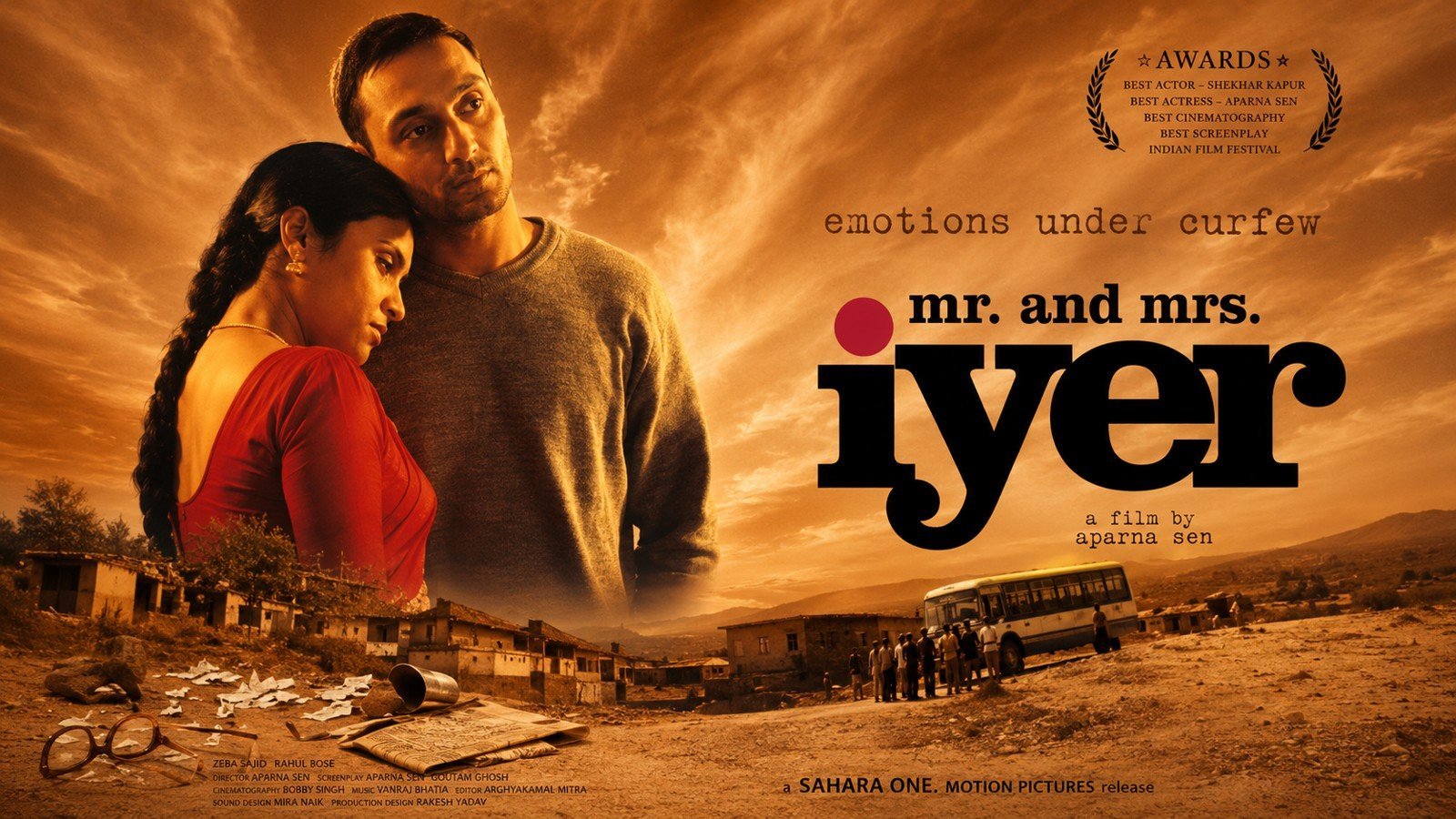
Mr and Mrs Iyer (2002)
Cast: Rahul Bose, Konkani Sen Sharma
Director: Aparna Sen
Music Director: Zakir Hussain
Synopsis: A bus ride to Calcutta turns into a harrowing ordeal when fanatics strike
Reviewed by: Omar Khan
Mr and Mrs Iyer is a deceptively simple road movie that touches upon several profound issues. Beautifully acted and directed with rare skill and sensitivity, it rarely falls into the trap of becoming overly sentimental. Aparna Sen's film follows a long bus journey across India towards Calcutta, one that would ordinarily be little more than an uncomfortable and laborious trip. Against the backdrop of the horrific communal riots, however, it becomes a journey overshadowed by the constant menace of death.
In the opening scenes, the viewer is gradually introduced to the occupants of the bus. The focus soon settles upon Meenakshi Iyer (Konkona Sen Sharma), a proud Tamil Brahmin travelling alone with her infant son to reunite with her husband in Calcutta. Barely out of school herself, shy yet quietly spirited, she struggles to soothe her restless baby while Aparna Sen subtly introduces the remaining passengers one by one, allowing us to understand exactly "where they are coming from." It is no accident that almost every cross-section of Indian society appears to be represented on this bus.
Most are middle-class Hindus travelling on business, holiday or to visit relatives. There is an elderly Muslim couple, gentle and unassuming; a group of noisy youngsters conducting an enthusiastically tuneless singalong; a handicapped child accompanied by his weary mother; a pair of Sikhs discussing an impending family wedding—what else?—and a young wildlife photographer of Bengali origin who has recently returned from Britain and who also happens to be a Muslim. Somewhere along the way we also discover there is a Jewish passenger aboard.
The journey unfolds much as any long bus ride does. Babies cry, conversations begin and fade, the rowdy teenagers eventually fall asleep, and life settles into its monotonous rhythm. Mrs Iyer, struggling to feed her child, asks the photographer for assistance, and the two share a quiet conversation that begins to chip away at her reserve.
Then terror strikes.
The bus is halted because communal riots have broken out in a nearby town, and the flames of hatred begin drawing ever closer. At first the passengers fail to grasp the seriousness of the situation until horror literally climbs aboard.
A pack of wild-eyed fanatics storms onto the bus baying for Muslim blood in revenge for the violence elsewhere. In one of the film's most unbearably tense sequences, each passenger is ordered to identify themselves by name, effectively proving that they are Hindu—or suffering the consequences.
The gentle elderly Muslim couple are betrayed by another passenger. Instantly, the mob descends upon them. The old man quietly gives his name, and that alone is enough to condemn both husband and wife. They are dragged from the bus towards certain execution.
Only then does the full horror of the situation register with the remaining passengers. Yet self-preservation takes precedence. Terror reduces everyone to silent spectators.
The mob continues its search, forcing men to prove in the crudest and most barbaric fashion that they are not Muslims.
Mrs Iyer, a woman brought up to avoid close contact with Muslims, watches the elderly couple disappear and something inside her changes. Deeply shaken, she makes the split-second decision that defines the entire film. She calmly tells the killers that the man seated beside her is none other than Mr Iyer—her husband and a respectable Brahmin like herself.
It is a scene as revolting as it is heartbreaking, and utterly convincing in its depiction of communal hatred. To witness human beings turning upon one another with such savagery, consumed entirely by prejudice, is profoundly disturbing. More disturbing still is the knowledge that such brutality can flourish in supposedly enlightened and educated societies.
From this point onwards, the film gradually shifts towards the strange relationship that develops between Mrs Iyer and the man whose life she has saved. In return, she slowly finds herself depending upon him, fascinated by him and, perhaps for the first time, questioning the prejudices that have shaped her entire upbringing.
Every bend in the road now carries danger. Every encounter threatens exposure. At any moment someone may realise that Raja is not, in fact, Mr Iyer at all. His accent, a careless word, his mannerisms, his eating habits—any tiny slip could expose him and condemn him to instant death.
Aparna Sen sustains the tension almost until the closing moments while simultaneously charting the subtle emotional awakening taking place within Mrs Iyer. Whether Raja survives or dies ultimately becomes almost secondary. Even if she never sees him again after the journey ends, his influence upon her life will remain permanent. One senses that whatever else happens, she will never allow her own child to inherit the prejudices that have poisoned so many around her.
Aparna Sen has produced a remarkable film—simple on the surface, yet extraordinarily rich beneath it. It is essentially a relationship-driven road movie, but one that explores prejudice, communal hatred, social conditioning and the dangers of unquestioned tradition. It is both relevant and important, managing to entertain while quietly educating its audience.
Aparna Sen was one of India's finest actresses, and here she proves herself every bit as accomplished behind the camera. Her direction is assured, intelligent and deeply humane.
The performances are uniformly excellent. The elderly Muslim couple are beautifully portrayed with extraordinary dignity. Rahul Bose delivers a thoughtful, understated performance as Raja, but it is Konkona Sen Sharma who completely owns the film. Her portrayal of Mrs Iyer is utterly captivating, charting the character's gradual transformation with remarkable subtlety and emotional honesty.
If one were searching for faults, it could perhaps be argued that the second half never quite matches the extraordinary power of the first. As the focus shifts increasingly towards the relationship rather than the political situation, the narrative occasionally drifts towards sentimentality and momentarily loses some of its earlier intensity.
That, however, is little more than minor criticism. Ustad Zakir Hussain's magnificent score more than compensates for any occasional lull in proceedings, although the English-Hindi fusion number is decidedly dreadful. Likewise, the opening montage of newspaper clippings feels awkwardly pasted on for dramatic effect and never quite works.
Some Western critics found the film lacking in subtlety, and one cannot entirely dismiss that criticism. Yet it is equally true that many Western commentators may not fully appreciate either the emotional vocabulary of South Asian culture or the political and communal realities that continue to shape everyday life on the subcontinent. The grief of a South Asian woman mourning her dead may appear exaggerated to outsiders, but cultural expression is not measured by universal standards. Simply because one culture appears more restrained does not make another any less authentic.
Mr and Mrs Iyer is a moving, intelligent and deeply compassionate film that deserves to be seen by the widest possible audience. It reminds us that humanity ultimately matters more than identity, and that sometimes the bravest act imaginable is simply refusing to hate.

0 Comments
Leave a Comment